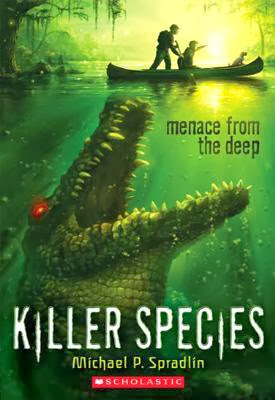
Showing posts with label KILLER SPECIES #1: MENACE FROM THE DEEP. Show all posts

Thursday, November 14, 2013

7 Questions For: Author Michael P. Spradlin


Michael P. Spradlin is the author of more than a dozen books for children, some of which have actually been published. He grew up in a small town in Michigan not far from the Indiana border, which may explain his irrational fear of Hoosiers (Both the inhabitants of the state of Indiana and the movie starring Gene Hackman, but not the Ninja).

Surrounded by books in his formative years, he grew up loving to read, imagining himself the hero of numerous epic battles and indulging in his favorite pastime, which was smuggling fireworks across the Ohio border so that he could blow up his collection of Plastic Green Army Men and Matchbox Cars.

Michael is the author The Youngest Templar trilogy, The Spy Goddess series, and several picture books including the award winning Daniel Boone's Great Escape. He's also the author of such Ninja favorites as Every Zombie Eats Somebody Sometime and It's Beginning to Look a Lot Like Zombies!

When not writing, he enjoys reading, traveling, spending time with his family and worrying over the fact that he really should be writing instead of doing other stuff. He lives in Michigan with his wife Kelly, son Michael, daughter Rachel and two dogs Willow and Apollo.

Click here to read my review of Killer Species #1: Menace From the Deep.

And now Michael Spradlin faces the 7 Questions: 

Question Seven: What are your top three favorite books?

My very favorite book is Cannery Row by John Steinbeck. It surprises people when I say that because most consider his best work to have been done in the thirties. Or as my friend Christopher Moore says “In school they make you read all his books where everyone dies” like The Red Pony, Of Mice and Men and The Grapes of Wrath. Then, when you read Cannery Row, and you’re completely surprised by how funny and delightful it is. I like writers who love humanity, despite all of its flaws, and that to me is Steinbeck in a nutshell. He had a genuinely optimistic view of people that I find many of his peers at the time did not share.

Lonesome Dove by Larry McMurtry is my ‘book I would take to a deserted island.’ It’s such an epic story and it contains some of the best dialogue ever written.

And I also love The Great Gatsby by F. Scott Fitzgerald. Mainly because I wish I could write a novel with an ending as perfect as he does it in that book. 

Question Six: How much time do you spend each week writing? Reading?

Writing happens all the time. I don’t know if I could put an hour figure on it, but it’s a lot. My computer is always on except when I’m sleeping and sometimes I sit down in the middle of a chore or something and write a just a couple of sentences. Or a line of dialogue that pops into my head. But the answer is mostly a lot.

Reading time varies and is really driven by my writing schedule. When I don’t have a deadline, I get to do more pleasure reading. When I’m writing or getting ready to work on a book, my reading is usually limited to something for research. But I still try to read for pleasure as much as I can. It’s a great stress reducer.


Question Five: What was the path that led you to publication?

It was a circuitous one. Growing up, I was surrounded by books. My mother was a voracious reader and, luckily for me, understood and appreciated the value of reading just for the sheer joy of it. I grew up in a small town so there wasn’t a lot to do, but luckily we had a great little library. After college, I worked as a bookseller and sales rep for a publishing company for a while and got a sense of what the marketplace was like. But I always wanted to write. One day I just said ‘It’s time.’ Started writing and submitting and got published. 


Question Four: Do you believe writers are born, taught or both? Which was true for you?

Both. I think some writers just have a gift. No matter how hard I try, I’ll never be able to craft a sentence a well as Fitzgerald or McMurtry or Steinbeck or write dialogue that crackles the way Elmore Leonard did. But I also believe (and tell students during school visits) that writing is a craft like any other and you get better at it by practice. I try to make sure my writing improves with each book. Like anything, the more effort you put into it, the more you will get out of it.


Question Three: What is your favorite thing about writing? What is your least favorite thing?

I love being ‘in the zone’ when you have the characters voices nailed down and the plot is spinning. The words are coming so fast and furious you can barely type fast enough. It’s an adrenaline rush almost. That’s my favorite part.

My least favorite part is turning the book in. I’m always rereading my books after they’re published and nit-picking myself. “I wish I had written this instead of that.” Or “I wish the character had done this, instead of that.” There is that old quote that ‘no book is ever finished it is only abandoned.’ Finally giving it up to your editor is hard. 


Question Two: What one bit of wisdom would you impart to an aspiring writer? (feel free to include as many other bits of wisdom as you like)

1. Read. A lot. It helps you develop your voice.

2. Read outside your comfort zone. Try new authors and different styles and genres.

3. Write. I’m not a ‘you must write every day’ guy. No one has any kind of job that they never take a break from. When it gets hard and frustrating step away. Take a breather. But the important thing is to go back. Keep at it. Keep trying to improve.

4. When you think you’ve finished, go through what you’ve written and revise it. You’ll always find things you can make better. Eliminate excess adverbs and pronouns. Never use three words when one will do. Make your readers feel what your characters are feeling. Do the raindrops feel like pebbles or sand on their skin? Don’t tell them. Avoid lazy words. Like Robin Williams’ character in the movie The Dead Poet’s Society says, “a man is not very tired. He is exhausted.” One of the great things about the English language is the multitude of words we have to express feelings and describe things. Use them. 


Question One: If you could have lunch with any writer, living or dead, who would it be? Why?

Definitely Steinbeck. He lived during and chronicled such an extraordinary period in our country’s history. And I would love to ask him how his experiences and the way he lived and the things he saw influenced his work. Plus I read in his biography that in his last years he used to turn down the volume on the TV show The Wild, Wild West and make up the dialogue. It would have been the perfect after dinner activity.

Wednesday, November 13, 2013

Book Review: KILLER SPECIES #1: MENACE FROM THE DEEP by Michael P. Spradlin

http://www.amazon.com/gp/product/0545506719/ref=as_li_tf_tl?ie=UTF8&camp=211189&creative=373489&creativeASIN=0545506719&link_code=as3&tag=midgranin-20
Quick Plug: I've written a guest post over at Pearls Cast Before a McPig. Comment to win a copy of my book:) 

First Paragraph: The boat slid silently across the surface of the water. At the stern the man turned the tiller to the left on the nearly silent electric motor. The craft responded instantly and he pointed the bow toward a bank of mangrove trees rising up out of the swamp. After thirty yards, he switched the motor off and the boat floated to a stop, the trees another twenty yards away. He flipped on his infrared night-vision goggles and studied the trees for heat signatures. Scanning from the far left of the tree line, he saw nothing. Then, there it was, a slight movement in the branches of a tree to his right.

Oh, Esteemed Reader, I've got a proper treat for you today. Killer Species is exactly the sort of series I would've wanted to read as a boy and adult me has had my eye on it for a while. If a cover wants to grab my attention, it needs to have a monster on it (or a zombie or a superhero). Menace from the Deep has a giant alligator on its front. It had me at "hello."

Still, young me would've been skeptical. Is this book really populated by giant alligators, or is the cover a teaser image? If Spradlin had opened with 50 pages of exposition establishing his protagonist and all that good stuff, then introduced the monster, I wouldn't know about it because I would've already put the book down in favor of Super Mario. Fortunately, he opens his monster book in the finest way a monster book can open; with violence (naturally):

The python moved its head back and forth, slithering down the tree trunk. But it was too late. The Pterogators leapt from their perches in the nearby trees. As they jumped they spread all four legs and a flap of skin opened, connected to their bodies, just above their knee joints. It allowed them to glide from branch to branch, much like their reptilian ancestors, the archosaurs, navigated the canopy of the Cretaceous forest millions of years ago. 

They fell upon the snake, their rakish claws carving into the python. The snake turned and struck the closest beast, trying desperately to sink its fangs into the hard, scaly skin. It had no effect. The python struck again and again but could not find purchase on the creatures about to destroy it. 
The first bites from the genetically superior creatures were devastating. They bit down with a force equivalent to a one-thousand-pound sledgehammer crushing a watermelon, killing the snake instantly. Though it was already dead, the nerves and muscles throughout its body continued to twitch. The gators continued their work, and in less than two minutes the snake was a mass of twisted scales and flesh.

No people are harmed, of course, as this is a book targeted at children. But I can't promise no one gets hurt later as that would be a spoiler. And besides, alligator monsters so giant and so awesome don't need to hurt people right off to be interesting. Watching them tear apart a python will sate young boy's appetite for blood for a time--though eventually the pterogators will have to attack some people--and they do, they do:)

And if we're going to be worried about these pterogators attacking people, we're going to need to care about those people. Once Spradlin introduces the stars of the book, he introduces our protagonist in as succinct a fashion as I've ever seen:

“Sorry,” Emmet’s dad said. “Probably should have gotten the shocks replaced before we left Montana.”
“Probably,” Emmet muttered, looking out the window. He was twelve and moving for the fourth time in six years. His dad was most recently posted to Montana for just over a year, not long after Emmet’s mom died. Emmet liked Montana.

What I like about this paragraph is the way it downplays the most important piece of information. Emmet moving around a lot is important and I'm sure it will play a factor as the series goes on. His age is good to know. But by casually tossing the death of Emmet's mother amongst a discussion of Emmet's love of Montana, Spradlin is mirroring Emmet's desire to push that event to the side of his mind. Emmet doesn't want to deal with her death. Nor does the story. It wants to be a tale of monsters, and it is, but you can bet Mom's death will come up again before the book is done.

This is a master stroke. Of course the reader empathizes with a boy who's lost his mother. More, Emmet and his father have their own issues before the monster shows up. They're not monster bait waiting for the terrible thing to come knocking on their door. They're fully formed characters with their own concerns. Two men dealing with the passing of Emmet's mom and rebuilding their family would be an interesting book all on it's own. That way when the monsters do come, bashing down doors with their great tails, we care that they're not chasing monster bait, they're chasing Emmet! 

But these aren't just alligators. Oh no, my friend. These are genetically altered monsters:
 
It’s fascinating, really. Someone with a tremendous knowledge of molecular and cellular biology has created a hybrid species. In this case, they’ve recombined the DNA of an alligator and a bird of prey. The result is a creature similar to some types of archosaurs that existed millions of years ago,” Dr. Doyle said.

Emmet hooks up with Calvin, a Florida native who's not the least bit concerned with alligators, or even pterogators, and Calvin's mom (her husband is also conveniently dead) makes eyes at Emmet's Dad. There's a mad scientist (naturally), and the book is soon overrun with monster attacks. I loved it. I had a great time, I feel like I got my money's worth, and I'll be reading Killer Species #2.

No review would be complete without mentioning Emmet's dog, Apollo. I was worried he might get chomped from his introduction (and he might--I'm not saying either way). Authors who include cute dogs in their stories are absolutely pandering to readers, and it totally works:) I've viewed Air Bud and looking forward to Super Buds. I know I'm silly, but I'm reading Killer Species to be entertained. There's no monster story a cute doggie can't make better:

When he opened the door, Apollo catapulted out of the truck. He climbed out slowly, his muscles stiff and achy. The little mutt went right to a bush by the front door, sniffed at it, declared it suitable, and then did what dogs do. The two of them stretched and tried to stifle yawns.

There's plenty of science in Menace From the Deep, but it's mostly outlandish. To compensate, Spradlin pays extra attention to the details of real science--which is very Michael Crichton of him. In alternating chapters, we're treated to the villain's perspective, though he remains anonymous for a time. These chapters reminded me a bit of the Voldemort chapters in Harry Potter and they build suspense nicely because we know how formidable Emmet's enemy is before he does. Also, we get to learn just how much work goes into being a super villain:

FROM A COMPOUND HIDDEN NEAR THE NORTHERN EDGE of the Everglades, a man sat at a bank of computer screens and monitors. The building was prefabricated and set deep into the swampy soil. Construction crews he flew in illegally from South America brought the structure here in pieces. Once it was assembled he sent them back home. And from his secret hideaway, his work began in earnest. It was from here he set out to stop the destruction of the Everglades. 
No one would ever find this place. The building was dark concrete and the outside walls and roof were covered with native vegetation. The roof was too thick for heat to escape, and the power came from a place no one would ever suspect, more than a mile away. He used specially designed waterproof cables to carry the electricity beneath the swamp to his compound. Even if someone were to uncover the deeply buried cables, it would still be a Herculean task to trace them this far. At night, two wind turbines emerged from specially built shafts at the rear of the building and wind energy generated power to backup batteries that could keep the compound running for nearly three days, should the generators go down. Long enough for him to fix the problem or evacuate to a backup location much like this one but in a place just as hard to find.

And that's going to do it. Buy yourself a copy of Menace From the Deep and be prepared to buy the entire Killer Species series. They're good time books of the sort I wish we had more. I hope Spradlin keeps his monsters coming.

As always, I'll leave you with some of my favorite passages from Killer Species #1: Menace From the Deep: 

Calvin just shrugged again, and Emmet thought he was pretty low-key for someone who spent his whole life surrounded by alligators.


He thought maybe Dr. Geaux was crushing on his dad a little bit. The thought made him queasy, so he tried hard to think of something else. Alligators! Alligators chasing me! It only worked a little bit.


Emmet sat in the boat. Apollo was poised, trembling, on the edge of his seat, his nose working the air. He was desperate to jump out and follow Calvin, and give the island a good smelling-over.

“And you’re sure it was taken? It didn’t just come loose?” Dr. Geaux asked. 
Calvin looked at his mother and blinked a few times before answering. Emmet wondered if this was the Calvin equivalent of a tantrum. 
“Yes, Mom. Somebody took it. It would need to ‘come loose’ on both ends. And besides, whoever did it also took the radio mic to make sure we couldn’t call for help.” Calvin looked down at the floor then, as if to say that this part of the conversation was over. 


STANDARD DISCLAIMER: All reviews here will be written to highlight a book’s positive qualities. It is my policy that if I don’t have something nice to say online, I won’t say anything at all (usually). I’ll leave you to discover the negative qualities of each week’s book on your own.