Showing posts with label Alison Hart. Show all posts

Thursday, May 27, 2010

7 Questions For: Author Alison Hart

Alison Hart is an adjunct college instructor teaching reading and writing as well as the author of over sixty mysteries and historical suspense novels for young readers. In her own words, "I honed my craft writing Nancy Drew mysteries and quickly developed a love of strong characters who are thrown into suspenseful situations; in other words, I love writing books that keep young readers glued to the pages." Her current works available include Emma’s River, Horse Diaries: Bell’s Star, The Racing to Freedom Trilogy: Gabriel’s Journey, Gabriel’s Horses, Gabriel’s Triumph, Anna’s Blizzard, A Spy on the Home Front, Fires of Jubilee, Return of the Gypsy Witch, Shadow Horse, and her newest, Whirlwind. 

And now Alison Hart faces the 7 Questions:


Question Seven: What are your top three favorite books?

There are too many to mention. Unfortunately, it's the badly written books that go on to huge commercial success that stick in my mind. (I won't mention any titles.)


Question Six: How much time do you spend each week writing? Reading?

Because I also teach at a community college, I spend a lot of time reading and writing to prep for classes. My time writing as an author varies on whether or not I have a deadline. When a deadline is looming, I write five to six hours a day including weekends. But now, for example, I am working on an outline about competitive diving for a series. Because I know nothing about the subject, my time is spent researching and taking notes.


Question Five: What was the path that led you to publication?

I sold my first short story to Highlights magazine in 1984. After that, I had no success selling anything. About four years later, I started writing for the Linda Craig series, a remake of a 1960's series about horses. I had to 'audition' for the job, writing a proposal and first chapters. I wrote several in the series, and then went on to write Nancy Drew mysteries. So my career start was somewhat unusual.


Question Four: Do you believe writers are born, taught or both? Which was true for you?

I was born reading and writing; however, I continue to learn the craft and hone my skills every day. Writers also need to have a determined/stubborn personality to handle the revising, rejections, bad reviews and setbacks and still continue to write and submit.


Question Three: What is your favorite thing about writing? What is your least favorite thing?

I am an idea person who loves a great story. Every book I write teaches me something new. For example, for my diving book, I read Greg Louganis' biography, Breaking the Surface. It was fascinating, yet I never would have read it if I hadn't needed to research the sport.

My least favorite thing is when I write a great book that I love but sales are zilch.


Question Two: What one bit of wisdom would you impart to an aspiring writer? (feel free to include as many other bits of wisdom as you like)

Writers must find interesting ideas, research to find a new slant on the idea, hone their craft, polish their work and market their works professionally. Writing is a creative art as well as a competitive business. You have to be able to handle both sides. After that, determination and perserverance are key to publishing today because of the tough economy.


Question One: If you could have lunch with any writer, living or dead, who would it be? Why?

I would rather have lunch with kids who love my books!


Monday, May 24, 2010

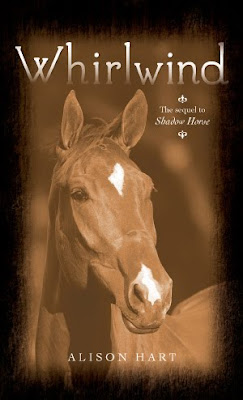
Book of the Week: WHIRLWIND by Alison Hart

http://www.amazon.com/gp/product/0375860053/ref=as_li_tf_tl?ie=UTF8&camp=211189&creative=373489&creativeASIN=0375860053&link_code=as3&tag=midgranin-20
 To be fair, Whirlwind is actually a book for teens, or a young adult novel, or possibly even a tween novel. Some of you may remember that a few weeks ago we discussed Emma’s River, a middle grade novel by Alison Hart. If you don’t remember that, here’s the link.I’m trying to leave YA books to the Young Adult Ninjas out there, but I thought reading both types of books by the same author might provide a nice discussion for the differences between the two genres (as though I needed an excuse to read a new Alison Hart book).
Unfortunately, trying to pin down exact definitions of middle grade or young adult books is like trying to pin down the exact definition of a literary novel. Everybody knows what you mean, but no one has a definition that is exactly like anyone else’s. I’ve read varying estimates, but generally a MG novel is 25-60,000 words and a YA novel is 50-90,000 words, and a J.K. Rowling novel is as long as she says it is. MG novels star characters that are 10-14 years old and YA novels star characters that are 13 to 19 years old. MG novels typically watch their language, have no sexual content, and usually steer clear of drugs and alcohol. YA novels can follow similar guidelines, or they can throw them out and write as filthy a book as they like (lucky!). For such a book, check out Courtney Summer’s brilliant Cracked Up To Be.

Now then, even as I write these very loose definitions, I am sure someone will be planning to correct me in the comments section (please do). Better book fans than I have tried to set definitions and failed, so let’s just talk about the books at hand.

The protagonist of the 263 page Whirlwind is thirteen year-old Jas Shuler (which makes this an early YA, perhaps even tween). The protagonist of the 142 page Emma’s River was ten year-old Emma Wright. Both girls love animals, horses in particular. Emma was outraged that her horse, Twist, was being mistreated by deck hands on the steam boat. Cruel social circumstance separated Emma from Twist and she spent the novel fighting to reunite with her horse. Jas is outraged that her horse, Whirlwind, is being mistreated by cruel race horse insurance scammers. Jas spends the novel fighting to reunite with her horse. I don’t mean to suggest that the books are the same, only that there are clear similarities.

And why wouldn’t there be? The same fantastic writer is responsible for both.

The thing to notice is the difference in details. For example, both books feature romantic subplots, but Emma and the handsome boy who challenges her as he helps her with her horse are really nothing more than friends. Jas and the handsome boy who challenges her as he helps her with her horse is always looking deep into her eyes and puckering up his lips. Do they kiss? I would never spoil that for you, Esteemed Reader. You’ll have to read the book to find out.

But still, it’s worth noting that ten is too young for snogging in books and thirteen is perhaps acceptable for snogging. Not that Alison Hart has much interest in devoting much of the book to romance, as evident in this editorial aside from Whirlwind: “Jas flipped the page in her novel. It was about a girl’s infatuation with a vampire, only the girl acted so stupid and in luv, Jas couldn’t concentrate on the story.” Hmmm, I wonder what book Jas was reading.

A more subtle difference between the books is in the type and severity of danger the two protagonists get in while on a mission to save their horses. Emma is chased around by deck hands and rude adults who do not understand how important her horse is. Cruel adults threaten to murder Jas’s horse. Emma has to contend with a steam boat disaster and is nearly run through by a railroad spike. Jas is stalked and threatened by an adult male who might just murder her. Middle Grade readers would not tolerate this beast terrorizing a ten year old. They would turn on the writer. However, make that girl thirteen or older, and it’s perhaps a fairer fight that will excite readers and keep them turning pages.

Another thing to notice is that the greater length of Whirlwind allows for expanded secondary characters. There are plenty of secondary characters in Emma’s River, but they are kept brief and the main focus is their interactions with Emma. In Whirlwind, there are more secondary characters and they are able to have their own more developed subplots that are related to Jas’s situation, but are not strictly about Jas. They have romances and work problems and things they’re working through. They don’t get their own separate chapters, but they are allowed to take some of the spotlight from Jas.

There are other differences, but I don’t want to finish this review without saying that Whirlwind is a great book and worth your $7.99. Alison Hart wrote a few Nancy Drew novels and it shows. The mystery at the center of Whirlwind is a corker and it will keep you guessing until the very end. More, you’ll care about Jas and Whirlwind and before you notice it, you’ll have read the last page. You’ll be sorry it’s over, but relieved that Hart has left things open enough for a third go-round.

The last thing I want to say is to again express my admiration for Hart’s keen ability to weave factual information into her fictional narrative, thereby establishing authorial authority. The worlds Hart creates are authentic and suspension of disbelief is made possible by her complete knowledge of those worlds. Here are two perfectly written details slipped seamlessly in the text to achieve that effect:

“The hay supplier just called. He’s out of Hay. I’ve been calling around, but because of the drought, hay’s in demand. Everyone wants too much money. And folks keep calling about horses they want us to take, because they have no grass and can’t afford to feed them.”


“Scam artists like Hugh Robicheaux are careful and clever. We just recently shut down a scheme where racehorses were being sold for inflated prices. An agent and appraiser would place a high value on a horse, even though the actual money changing hands between the previous owner and the new owner was way lower. Based on the appraiser’s value, the new owner could insure the horse for the inflated price. If the horse injured itself on the track or proved not to be a winner, it was killed.”


STANDARD DISCLAIMER: Book of the Week is simply the best book I happened to read in a given week. There are likely other books as good or better that I just didn’t happen to read that week. Also, all reviews here will be written to highlight a book’s positive qualities. It is my policy that if I don’t have something nice to say online, I won’t say anything at all (usually). I’ll leave you to discover the negative qualities of each week’s book on your own. 

Sunday, April 25, 2010

Book of the Week: EMMA’S RIVER by Alison Hart

http://www.amazon.com/gp/product/1561455245?ie=UTF8&camp=1789&creativeASIN=1561455245&linkCode=xm2&tag=midgranin-20
Do you like horses, Esteemed Reader? How about steamboats? Well, if you’re like me, you like horses, steamboats, well-written middle grade historical fiction, and you’re going to love Emma’s River. I certainly did.
I’ve never written any historical fiction. Probably because I have enough trouble doing the research to figure out how characters might react to the current age. I would have a heck of a time adding even another layer of research to my writing. But Alison Hart is more gifted than I and her ability to weave historical facts into her narrative and create for the reader the world of the past is worth studying. More on that in a moment.

Before I get to the book, let me just start by praising what a superior product Peachtree Publishers has put together. I know it’s a little unusual to praise a book’s binding in a review, but seriously this book is so nice it’s a pleasure to hold it in your hand and I like the look of it on my shelf. Everything from the artwork to the layout of the pages to the spacing of the words to yes, the binding, are all top notch. We’re told as children not to judge a book by its cover, but most kids do anyway, and this is a book that was built to attract young readers and sustain any amount of rough treatment (it’s got a thick hardcover).

Okay, enough with that stuff. Let’s talk story. The year is 1852 and ten-year-old Emma Wright is traveling up the Mississippi with her pregnant mother on the steamboat Sally May. Also traveling with Emma is Twist, her horse, and it is Emma’s love of Twist that drives the story. Twist is mistreated by deck hands and stored below the main ship where Emma will not be able to see him for the full four days of their journey. Well, plucky girl that she is, Emma finds ways to sneak down to see Twist and make sure he’s well taken care of, despite the various adults who conspire against her. She makes friends, she learns about the world around her, and the nature of true social justice. Better yet, the book culminates in an action blow out that I won’t spoil here, except to say that I was moved by the sad parts of the story and I truly enjoyed the finale.

So there you have it, Emma’s River is a fine book, well put together, well written, and worth parting with your money for. Everything else I have to say will be directed toward fellow writers, because Alison Hart has got mad skillz and her work is worthy of a little more analysis. The first thing to notice is that Hart doesn’t dumb down history for kids, which I respect. She doesn’t dwell on the unpleasant aspects, but she doesn’t omit them either. Emma and her mother are white and privileged, but there are plenty of Negroes (the right word for 1852), Indians, and Irish people in the story, and Hart doesn’t pretend they were treated any better than the facts suggest. Here is how she handles the plight of a native American man:

“Mist LaBarge, did you see the Indian on the hill?” Emma asked.
“Aye.
“Was he not preparing to attack us?”
He shook his head. “The Indians in this area won’t attack. Too many of them have been wiped out by cholera and smallpox. Others starve on reservations because settlers have taken their land. The rest trade trinkets or beg food to survive.”

Hart’s rendering of history with an eye toward the mistreated underclass reminds me of my favorite historian, Howard Zinn, who’s A People's History of the United States should be taught in classes everywhere rather than the doublespeak dreamed up by Texas text book publishers (that’s a rant for another post). But there are a number of historical books for kids and otherwise filled with a fantasy version of the United States that never existed and that I would not allow my kids (when I have some) to read. I would let my kids read Emma’s River because Hart tells the truth about the bad stuff and in so doing gains my trust regarding her reliability for the rest of it.

Emma’s River is clearly written and published with an eye for school libraries and the classroom. There’s a seven page section at the back of the book filled with factual information about life in 1852 and steamboats as well as a list of material references and a webpage. So if teachers wanted to incorporate Emma’s River into their history lessons, Hart and Peachtree Publishers have made it easy for them.

But for all of that, Emma’s River doesn’t read like a boring history lesson at all! Hart’s most amazing accomplishment as far as I’m concerned is that she has found a story vehicle that delivers historical information as it entertains. Her facts, which in the hands of a lesser writer would have slowed the story faster than exposition, are used to propel the story forward and are presented in the most exciting possible manner. I want to leave you with one last excerpt from early in the book and the thing to notice is that every detail Hart presents is made relevant to the story by its relationship or potential relationship to Emma. Great stuff:

“Aye, I can read these rivers like a schoolgirl reads a primer.”
“Read a river?” Emma repeated.
“Look here. I’ll show you.” The pilot waved her closer. Emma stepped next to him. If she stood on tiptoe, she could see out the open front of the pilothouse. The sun was slowly setting, turning the river into a golden-red ribbon.
Mister LaBarge pointed ahead. “See those ripples in the water to yer left?” She nodded. “See how they slant? That tells me ‘gravel reef ahead.’ If we hit that reef, Sally May could stop dead in the river. “
“We don’t want that.”
“Nay, we do not. Traveling upstream, the Sally May’s slow enough.” He pointed to the right. “See that circular whirl? That signals a snag.”
“A snag is a tree that’s fallen into the river,” Captain Digby explained. If the Sally May is unlucky enough to ram a big one, it could split her hull and we’d sink.”
Emma gasped. “Sink? Just like that?”

And there you have it. Hart just taught us something important about life on a steamboat in 1852, but it didn’t feel like learning. Partly because I’m sure she cherry picked the most interesting details (nothing wrong with that), but also because what we learned about felt relevant. To paraphrase one of my favorite lines from Jaws: “Boat goes in the water. Emma goes in the boat. Deadly Snag is in the water. Emma sinks in the water. Our Emma. Farewell and adieu to you fair Spanish ladies…”


STANDARD DISCLAIMER: Book of the Week is simply the best book I happened to read in a given week. There are likely other books as good or better that I just didn’t happen to read that week. Also, all reviews here will be written to highlight a book’s positive qualities. It is my policy that if I don’t have something nice to say online, I won’t say anything at all (usually). I’ll leave you to discover the negative qualities of each week’s book on your own.