R. U. Ginns and I discuss his career in publishing writing for Sesame Street Magazine, 3-2-1 Contact, and The Electric Company, and his many pennames as well as his newest book, 1-2-3 SCREAM. We talk about why a giant eyeball is his preferred marketing prop, advice for a successful school visit, how, the hardest part of being a writer is staying in the chair, how Stephen King’s FIRESTARTER saved his life, the importance of interacting with readers and other authors, and so much more.
Russell Ginns is a game designer, writer, and composer, primarily known for children's fiction, puzzles, and educational games. He is the author of more than 100 books, including Super Atomic Wombat Girl, Puzzlooies, 1-2-3 Scream! and the Samantha Spinner series. He has created or contributed to several notable software titles, including Castle Infinity, Hooked on Phonics, Reader Rabbit and Half-Life.
Get ready to scream with this collection of hillarifying—hilariously terrifying—tales, fully-illustrated and perfect for scary story lovers who are looking for a side of humor to go with their helpings of horror.
Stop!
Unless you want to be scared, do NOT read this book.
These tales of terror are so horrible, so alarming, they had to be bound up between these pages forever!
You’ll discover The Boogerman, an oozing horror that lurks in mirrors. You’ll read about Instagrave, a popular new app that tells kids how they are going to die. In Epizeuxis, you’ll learn what happens if you speak the name of a—wait. We’ve said too much already. The things between these covers are too dangerous to ever be let out. That's why we're warning you: stay away from this book, or else!
Of course, if you are reckless enough to open this book, then be sure to read these stories in a safe, indoor space, far from the beady, prying eyes of any birds*.
Now, on the count of three: 1…2…3…SCREAM!
*Is that a crow, a magpie, or an indigo bunting behind you? Be careful. Birds will do anything to keep people from discovering the secrets of this book!
Lindsay Currie and I discuss all sorts of creepy, spooky,
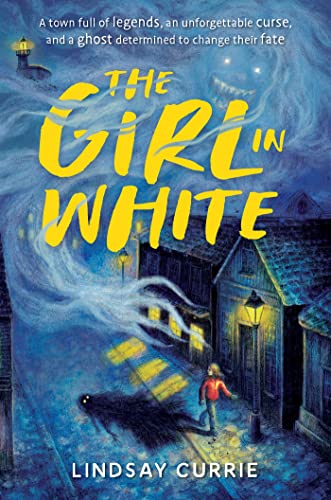
but middle-grade friendly things, such as her novels THE GIRL IN WHITE, SCRITCH
SCRATCH, and IT FOUND US. We chat about her travels through various graveyards,
the Alley of Death, and other horrific locations she loves to visit, as well as
how to research the paranormal while setting safe personal boundaries. She
relates how her religious upbringing primed her to be horror author (me too),
how pantsing is a virtue in horror fiction, her struggle to write non-horror
stories without being scary, her thoughts on the afterlife, and so much more.
Lindsay Currie is the author of spooky middle grade novels. While she's never experienced anything truly paranormal, Lindsay enjoys researching her city's forgotten history and learning about the events that shaped the many ghost legends in Chicago. When she's not reading or writing a mystery novel of her own, Lindsay can generally be found taking long walks with her family, chilling with one of her three dogs, or searching the graveyard for her next antagonist.
Lindsay has three middle-grade novels out currently - THE PECULIAR INCIDENT ON SHADY STREET, SCRITCH SCRATCH, WHAT LIVES IN THE WOODS, and THE GIRL IN WHITE. Coming soon, IT FOUND US!
For fans of Small Spaces and the Goosebumps series by R.L Stine comes a chilling story about a twelve-year old girl who must face down the most notorious ghost in her haunted East coast town to stop a centuries-old curse that threatens to destroy everything.
Mallory hasn't quite adapted to life in her new town of Eastport yet. Maybe it's because everyone is obsessed with keeping the town's reputation as the most cursed town in the US.
And thanks to the nightmares she's had since arriving, Mallory hardly sleeps. Combined with the unsettling sensation of being watched, she's quickly becoming convinced there's more to her town. Something darker.
When Mallory has a terrifying encounter with the same old woman from her dreams, she knows she has to do something—but what? With Eastport gearing up to celebrate the anniversary of their first recorded legend Mallory is forced to investigate the one legend she's always secretly been afraid of . . . Sweet Molly.
Happy Halloween, Esteemed Audience! Dan Poblocki and I discuss the importance of writing horror novels for children such as his newest, TALES TO KEEP YOU UP AT NIGHT. We also talk about the craft of writing horror for younger readers and the fear some adults have of allowing children to think independently. Also, the subject of Dan having lived in multiple haunted houses while writing scary books comes up, so maybe listen to this conversation with the lights on.
Dan Poblocki is an American author of mystery, horror, and adventure novels for young people. He is the co-author with Neil Patrick Harris of the #1 New York Times bestselling series The Magic Misfits (writing under the pen-name Alec Azam). He's also the author of The Stone Child, The Nightmarys, and the Mysterious Four series and many more. His books, The Ghost of Graylock and The Haunting of Gabriel Ashe, were Junior Library Guild selections and made the American Library Association’s Best Fiction for Young Adults list. His work has been translated into French, Greek, Russian, German, Polish, and Farsi.
Dan was born in Providence, Rhode Island. During his pre-teen years, his family moved to Basking Ridge, New Jersey, where he often looked for adventure with his best friends. Later, he graduated from Syracuse University with a degree in theater. Subsequently, he toured the United States playing ultra-challenging roles such as Ichabod Crane in The Legend of Sleepy Hollow and the Shoemaker in The Shoemaker and the Elves to packed houses filled with literally thousands of screaming children. (He hopes they weren’t screaming in fear.)
After that, he spent many hours as a traveling bathing-suit salesperson, an audience wrangler for a popular TV game show, a temp secretary, a floral assistant, and finally, a clinical admin and systems analyst at Memorial Sloan-Kettering Cancer Center in New York City. (EXCITING.) All the while, he was writing stories in his spare time (MORE EXCITING), often late into the night, and then early in the mornings, before the sun came up.
Dan now writes full time in Saugerties, NY where he lives with two scaredy cats in a creaky old house. He's probably working on something new this very minute!
From the co-author of the #1 New York Times bestselling series The Magic Misfits comes a spectacularly creepy novel that will keep you up way past bedtime. Perfect for fans of Scary Stories to Tell in the Dark!
"Grab a flashlight and a blanket—this lives up to its titular claim."— Kirkus Reviews
Amelia is cleaning out her grandmother's attic when she stumbles across a book: Tales to Keep You Up at Night. But when she goes to the library to return it, she's told that the book never belonged there. Curious, she starts to read the stories: tales of strange incidents in nearby towns, of journal entries chronicling endless, twisting pumpkin vines, birthday parties gone awry, and cursed tarot decks. And at the center of the stories lies a family of witches. And witches, she's told, can look like anyone...
As elements from the stories begin to come to life around her, and their eerie connections become clear, Amelia begins to realize that she may be in a scary story of her own...
With hair-raising, spine-chilling prose, Dan Poblocki delivers a collection of interconnected stories that, if you're anything like Amelia, is sure to keep you up late in the night.
Amy Christine Parker and I talk about the Sunday school lessons that terrified and shaped us to write horror stories such as her newest young adult novel, FLIGHT 171. Of course, Amy did live in a haunted house when she was in the third grade, so that might also have had something to do with it. We discuss how she went from a stay-at-home parent to a professional writer in two years per an agreement with her husband, how she met her agent in a writers critique group, how she outlines her novels in such a way as to create a near first draft, how she stays fit while writing, how she watches out for serial killers, and so much more.
AMY CHRISTINE PARKER earned her degree in elementary education at Southeastern University in Lakeland, Florida, and then proceeded to try out many different jobs, including collectible doll maker, fondue waitress, and inner-city schoolteacher. It wasn’t until she became a mom and began making up bedtime stories for her children that she finally realized what she was meant to do. Now Amy writes full-time from her home near Tampa, Florida, where she lives with her husband, their two daughters, and one ridiculously fat cat.
In this edge-of-your-seat horror novel, a four-hour flight takes a nightmarish turn when a supernatural creature gives a group of high school students a sinister ultimatum.
Devon Marsh is haunted by secrets. Like the identity of the person who killed her twin sister, Emily, in a hit and run accident last Halloween, which Devon has vowed to uncover. Like the things Devon said to Emily just before she died.
But she’s determined to start fresh when she boards a four-hour flight along with her classmates for their senior class ski trip. Devon never could have guessed those secrets would surface in the most terrifying way when a supernatural creature hijacks their flight and gives the students a deadly ultimatum:
Choose one among them to sacrifice before the end of the flight. Or the plane will crash.
As the clock ticks down, the creature slowly unearths the passengers’ deepest, darkest secrets—and reveals that one of the teens on the plane is responsible for Emily’s death. The students must agree on a sacrifice, or there won’t be any survivors. But can Devon find a way to stop the creature, or will she give in to her anger and let revenge take control?
Ally Malinenko and I discuss glorious middle grade horror such as her novels GHOST GIRL and THIS APPEARING HOUSE and why it’s important for children to have access to scary stuff. We talk about the trauma of surviving cancer and living life (and writing) with NED, or “No Evidence of Disease.” We also chat about Ally’s tumultuous publishing journey, flying saucers, the after life or lack there of (naturally), and so much more.
Ally Malinenko is a poet, novelist, and librarian living in Brooklyn, New York, where she pens her tales in a secret writing closet before dawn each day. Connect with Ally on her website at www.allymalinenko.com.
From the author of Ghost Girl comes another standalone spooky middle grade for fans of Nightbooks and Ghost Squad, about a terrifying house and the girl haunted by her experience with cancer, grief, and healing. Are you brave enough to step inside?
For as long as anyone could remember there wasn’t a house at the dead end of Juniper Drive . . . until one day there was.
When Jac first sees the House, she’s counting down to the five-year anniversary of her cancer diagnosis, when she hopefully will be declared NED, or “no evidence of disease.” But with a house appearing, and her hands shaking, and a fall off her bike, Jac is starting to wonder if these are symptoms—or if something stranger is happening.
Two classmates dare Jac and her friend Hazel to enter the House. Walking through the front door is the way in. It’s definitely not the way out. There’s something off about the House; Jac can feel it. The same way she knows it’s no coincidence that the House appeared for her five-year marker. It wants something from her. And she won’t be able to get out until she figures out what.
Jerry Gordon makes stuff by making stuff up. He is the author of the apocalyptic thriller, Breaking the World.
He is also the Bram Stoker and Black Quill Award-nominated co-editor of the Dark Faith, Invocations, and Streets of Shadows anthologies. His short stories and essays have appeared in numerous venues, including Apex Magazine and Shroud.
When he's not writing and editing, he runs a software company and teaches. You can find him blurring genre lines at jerrygordon.net and on Twitter @jerrylgordon.
And now Jerry Gordon faces the 7 Questions:
Question Seven: What are your top three favorite books?
I don’t know that I could pick three favorites. I might be able to put together a top twenty if you didn’t hold me to a specific order. How about three books that occupy a special place in my heart? The Mist by Stephen King I Am Legend by Richard Matheson Fahrenheit 451 by Ray Bradbury
Question Six: How much time do you spend each week writing? Reading?
On an average weekday, I write for 2-3 hours and read fiction about half as much. I like to write early in the morning when I'm fresh and distraction free. If I wait, a thousand things conspire to rob me of the time. Reading, on the other hand, weaves its way throughout my day. I read at lunch and bedtime and listen to audiobooks in the car and gym. I try to stay away from weekend writing when deadlines allow. That's family-first time.
Question Five: What was the path that led you to publication?
Like most, I started writing novels in a vacuum. I didn’t know other writers or have any sense of how the craft and business worked (outside of a handful of outdated and sometimes misguided books). The path to publication, for me, started with attending professional writing conferences and workshops. I quickly found my "writing family" and started to learn how the business worked.
I set aside my early attempts at novels and refocused on short fiction, which is a great way to accelerate your craft. Then I co-edited several high-profile anthologies with fellow writer and editor, Maurice Broaddus. The first of which, Dark Faith, was nominated for a Bram Stoker Award. I took all those lessons back to writing long fiction.
Question Four: Do you believe writers are born, taught or both? Which was true for you?
I've met a small minority of writers that seem naturally gifted, but most of us have to work at it. I always felt like a natural storyteller that had to learn the craft. Ideas and structure come easy to me. The line-by-line trench warfare of writing a novel took a lot of effort. There aren't many shortcuts. You learn by doing.
Question Three: What is your favorite thing about writing? What is your least favorite thing?
I love being a generalist. I'm interested in just about everything, and writing gives me an outlet to explore the world without committing to a specialty. I've researched cults, government black sites, digital privacy, artificial intelligence, pandemics, missile dispersal patterns, and a host of other topics that have me on a government watch list somewhere.
My least favorite thing? Live promotional interviews. Between anthologies and novels, I've probably done a hundred of them (and enjoyed half a dozen). I almost always feel like a pretentious tool talking about myself and my work. It doesn't help that I'm a perfectionist and live interviews are rarely perfect.
Question Two: What one bit of wisdom would you impart to an aspiring writer? (feel free to include as many other bits of wisdom as you like)
Study the stuff you love. Pick apart and try to fix the things you don't. Develop a sense of what works for you and other people. Then read things and write things and talk to people that shatter your preconceptions. There's no shortcut. Becoming a writer is like becoming a person. It's the journey that makes you.
Question One: If you could have lunch with any writer, living or dead, who would it be? Why??
Lunch with a writer is a pretty boring thing. How about dinner and drinks? There are so many amazing choices: Twain, Bradbury, Dickens... If you pressed me, I'd pick Shakespeare. We know so little about him as a person, and most of our preconceptions are a byproduct of four hundred years of literary criticism. I'd love to meet the man behind the work, the starving and uncertain artist. We could have a few too many pints and talk writing and life well past the chimes of midnight.
"The writing is rich and evocative, and it drew me in so deeply that when I turned the final page an audible “what no” escaped me because god***mit I wanted more. " Bookish Creature
"Absolutely love this story. It has a little but of everything; a haunted house, ghosts, aliens, demons, religious zealots, murder, you name it. The book has humor, horror and an introspective look at ourselves and mankind. I think this has Netflix series written all over it and would love to see it." Amazon Reviews
"Kent's style keeps the action moving, whether it's flashback, dialogue, or precise description." Goodreads
The term horror, especially when applied to fiction always carries such heavy connotations. What’s your feeling on the term “horror” and what do you think we can do to break past these assumptions?
I like horror novels, obviously, and when I see that a book is listed in the horror section, I'll at least read its description, if not a sample. I like that so many of my novels are classified as "horror" because it means they're in good company and I would be interested in them if I didn't already know how they ended. As for assumptions, there are some types of readers who prefer to steer clear of anything that might upset them, which is unfortunate, as it's good for you to be upset occasionally.
It's also true that bad horror is more noticeable than bad fiction in other genres because horror is so very do or die. A horror story is either scary or it isn't. A mystery can be obvious, implausibly solved, but still enjoyable to readers if the detective's kitten gets up to adorable antics. A non-scary horror story can't necessarily win over horror hounds with a cute romantic subplot.
Being a horror fan often means having to wade through some not great stories to find gold, but that's part of the fun. It makes finding something really scary all the more special. Non fans aren't always willing to put up with such a hit or miss genre. Me, I'll never claim Bait 3D is a great movie, but I own a copy and love to rewatch it with friends because sharks in a grocery store is my idea of a good time.
Were you worried that the introduction of aliens and Sexy Jesus might turn people off what is at first a 'haunted house' story? I'll admit to wondering what the hell was going on the first time the painting spoke!
I wasn't worried. In fact, I was certain some people would be turned off and I tried to target them as much as I could. I made sure to drop a few F-bombs in the opening passages so that anyone who might know me for my writing for children would know this wasn't that (assuming they skipped the warning in the description and on the first page). The language gets much fouler before the end, so I wanted those readers who would be bothered to tap out early.
There's A LOT of really offensive stuff in this story I wouldn't discuss at the diner table in front of grandma, but I might discuss some of it with a select audience late at the bar. That's one of the reasons I wanted to publish The Book of David as a serial novel. The first chapter is always free to read as an ebook and it's short. If a reader gets to the end of it (or the middle) and they're turned off, they're not out any money or that much time. Plenty of other books out there for those readers and I hope they find a story more to their liking. The second chapter is also short, but it's much more offensive than the first chapter and goes farther down the rabbit hole.
Chapter four and five are absolutely nuts. I don't want anybody reading them who hasn't already made it though the increasing offensiveness of the first three chapters. If you're still reading by chapter five, you're obviously entertained and having at least some fun because you had four perfectly good opportunities to quit reading. As much as possible, I want those readers to self select.
For me, writing middle grade (MG) novels always seemed a good fit. I remember vividly that time in fifth grade: two of my best friends had a falling out and I was caught in the middle. One of the friendships would survive. The other didn’t. It was a very eye-opening episode in my life. I had to decide on the qualities in a friend that were most important to me. I discovered that not everything or everyone was what it appeared to be. I was a child taking small steps into adulthood.
This time period for young readers—between lower elementary and teen years—is an important transitional period. A MG writer needs to keep these issues in mind.
Author Claire Fayers says, “It’s the age at which children are starting to gain a sense of independence and explore their own likes and dislikes. Books they love at this age often stay with them forever…” So true! I still remember the first MG book I read as a child that had such an impact on me: BLUE WILLOW by Doris Gates. It is a historical fiction story set during the Dust Bowl era—highlighting poverty, discrimination, and family ties.
As powerful as the message found in Ms. Gates’ MG book was for me, I was also drawn to comical adventure stories like HOMER PRICE by Robert McCloskey. Homer was always getting himself into a new pickle, and I loved to see how he found his way out.
Kids love to laugh. That’s one of the big reasons I enjoy writing MG stories. Author Bridgett Hodder says, “I write for this age group, because in some ways I'm still part of it!” I certainly second this statement. I can identify with the overall joy and adventure that life at this age usually means.
Although that’s not to say that things always come easily for MG readers or characters. Author Margaret Dilloway shared a statement from Shannon Messenger explaining that MG “is about finding your place in the world and YA is breaking free of that place you were assigned.” The transitional tugs between childhood and adulthood found in MG stories are what drive the plots, creating realistic tension and situations that –even in a fantasy realm—tween readers can relate to.
Author Patrick Samphire agrees that “MG is much more externally focused” while “YA is more internally focused.” And while that's true, MG characters still grapple with doing what's right or solving a dilemma.
An important component of MG writing means keeping the adults in the background, so—as Ms. Fayers says, “the kids can drive the story.” In my own MG writing, I love to anchor the stories with interesting adults—like evil Principal Snaggle or quirky teacher and swamp monster, Ms. Hagmire. But the kid characters are always front and center on stage. They make the decisions and take the actions that create the plot of the story.
Oftentimes the characters' inexperience shows during critical times. These times bring out their worst and best qualities. How the characters mold these qualities help determine how well they fare in their future encounters. MG readers are eager to see how these book friends approach life. The readers can learn from these literary failures and triumphs.
MG is the time of venturing outside of the family—but not too far. It’s a time of friendship and betrayal. It’s a time of laughter—corny, slapstick, gross, tongue-in-cheek. It’s a time of discovery—the wide world awaits with all its wonders and mysteries.
MG is a magical time, and perhaps that why I love to write for this age group. For I make magic—one word at a time.
I’m a curious librarian who ventured from behind the stacks to become a children’s author. Now I contend with monsters, mayhem, and odd assortments of characters—both real and imagined—on a daily basis. As an advocate for children’s literacy and supreme defender of reluctant readers everywhere, I manipulate words into wondrous kid-friendly creations to be enjoyed over and over again. As one of my poems attests, I’m always reaching for the stars. For more information, visit www.cynthiareeg.com.
In this tale of two monsters, seventh-grade troll Malcolm McNastee is on a mission to rid Uggarland of misfits, especially Frankenstein (Frank) Frightface Gordon. Much to Malcolm’s horror, Frank rescued Malcolm’s disgraced dad from exile. This unspeakable act could tarnish Malcolm’s true-blood troll reputation. On the other claw, Frank—a neat freak who’s never fit the normal monster mode—must quickly reform under a new Uggarland law. If he doesn’t, he could face exile—or worse.
Malcolm decides to regain his good-monster standing by leading Frank and a band of misfits into the dangerous Shadowlands—where many enter and few emerge unscathed. Frank and Malcolm must brave the Shadowlands’ perils, realizing that even if they make it out alive, their lives will never be the same.
The journey I underwent to get my
upcoming novel published is not one I would recommend for other writers. While
I am quite pleased and proud of the final result, a deliciously-creepy,
humorous Middle Grade adventure called Beyond the Doors, getting to this
point was difficult, stressful, and difficult. Did I mention stressful?
The story of Beyond the Doors,
which is my second novel, begins with the story of Dr. Fell and the
Playground of Doom, which is my first novel. I wrote Dr. Fell, handed it
over to my agent, and was in the midst of sitting back and calmly waiting for
him to work his magic when he calls me out of the blue in the middle of the
day.
“David, it’s your agent,” he said.
“Why do you think I’m calling you out of the blue in the middle of the day?”
My jaw dropped. My stomach dropped.
I almost dropped. An honest-to-goodness mainstream publisher wanted to publish
my novel. I danced a little jig. But my agent had another surprise in store.
“They want a two-book deal,” he
announced.
Two books! Holy guacamole! That’s
twice as many as one! “They want a sequel already?” I asked.
“No,” he said. “They want something
new.”
I stopped jigging.
It seemed my new publisher wanted me
to pitch ideas for a second book to them. They wanted a selection from which to
choose. No problem. As it turns out, I already had three different projects in
one state of completion or another. One even had over 40 pages written already.
I sat down and wrote brief summaries for all three books, then added a synopsis
for an idea for a sequel to Dr. Fell which had popped into my head. Satisfied,
I passed the four pitches by my agent.
“Do another one,” he commanded.
“Five is a better number than four.”
While unable to dispute the fact
that five is a better number than four, the sad truth was I didn’t have a fifth
idea. No other project was more than a couple of un-fleshed-out notes on a Word
doc. I struggled with this for a bit, but finally settled on an old idea. It
was just an image, really. Some kids standing in a big, empty, round room in
the center of which stands this bizarre machine that has a plain, wooden door
hooked up to it for some reason. A bunch of other plain, wooden doors are
scattered around the floor.
That was it. I had no idea where the
doors went. I had no idea why the kids were there. I had absolutely nothing but
a single image. So I described that image and sent in my five pitches.
I think we all know which one they
chose.
When my agent first told me they’d
gone with “Doors” I thought he was joking. I laughed. Then I realized he wasn’t
joking. I cried. Seriously? Doors? I didn’t even have a catchy title. I was
literally just calling it “Doors.”
And thus, the adventure began.
The first thing I had to do was
answer all the questions the single image in my head inspired. Starting with
“Why is someone hooking up doors to this machine?” I came away with dozens of
possibilities: some halfway decent, others truly horrid. At one point I
entertained the thought that the doors led to some sort of intergalactic
refrigerator.
That idea didn’t last long.
Eventually, however, I hit upon my
solution. Avocados! Yes! Of course! It was all about the avocados
I should hasten to point out that my
book is not, in any way, about avocados. I am using the word avocados as a
placeholder for the true concept behind the story because I do not want to
spoil the book for anyone. The question of what’s going on with all these doors
is central to the book, and despite far too many book reviewers who seem
determined to ruin it for everyone (I shake my fist at you all!), I maintain
hope that some of you, at least, will be surprised.
The next question to answer was who
were to be my main characters? Specifically, how many children? I didn’t want
to do three, because Dr. Fell has three main characters and I didn’t want to
pigeonhole myself as a writer who only writes books with three main characters.
One or two main characters seemed uninteresting to me. Since zero was out of
the question, I landed on four.
The Rothbaum children quickly took
shape. Their world began to come to life around them. All was well. Until it
wasn’t. I suddenly noticed the pages were coming slower and slower, and I was
rewriting what I’d written the day before on a daily basis.
I was stuck.
I told my editor this fact and I
suggested I move on to one of the other four pitches. My editor slapped me in
the face (figuratively) and told me to get back to work. I got back to work.
The story progressed in small spurts. My heart wasn’t in it. At the same time,
a new story idea jumped on top of me. I loved it. It was awesome. I wrote about
50 pages of it and gave it to my editor, basically saying “Hey! Let’s do this
instead!”
Face slap. Back to work.
When I’d first been given my
deadline, I’d laughed. Dr. Fell had taken half that time to write, so of course
I’d make this deadline. Now, however, I began to worry I wouldn’t finish a
first draft of the book in time. Panic ensued. There was much tearing out of
hair.
But then something happened that is
hard for me to describe. Basically, I fell in love with the story. The
new-found love came upon me suddenly. I’d pushed my way through another
chapter, gone to bed, and woken up excited. I sat down and quickly burned out
two chapters in a day. Suddenly, everything fit. I read what I’d written
already and found that I really liked it. I really enjoyed playing with the
avocados! There was so much in this story for me to explore!
Maybe the writing gods smiled upon
me while I slept. Maybe a brain cell fired a certain synapse in a certain way
at a certain time. But from that point on, I wrote with the innocent glee of a
young child opening up a Birthday present. Each chapter I wrote was something
new and exciting, and I couldn’t wait to see what would happen next. I
surprised myself and was both writer and reader--living the story in real time
as I wrote it, and doing a lot of giggling along the way.
As I said at the top, I don’t recommend
this particular writing process to anyone. It’s not nice to fight with your
book. But when you have something worthwhile, you would do well to follow where
it leads.
Because you never know when you’re
going to find your avocados.
David Neilsen is the author of odd, weird, supernatural, and occasionally slightly disturbing stories. His debut novel, Doctor Fell and the Playground of Doom, was published by Crown Books for Kids (a division of Random House) in August of 2016. His next book, Beyond the Doors, will be published August 1, 2017. David is based next door to Sleepy Hollow, NY and also works as a professional storyteller up and down the Hudson River Valley. His one-man performances based on the work of H.P. Lovecraft have sent many screaming into the hills in search of their sanity while his education school presentations have inspired hundreds of Middle Grade-aged children. Learn all you could ever hope to learn about David and his work by visiting his website at https://david-neilsen.com/. He is not a ninja.
Fans of A Series of Unfortunate Events and Coraline will devour this dark and creepy, humor-laced tale about four siblings who discover a mysterious world where secrets hide around every corner. When a family disaster forces the four Rothbaum children to live with their aunt Gladys, they immediately know there is something strange about their new home. The crazy, circular house looks like it stepped out of a scary movie. The front entrance is a four-story-tall drawbridge. And the only food in Aunt Gladys’s kitchen is an endless supply of Honey Nut Oat Blast Ring-a-Dings cereal. Strangest of all are the doors—there are none. Every doorway is a wide-open passageway—even the bathroom! Who lives in a house with no doors? Their unease only grows when Aunt Gladys disappears for long stretches of time, leaving them alone to explore the strange house. When they discover just what Aunt Gladys has been doing with all her doors, the shocked siblings embark on an adventure that changes everything they believe about their family and the world.
A quick reminder just in case you missed Part One of this Afterword, ideally to be read after you've read The Book of David: This book is not appropriate for younger readers.I wouldn't let my kid read it and I would never give a copy to your child. Should they obtain a copy elsewhere, this is me giving parents a heads up to use extreme discretion. Don't write me an angry email or yell at me at a signing. Pay attention to your kids and what they're reading, dude.
All right, Esteemed Reader, hopefully it's just you, an adult old enough to have read the full novel and interested in some behind the scenes material, and me. But this is a public blog, so welcome whomever:)
I had a friend passively-aggressively leave behind a few church pamphlets during one of his ultra religious phases, which was irritating ("I'm judging you and worried you're going to Hell for not being as good as me"), but totally forgivable as one of those pamphlets featured a ridiculously sexualized depiction of Jesus on the cross. It's still hanging on my wall and never fails to make me smile. I've seen sex used to sell everything else, but religion? Really?
I'm not going to share that picture here because it doesn't match up exactly to the Sexy Jesus I described in the story. I think whatever erotic depiction of our Lord and Savior you conjured in your head as you read the story is perfect and I don't want to mess with it. The wonderful thing about a book is that it doesn't work without reader participation, which is why the scares are so much more personal than they could ever be in another medium. The reader has to help the writer terrify them by imagining the story in their head.
I once read a quote from a little boy in tears after he'd just seen the first Harry Potter film that made me cry. He told a reporter, "I got it wrong. I imagined Hogwarts all wrong."
I'm never sure just how much to share about these books of mine and how much to leave a mystery. On the one hand, we created the story in your head together and it's yours now. On the other hand, what's the point in writing these afterwords if I don't share some insight and some behind the scenes stuff?
So I'll make you a deal: I won't share the pamphlet that inspired Sexy Jesus (I also saw Ted Neely perform Jesus Christ Superstar in person), but I will share some ACTUAL PHOTOS from the four-wall mural painted on my son's room when we bought our house, starting with this guy:
Hopefully, the version you imagined in your head is scarier. I did my best to make him scarier. But I found the original painting creepy enough to start with before I started playing it up.
Actually, there are a lot of creepy animals painted on my son's walls that didn't make it into the book. Like what the heck was the painter thinking here? Tell me he didn't want to frighten children:
I think the animal paintings were a big part of what made me want to buy this house. I knew at once they were going in a story. I knew they'd work in The Book of David because I needed an equivalent for the hedge animals at the Overlook Hotel. As I revealed in part one of this post that my initial idea for this story came by simply tweaking The Shining, I decided early in the writing process to lean in toward that and make my first truly long horror story serve as my love letter to Stephen King--although I also wrote an actual love letter just to be safe:)
There are multiple references to King's work throughout the five chapters. My favorite is a tie between the Takuro Spirit and the fact that all the souls in Heaven "float up here," though I do love the sentence: "Sexy Jesus strode across the desert, and David followed." The plot of BOD is an intentional remix of The Shining, both the novel and the film version.
I took a class on the films of Stanley Kubrick in college because it was available for a summer session and sounded like an easy way to fufill a credit requirement (it was). I came away with a deep appreciation for Kubrick, a lesser respect for the professor, and a whole lot more respect for Stephen King.
The professor annoyed me from the start because the only correct answer to any question was "Kubrick was a genius. Praise his holy name." A Clockwork Orange rules as does Full Metal Jacket and Dr. Strangelove, but I thought 2001 was "just okay," Barry Lyndon was a yawn fest no matter how excellent the lighting, and Eyes Wide Shut was so tedious it made nudity boring. I wrote the paper that would determine half my grade (the other half was determined by attendance, and yes, there were a lot of athletes in my class, why do you ask?) on a comparison between the novel and film version of The Shining.
The conclusions I came to are that both are excellent tellings of the same story by two masters, showcasing their different strengths and weaknesses. King probably should've drank less, Kubrick was a huge a-hole, and neither of them handled the magical negro, Dick Halloran, in a way I'm completely comfortable with (more on that in a minute), but those heterosexual white guys sure could tell a story:) Ultimately, I got a 'B' on the paper because I suggested Kubrick's film wasn't 100% perfect and he was too busy trying to be smart to always be scary. Also, he made a lot of dickish criticisms of King's book while claiming he'd made a superior version by repackaging ideas already contained within the novel.
The Book of David is intentionally a remix of The Shining. I like to think that Stephen King, who wrote a remix of Dracula early in his career, wouldn't mind.
We've got a haunted house instead of a hotel and it's the wacky pop who's got the supernatural psychic abilities instead of the son (though I think on a long enough timeline, Peter would come into his own), wacky pop is the opposite of an alcoholic for much of the story, and it's mom who's the writer and eventually, the addict, and who chops through doors with an axe (point to Kubrick on that one as King's croquet mallet isn't as exciting).
There are multiple touch-points throughout The Book of David referencing The Shining so long as I didn't find them too intrusive. I never could find a spot for a fire-hose that becomes a snake or creepy twin girls and didn't go out of my way to create one. But you better believe it's not a coincidence that David has an interview with a man named Ullman, makes a bargain with a nonliving Entity in a meticulously described orange bathroom, has to contend with regenerating wasps nests, and B2-17 is totally a reference to Room 217 because of course it is. If you suspect something in my book is a reference to King's better book or Kubrick's film, I assure you it probably is ("Give me the knife, Andy").
One thing that is obviously missing in The Book of David is that there is no magical negro. In fact, there's no diversity among the cast whatsoever, which is something I went out of my way to establish. By all rights, Katrina Paskus should be the black friend as she's the closest proxy to a Dick Halloran character, but I made her white because my best friends from a small Indiana town are all white. Also, I promised my wife I would never write a magic negro character as she's black and they piss her off (we've been married more than a decade now, and she's lovely, but not magic). Once in a while I do my best Bagger Vance impression and assure her that "the rhythm of the game just like the rhythm of life," to keep things interesting:)
In fact, BOD has an (almost) all white cast because it's appropriate to the setting. It grew out of me telling my black father-in-law a story of my youth in a small Indiana town he deemed "a crazy white people story" (he meant it with love), and I thought, I'll tell you a crazy white people story.
I'm writing Banneker Bones 2 now as penance. And besides, the racism in BOD is part of a larger theme as well as another touch point with The Shining. Both the film and the book drop N-bombs and if there's one decision I'm still not 100% confident in, it's my decision not to drop an N-bomb in BOD. The first draft contained a few and I don't believe in sacred words (or softening history), so I would definitely use the N-word in a story about slavery or the Klan (another bucket list item).
In the case of BOD, I found that the use of the N-word led to beta readers debating whether or not it was appropriate (it was). For this reason, I found that using the correct word I believe the characters might actually have said became too much of a distraction. And I wanted Esteemed Reader thinking "I wonder why racism is being brought up?" rather than "is Robert Kent himself a racist?"
I'm not against using the N-word in fiction when it correctly characterizes and is accurate in its deployment, but I never use it in conversation. When I sing along with Kanye, I sing "ninja." I don't mind looking black family members in the eye and saying, "yes, I used that word in a novel, never in your house," if the book truly called for it. But BOD doesn't absolutely call for it.
One of, if not the central theme of BOD is the momentum of the past and its impact on our protagonists. Thematically, one of the most important lines in the text is "Like so much of the United States, B2-17 felt to her like a
collection of bad decisions made by some long dead white men no longer in this
reality to suffer the consequences of those decisions." Stephen King wrote long pages about racist characters staying at the Overlook, Stanley Kubrick positioned a Calumet Can in different shots of his film, and I've got my sign for Brownsborough/Whitesville. The past is very much with all of us.
Originally, my plan was not to have any black characters in this story at all, because there are entire towns in Indiana that are still segregated. I grew up in one and I know some of what white people get up to when they're isn't any diversity to keep us honest. But by Chapter Four, I found that I wasn't completely against David even though I guessed Esteemed Reader might be, and his treatment of Susannah got me mostly onboard team f**k that guy.
I mean, sure, he was crazy, but it wasn't entirely his fault, and he was only killing hedge fund managers and politicians:). Any politician who supports the total repeal of their constituents' health care and the death of innocent people so another tax break can be given to the upper class might not actually be in league with Satan, but I ask you, if the result is the same, what difference does it make?
I think it's of great significance that I wrote the majority of this serial novel containing some definite political ranting in 2016. I cannot recall another election quite like the farce we held that year. I don't want to rehash that unpleasant contest as I didn't vote for either major political party's candidate and I don't really care who you voted for, Esteemed Reader. But there was more anger in the populace than I can recall seeing during any other election in my lifetime. I found myself hating both Republicans and Democrats and fantasizing about a way in which I might be able to stop them and all their banker friends, who never went to jail despite my vote for hope and change eight years previous.
In the aftermath of current political events, I'm not sure how we go on from here. A revolution--hopefully a non-violent one--is inevitable. Our elected officials cannot be this openly evil and this openly corrupt and the rest of us still pretend we're living in a free country. How can we ever again take the office of the US President serious now that it's been held by Donald Trump? How can we can take the Democratic Party serious after they openly stabbed Bernie Sanders in the back and made it clear they don't care what the people want? Of all the outdated momentum from the past the characters encounter in BOD, perhaps the greatest is the American political system. We're still operating on a patched-together shamble of laws originally conceived when people wrote with feathers and quills by candlelight. It's a system designed to benefit a certain class of heterosexual white males and its not coincidence that it continues to do so. That's what it's meant to do. If you want a system that supports all Americans, we're going to need a new system. Period.
That being said, I am not in favor of violent revolutionary tactics. Yes, we can all see that the United States has the largest prison population by far because we're the sort of as$h*les who make that and healthcare profitable for a select class, but that doesn't mean it's okay to kill innocent citizens to change society. I'm also not playing fair in BOD. If you and I went out for a beer to discuss political policy, I would never be as extreme as the tone of BOD. My opinions are far more nuanced. It truly bothers me that we haven't punished any bankers and that those who are hoarding the nation's wealth aren't afraid of the rest of us. Otherwise, I'm generally pretty reasonable on most issues and I usually land somewhere in the middle between the extreme left or right.
But moderation in politics doesn't make for an exciting story. I want Esteemed Reader half on David's side by the end of Chapter Five, so I did my best to amp them up over the previous four chapters. I'm not going to slow the momentum of the novel by presenting every counterpoint to every political assertion made because this isn't a civics class, it's a horror story. The day is coming when Americans are going to have to stand up and take their country back from the oppressive elite. Or the oppressive elite will likely stop messing around and crack down on the citizenry hard until we're all Ferguson, MO. The only thing that scares me more is how many nuclear weapons are out there just waiting to be picked up by the disenfranchised Americans politicians have been perfectly clear they don't care about. No doubt, much of my research for BOD has landed me on a watch list or two. I'll end this afterword by showing you the 60-minutes piece that scared the crap out of me and inspired much of the end of this story. I figure if this is the base approved for media coverage, how much worse off are the top secret bases whose top secret funding has likely been skimmed?