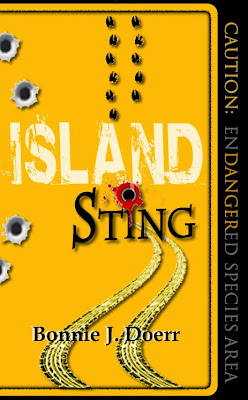
Bonnie J. Doerr is the author of Island Sting. She has taught students from kindergarten to college in eight states. Degrees in reading education, combined with a brief post as a science teacher, led her to write ecological mysteries. Her novels celebrate caring, involved, “green” teens who take action with attitude and a touch of romance. Her work has been honored by NOAA (National Oceanic and Atmospheric Administration) with a grant for its use in environmental education and has been included in Milkweed Editions literary field guides. When not nurturing her muse in the Florida Keys, she lives in a log cabin in North Carolina. Click here to read my review of Island Sting. And now Bonnie Doerr faces the 7 Questions:
Question Seven: What are your top three favorite books?
Much as I hate to dodge a question, there is no way I can answer this one. My favorite books change yearly. Maybe even monthly. And the ones that stay in my head are not necessarily my favorites. Sometimes they haunt me for the wrong reasons!
At this point in my life I read for a well-written, engrossing story. I read very little non-fiction. I most enjoy books that are a relief from daily news or pressures—a mini vacation. I’m very visual so horror and mayhem freak me out and spawn nightmares. There exists enough ugliness and violence in the real world. I don’t want to read about it—unless there’s a hero cleaning up that messiness. And I enjoy a bit of humor in the story. Oh, and I must have a happy ending. So, when I find a book with a great story, a bit of humor, and a happy ending, that book is my favorite of the day.
I will share one of my all time favorites from childhood though—The Wind in the Willows.
Question Six: How much time do you spend each week writing? Reading?
It’s gardening season now so I don’t spend enough time doing either! Today it’s raining. That’s why I’m inside answering your questions! However, I consider much of my thinking time as part of the writing process, so I’ll give myself points for the time in the garden when I’m contemplating plot or character. But when I’m tapping out a draft or editing I spend half the day at the computer. I read each evening. Lately it’s been reading other MG or YA novels. But I live for a time when I can set reading for the writing business aside and allow myself to be carried away by an adult read sans guilt for what I’m not doing.
Question Five: What was the path that led you to publication?
Long, winding, rocky, steep, and grueling. But I’m a determined chick. I knew I’d follow that path to the end even if it meant a dead end.
Question Four: Do you believe writers are born, taught or both? Which was true for you?
I believe anyone can be taught the skills to write. No one is born a writer. But to become an awesome writer, one must have emotional and psychological resilience and empathy that are not so easy to learn. I am always learning. Always searching. Always open to advice. There is an unlimited amount of information for writers out there and an amazingly deep reservoir of talented authors willing to share.
Question Three: What is your favorite thing about writing? What is your least favorite thing?
The thing I love the most is what I have the least time to do these days. I love exploring a world I naively imagine I’m creating. During this exploration unforeseen twists and surprises await me no matter how much I plan a plot. Magical and delightful moments happen. My characters have minds of their own. But these days my life has been all about marketing which is definitely my least favorite thing. I share that distaste with most authors I know.
Question Two: What one bit of wisdom would you impart to an aspiring writer? (feel free to include as many other bits of wisdom as you like)
Do not sit at home alone in your lair. Attend conferences. Join associations. Meeting and talking with professionals can open doors. Milk other writers for as much information as you can—through their writings or lectures—not by being personally pushy. But remember, your path will never be the same as theirs. You’re entering a whole new era of writing and publishing. Not all of published authors’ experience will even translate to your world. Be open, be aware, be cautious, be realistic, be patiently persistent. Develop many interests other than writing. Who knows what experiences will offer you insights or subject matter? And don’t be fooled into thinking that authors write for the money (in spite of a few big names).
Question One: If you could have lunch with any writer, living or dead, who would it be? Why?
Jean Craighead George. We share a love of nature and wild things. We both worry about the future of our planet and the disconnection of today’s youth from the outdoors. I’d so enjoy basking in her brilliance and listening to tales of her adventures.
While in college, I picked up a copy of John Grisham’s The Pelican Brief at about 10:00 at night the week of finals. I was worn out from studying and I just needed a little break. Big mistake. I finished the book at about 4am and then spent the next day of finals sub existing on coffee and cursing Grisham’s name. He wrote an un-put-downable book. That’s all well and good for adult novels about lawyers and conspiracies, but can such an experience be recreated in a book for younger readers?
Esteemed Reader, it can. Bonnie Doerr has done it. Island Sting is an un-put-downable book. Don’t believe me? Try reading the first chapter. Heck, the first page! You will flip that page, and then you will read the next, and you will not be able to stop until the book is finished. In fact, my first time through I read it so fast I forgot to make any notes for this review and so I had to go back through it a second time, which was sort of like watching a magic trick in slow motion to see how it was done. Fortunately, studying the way a book was crafted doesn’t ruin the trick, but instead deepens my appreciation for it.
That’s all good and well for me as I already had the experience of enjoying the book when it was fresh and new, but I don’t want to ruin it for you, Esteemed Reader. So here’s the plan: I’m going to do a summary and review and those of you who don’t care for having your magic tricks ruined before you see them should stop there. Those of you who have read the book or don’t mind having it dissected before hand can stick around and we’ll talk craft.
The story of Island Sting is thus: Kenzie Ryan and her mother have moved from New York to the wildlife refuge of Big Pine Key 30, just outside of Key West. In addition to adjusting to her new home among the critters, Kenzie is also dealing with her parent’s recent divorce. After rescuing a deer from drowning, Kenzie is drawn into a rollicking environmental mystery involving a poacher who enjoys torturing and murdering deer, and who might just enjoy torturing and murdering a certain nosey girl. Who is this poacher? Well, that’s the mystery. Along the way, Kenzie hooks up with Angelo, a smoldering hunk of boy who is an area native and well informed about the local wildlife. Will Angelo and Kenzie catch the poacher and stop the slaughter of innocent deer, or will the poacher catch them? Will Angelo and Kenzie share a kiss in the woods? Will Kenzie enjoy the silence of the deer (and dog) ala Clarice Starling style redemption? Will I stop asking these questions and get on with it?
Yes. Yes I will. Island Sting is a fast paced adventure mystery that readers will love whether they’re green teens or older ninjas. It comes highly recommended from me if you’re a lover of books, and extra recommended if you’re a writer looking to hone your craft. You’re going to have a good time and you’re going to learn a lot about the environment in the Keys. But not in a science class sort of way; in a Michael Crichton we’re-learning-about-genetic-engineering-and-palaeontology-to-better-appreciate-it-when-the-Tyrannosaurus-Rex-tries-to-chomp-folk sort of way. In fact, there’s an educational section at the end of the book so that Island Sting easily lends itself to the classroom setting .
My review in three words: read this book. Bonnie Doerr knows her way around the woods, so to speak, and she will show you a heck of a good time. That’s that. Review finished. From here on out, I’m going to talk about how there were actually two people in the box Doerr cut in half, and that’s why the legs kept kicking. If you’re not interested in that, thanks for reading and check back on Friday when we’ll have Ms. Doerr herself here to face the 7 questions. I’ll give you a paragraph break to navigate away now.
For those of you still here, let me ask you: when’s the last time you read a book that was too suspenseful, or too exciting? I’ll wager you’ve never read that book and if I told you I had, you would want to know the title of that book so you could read it. The secret ingredient in Island Sting is conflict, conflict upon conflict upon conflict upon glorious conflict. There is not a chapter in this novel that is not driven by conflict from the first page on. Angelo and Kenzie never just shoot the breeze, they spar back and forth, and beneath their apparent bickering, we sense the tension of romance. Even as they are discussing science, they are at odds and the reader plows through exposition without recognizing it or being slowed by it because there is conflict to be enjoyed.
The book opens:
Splash! Ripples circled across the dark water farther down the canal. Kenzie scrambled through the mangrove thicket, stumbling over tangled roots toward the disturbance.
Who is Kenzie? What color is her hair, her eyes? What’s her age? What is her background? You don’t know these things and should I reprint the entire first chapter of this novel, which I would like to do but might get in trouble for, you would not know them. And those things do not matter. Doerr doesn’t slow down to tell us. Instead, she focuses on the disturbance in the water, which is a drowning animal, and Kenzie’s will to rescue it. Kenzie puts herself in harm’s way and is nearly killed just after this (is it a spoiler if I tell you she doesn’t die in the first chapter?).
And that is all you need to know about this character to be drawn into the story at once. Eye color, background—these things do not a character make. A willingness to put one’s self at risk for the life of an animal makes a character. At the core, this is who Kenzie is and why we care about her. After this chapter, we know that anytime an animal’s life is at risk, Kenzie will be compelled to act.
Now, of course, Doerr does work in exposition along the way, and that’s how it should be done. If you want to write a book as exciting as Island Sting, start with conflict and fill in only the most necessary exposition only when it is needed. If you start your book with character detail rather than character conflict, you’re less likely to hook the reader, and the longer you delay conflict, the longer you test reader patience. Doer knows this, which is why she starts her conflict with the first word: Splash!
I see we’re nearly out of time. So let me make two more observations and close with some excerpts from the book. When we do learn about Kenzie’s back story, we learn most of it through an argument with her mother. That’s right. The conflict doesn’t stop for a little thing like exposition. We are interested in the fight and just happen to learn the back story along the way, just as we learn science through sparing matches between Kenzie and Angelo. This method works. Pages keep turning and the job of informing the reader gets done.
The exposition that is most essential, Kenzie’s motivation for saving animals, is what Doerr wisely focuses on. It turns out Kenzie feels responsible for the death of her dog and has vowed never to allow another animal to die on her watch. This is Batman vowing never to let what happened to his parents happen to other citizens of Gotham. This is the hero cop whose partner is gunned down in the opening scenes of the movie, and now it’s personal. It’s a tried and true formula. Island Sting is above all things an excellent example of proven methods of creating suspense and it works. If you want to write an exciting story readers will not walk away from, study this book.
Okay. That’s it. I’ll leave you with excerpts and the thing to notice is Doerr’s sparse use of words and great use of white space. In sections, the prose reads like a sort of action poetry. Island Sting is engineered to be read fast:
The ground collapsed. Splash! She plunged into the canal. Splatter. Splat. A landslide of gravel tumbled after her.
There had to be an opening in the edge of the dense undergrowth. Yes. A trail. Prickly branches grasped her clothes, caught her hair. She ducked and scrunched sideways as she squeezed along the deer trail. Pop. Pop. Kenzie jumped. Rustle. Rustle. She cringed. A lizard scurried through the underbrush.
She flinched. A giant winged shadow swooped across her path. Whoosh! Kenzie hit the dirt. Whoosh! Whoosh! Face down. Hands on head. Air rushed. One huge bird. Wings flapped. Two. Another and another brushed by. She peeked between her arms. Swoosh! Savage hooked beak. Zoom! Massive wings.
STANDARD DISCLAIMER: Book
of the Week is simply the best book I happened to read in a given week.
There are likely other books as good or better that I just didn’t happen
to read that week. Also, all reviews here will be written to highlight a
book’s positive qualities. It is my policy that if I don’t have
something nice to say online, I won’t say anything at all (usually).
I’ll leave you to discover the negative qualities of each week’s book on
your own.