Showing posts with label Mystery of the Third Lucretia. Show all posts

Tuesday, April 5, 2011

Book of the Week: ADVENTURE AT SIMBA HILL by Susan Runholt

http://www.amazon.com/gp/product/0670012017/ref=as_li_tf_tl?ie=UTF8&camp=211189&creative=373489&creativeASIN=0670012017&link_code=as3&tag=midgranin-20
You’ll remember last year, Esteemed Reader, I reviewed the first two books in Susan Runholt’s Kari + Lucas mystery series, Mystery of the Third Lucretia and Rescuing Seneca Crane. If you don’t remember that, here is the link. You don’t have to have read those books to enjoy Adventure at Simba Hill as each Kari + Lucas mystery is a self-contained adventure (though the books do reference one another). But really, both of those books are excellent and why would you not want to read them? I recommend you buy all three.

Incidentally, I’d tell you that author Susan Runholt will be here on Thursday to face the 7 Questions, but she already faced them. You don’t have to wait until Thursday, Esteemed Reader. You can read Susan Runholt’s interview right now (or just after this review).

For those of you who don’t already know, Kari and Lucas are two fourteen-year-old girls who trot the globe solving mysteries, striving to put right what once went wrong and hoping each time that their next leap will be the leap—never mind. But extra nerd points if you know that reference:) Kari is Batman to Lucas’s Robin and they never actually seek out mysteries. They just sort of find themselves in the right exotic location at the right time to become entangled in a new international mystery.

This book marks the third time this has happened and it sort of amuses me that the girls haven’t really noticed their incredible fortune--or is it misfortune--beyond the fact that they get excited at the hint of a mystery. In the same vein, I always like to imagine someone casually asking Jack Bauer if he’s noticed this is the seventh time he’s saved the country from a terrorist attack in just 24 hours without ever once using the bathroom. “Huh,” Jack Bauer might say. “That’s interesting. Tell me where the godmeeped bomb is!”

Whew. I’ve just referenced two television programs that are no longer on the air. I’ve got to focus! Actually, one of my favorite things in reading the two Kari + Lucas sequels is finding out just how Kari and Lucas are going to get themselves entangled in a mystery. After all, Runholt has yet to disappoint and have the girls go after a mundane mystery. The mystery in each book has been a complicated ordeal full of danger and intrigue that any mystery novelist would be proud to call her own.

This falls right in line with my new campaign to recognize middle grade books as family literature and not just children’s literature. Adventure at Simba Hill is a mystery a child can read and enjoy, but it’s also one that will likely snag any adult reader. This isn’t a good mystery novel for children. This is a good mystery novel that happens to feature children (adolescents, really) and that children will likely enjoy. But Runholt’s mystery series can go toe to toe with our old friend William Kent Krueger’s Cork O’Connor series. As he’s mentioned in the acknowledgements of Adventure at Simba Hill (isn’t the fiction world a wonderfully small place?), I doubt he’ll mind.

But I digress (always). The thing I was watching for as I read this novel was how long would it take and how much set up would it take before the girls were back in harm’s way, which is exactly where we like them. As this is something I struggle with in my own mystery writing, I’m keen to see how a pro like Susan Runholt does it.

The meter starts running on page one. First, Runholt reintroduces us to our heroes and their mothers. As this is the third book in a series, hopefully most of the readers know these characters already and need only a little reminding as we may have been reading a book a week since the last one:) Still, Runholt dutifully drops in the most necessary exposition carried over from the first two novels so that newcomers follow along as well.

This is probably another reason why Kari and Lucas never say to each other “Can you believe we’ve solved two, count them, two international mysteries? Wouldn’t it be just an insane coincidence if we found ourselves in the middle of a third?” One thing a writer has no way to control is when a reader will join her mystery series. After the newcomer enjoys Adventure at Simba Hill, he or she may want to read the first two novels, so why spoil the endings to them in the third book and risk losing those sales?

When we first join Kari and Lucas they are trying on outfits for their trip to Africa. We learn that the girls have been invited to visit Kari’s Uncle at an archeological dig. That’s chapter one and Runholt has taken care of a lot of business. But there’s still no mystery and the meter is still running.

In the next chapter the girls are on a plane and more exposition is revealed. They land and meet Uncle Geoff and see some of Africa. This is exciting and fun, but the meter is still running! And then, finally, on page 21 the girls learn that someone is looting artifacts from the Simba Hill archeological site:

The professor shook his head. “It’s a mystery.”
Lucas looked at me, her eyes wide. Nothing got our attention more than those three little words.

And there you have it. Susan Runholt, ladies and gentlemen. In 21 pages we are completely caught up with Kari and Lucas, they are already in another country for a relatively plausible reason and entangled in an international mystery. In the manuscript I’m currently revising, the main mystery isn’t introduced until page 233 (I’m working on it!!!). So understand I am in awe of Runholt’s ability, but still… I can’t help but think that 21 pages is an awful long time to keep readers, especially young readers, waiting. It’s not my fault hours of television and video games have given young minds everywhere attention deficit disorder. I want them to be up for old school Victorian novels that go on forever setting up the novel until page 102 when a stranger comes to town. But this is the readership we modern middle grade novelists have to deal with.

Runholt knows this. So, although as I have already belabored, she introduces the main mystery on page 21, she promises serious adventure on page 7 at the end of the first chapter:

Anyway, a couple of days after Christmas, there Lucas and I were with Uncle Geoff, in Africa, on Safari, with dangerous wild animals running around loose, in the middle of a ring of smugglers that was almost more dangerous than the animals, and—well, that’s what this story is about.

Once again, Susan Runholt, ladies and gentlemen. She knows that casual readers are dying to put her book down and get back to Facebook, X-box, Quantum Leap reruns—and she snags them before they can. And here she makes a promise to the reader that in the pages that follow we are going to enjoy an exciting adventure in Africa that will involve all sorts of danger and intrigue. It’s a promise Runholt makes good on, which is one of the many reasons I’ll be looking forward to the girls’ fourth mystery adventure.

What the meep? I see we are nearly out of review (a little past, actually), yet I still have craft points I want to make and passages to share. By the way, you may have noticed me inserting meeps throughout this review. This is one of my favorite things about the Kari + Lucas mysteries. Whenever the girls, who are fourteen and by all rights should have potty mouths being that they live in America, want to swear they instead insert a meep, as in “the bird scared the living meep out of me.” I’m crazy about the meeps and wish I had thought of this gag before Runholt as I totally want to steal it. It allows the girls to communicate honestly without closing the book off to younger, more impressionable readers who read up.

I will settle for one last craft point and then I will leave you with some of my favorite passages. Another thing I admire about Runholt is her gift for exposition. By its very nature, a mystery novel is one that involves a lot of exposition. We have to learn the details about and the motives of a lot of suspects as well as their whereabouts on the night the crime took place. The reader accepts this and will usually look the other way while some unimportant character tells our detective a wealth of seemingly unimportant information about some guest at the party, sort of like Chris Farley’s security guard in Wayne’s World (anyone here old enough to remember that movie?). This is all good and well and the reader accepts most of this because we’re with the detective(s) and we’re collecting the info to try and solve the mystery before she does.

But in a novel like Adventure at Simba Hill in which our characters are in a different country, we also have a lot to learn about the locale and various social customs. This stuff isn’t as interesting as the clues to solve the mystery, but we need to know it in order to understand the story. And because it’s fun to learn about new places. By the way, you have to admire that Susan Runholt writes a series that requires her to travel the world and do research. Suppose I could get a tax right off if I wrote a novel that takes place on the set of The Dark Knight Rises? It’s a love story:)

At the beginning of the novel, we learn that Lucas has been studying Africa at her private school (Kari goes to public) and is brimming with information about Africa. She is spouting off interesting facts before the girls’ plane even lands. And does her knowledge come in handy later in the book? Of course it does! But by planting this seed so early, when Lucas’s knowledge of Africa is required, it seems perfectly natural and expected that she have it. More, because Kari is annoyed by Lucas chirping in every so often with Africa facts, what could have been just dry exposition becomes part of a character interaction and even a small fight, which makes it interesting to read.

So that’s it for this week. Check out Adventure at Simba Hill. It’s at least as good as the other books in the series and filled with excitement, exotic locations, and plenty of girl power. More, it’s a good mystery and as I’ve been very careful to avoid spoiling it, you should get sucked right in.

And now, as always, I shall leave you with some of my favorite passages from Adventures at Simba Hill:

“Bernard, we know that jambo means hello from watching The Lion King. But what does safari mean?”


“Um, Lucas.”
“Ye-e-e-s?”
“About the looting?”
“What about it?”
“Well, I was thinking kind of two different things. One is that it would be fun to see if we could solve the mystery.”
Lucas looked at me as if I was a little nuts. “I thought that was, like, obvious.”

The room was as big as a medium-sized house. It had dirt floors full of big square or rectangular holes, and rock walls. Floodlights lit up tables set near the walls. The smell was a combination of dirt and diesel. But what I mostly noticed was that Professor Wanjohi and Mariea were at the back of the room, and although they were quiet now, it was obvious they'd been arguing. You could practically feel the anger in the air.

As we watched, Prosper looked at the guys sitting around him, his eyes half closed, reached for a piece of bread, took a bite, and chewed. Someone said something that must have added to the joke, because there was another wave of laughter. Prosper took another bite of bread, not cracking a smile.


STANDARD DISCLAIMER: Book of the Week is simply the best book I happened to read in a given week. There are likely other books as good or better that I just didn’t happen to read that week. Also, all reviews here will be written to highlight a book’s positive qualities. It is my policy that if I don’t have something nice to say online, I won’t say anything at all (usually). I’ll leave you to discover the negative qualities of each week’s book on your own. 

Thursday, August 12, 2010

7 Questions For: Author Susan Runholt

Award-winning Susan Runholt, author of the Kari and Lucas mystery series (click for my review), shares her teenage heroines' love of art and travel and commitment to feminism. She has traveled extensively in Europe, Asia and Africa, and lived in Amsterdam and Paris, working as a bank clerk and an au pair. She's also been a waitress, a maid, a motel desk clerk, a laundress, a caterer, and director of programming for South Dakota Public Television.

For the past two decades she has lived in Saint Paul, Minnesota, where she serves as a fundraising consultant for social service and arts organizations. She was named runner-up for the Debut Dagger Award by the Crime Writers' Association of Great Britain for The Mystery of the Third Lucretia (Kari + Lucas Mystery).

And now Susan Runholt faces the 7 Questions:


Question One: What are your top three favorite books?

Okay, everybody cheats. We know this. But if I'm going to cheat, I need plenty of scope. So I'm going to make a list by age range, cheating as I go.

My favorites in, say, fourth and fifth grades: the Nancy Drews, Trixie Beldens and Betsy Tacy books. Oh, and The Secret Garden, Alice in Wonderland and The Wind in the Willows.

By sixth and seventh grades: Some of the earlier favorites plus Jane Austen and Agatha Christie. Oh, and that's when I discovered Mary Stewart and Sherlock Holmes.

What I keep re-reading now: Jane Austen, Charles Dickens, P.G. Wodehouse, Mary Stewart, the Rumpole stories and, when I need comforting, Miss Read. Oh, and mysteries by Marsh, Caudwell, Beaton, Leon, Allingham, Francis, Brett, and on and on and on.


Question Two: How much time do you spend each week writing? Reading?

I probably spend 15 to 20 hours per week actually writing, and about that same amount of time on the business of being an author: appearances, maintaining a web presence, doing research,corresponding with fans, attending my writers' group, etc. I also have a day job and -- and this is more relevant than one might think -- I'm single. So I have to go to the bank and the grocery store, take out the garbage, walk the dog, pay the bills...

I'm reading more these days because I've discovered that if I'm going to stay healthy, I have to take time to relax. I try to read for at least a half hour before going to bed, and I usually get in six or seven hours on Sundays. That's not counting the audio books I consume by the dozens as I drive, clean my house, walk the dog and deal with almost anything that has to do with finances.


Question Three: What was the path that led you to publication?

I had been writing for 18 years when I learned about the Debut Dagger Awards given by the Crime Writers Association of Great Britain. Our CWA bestows Edgars, their equivalent is the Dagger. And the Debut Dagger is a category the Crime Writers of America don't have: manuscripts by previously unpublished authors. It's open to anyone who meets their qualification for unpublished, writing in the crime genre in the English language anywhere in the world.

I submitted The Mystery of the Third Lucretia, which emerged as Highly Commended -- essentially second place, but it is only awarded when they believe the field of submissions is particularly strong. I'm not certain, but I think mine was the first manuscript for young readers ever honored by the Debut Dagger committee.

As it happens, one of the judges was an agent for ICM, which at that time had an office in London. She referred me to Tina Wexler (click for an interview) , her colleague in the New York office, who reviewed and accepted my manuscript. Tina managed to get a mini-bidding war going, and the book was finally placed with Viking.

An interesting side note. My manuscript was highly commended by the Debut Dagger committee in 2005. In 2008, a manuscript by the wonderfully talented Charlie Rethwich (pen name C.J. Harper), another member of my writers' group, earned the same honor. Same honor, same writers' group, Twin Cities, Minnesota, USA -- what are the odds?


Question Four: Do you believe writers are born, taught or both? Which was true for you?

I believe a writer is born with the ability to create a story, just as a composer is born with the ability to write music. One indication is the perennial fan question: "Where do you get your ideas?" This question tends to leave many writers speechless. The answer seems so obvious. Of course we get our ideas from our imagination.

(Interesting that I don't get this question from the young people I meet. Kids are still close enough to their imagination not to have to ask.)

I also believe that writers need to be taught, and, if they are to succeed, must learn to take criticism and become a better writer because of it.


Question Five: What is your favorite thing about writing? What is your least favorite thing?

I love getting lost in the story. I love it when my characters come alive and start behaving in ways I couldn't have predicted. I love fan mail. But the single best thing is traveling to do research in the places I write about. London, Paris, Amsterdam, Scotland, Kenya -- what's not to like?

My least favorite thing, hands down, is working with voice activated software, which I have to do because of repetitive stress issues. Imagine having to write an entire manuscript this way:

Open quote Lucas all caps that exclamation point close quote I screamed period open quote look out exclamation point close quote new paragraph the cap jaguar missed her by inches period

In print this would look like:

"LUCAS!" I screamed. "Look out!"

The Jaguar missed her by inches.

That's not even including the problem of the mistakes the program makes. And as wonderful as Dragon NaturallySpeaking is, it still makes lots of mistakes.


Question Six: What one bit of wisdom would you impart to an aspiring writer? (feel free to include as many other bits of wisdom as you like)

To succeed as a writer you need to do five things.

1) Read everything you can, preferably including Shakespeare and the King James version of the Bible.

2) Write. Preferably every day, whether you think you have it in you or not.

3) Finish your projects. You'll never get anything published if you don't get anything finished.

4) Take criticism. (See above.)

5) Persevere. Even when it's a drag.


Question Seven: If you could have lunch with any writer, living or dead, who would it be? Why?

Jane Austen. I want to find out how on earth she managed to write such incredibly wonderful books with only the barest minimum of plot. Frankly, the thought of so much talent makes me tired.


Tuesday, August 10, 2010

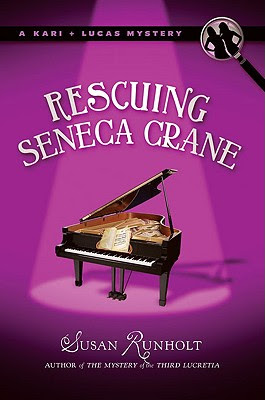
Book of the Week: RESCUING SENECA CRANE by Susan Runholt

http://www.amazon.com/gp/product/B002XFP9AQ/ref=as_li_tf_tl?ie=UTF8&camp=211189&creative=373489&creativeASIN=B002XFP9AQ&link_code=as3&tag=midgranin-20
Do you like a good mystery, Esteemed Reader? A hint of danger and some heart-pounding adventure? Unless you have some sort of special heart condition or a neurological disorder, I’ll assume that you do. And therefore you are going to love Susan Runholt’s Kari + Lucas Mysteries. The ninja loves them and is looking forward to future additions.

So we’re going to change things up a little bit this week. Instead of reviewing one book, I’m going to review two books in one post. Why? Well, I don’t review every book I read and I enjoyed the first book in the series, Mystery of the Third Lucretia, on audio book. I highly recommend that version, by the way, as the reader is fantastic. I wrote to Susan Runholt to ask her to appear here (she will, this Thursday!) and guess what? She sent me a signed copy of Rescuing Seneca Crane! God, I love being a ninja!

Here is perhaps the finest praise I can offer a series: when the third book comes out, I’ll be all over The Adventure of Simba Hill, just for me. I want to know what happens to Kari and Lucas and I want to see what Runholt’s going to do to top these first two wonderful books. If you haven’t read Runholt’s mysteries yet, get started now and we can wait for book three together.

That officially concludes the review portion of this review: buy these books. Now let’s talk craft. A good series is hard to pull off, yet so many writers have ambitions for one, including the ninja. As a writer, part of the appeal to the series is a multi-book contract. But more, I suspect the joy in writing a series is the same joy the reader has in getting to spend more time with the same characters and experiencing a story larger than one book can contain. Whether that series is a Harry Potter story that is interconnected and building parts to a larger whole, telling one story over seven books. Or whether, as is the case here (so far), the books in the series are each self contained adventures like Batman stories or a television show. I like both kinds of series, but my preference is for episodic tales so that if one book sucks (not the case here) it doesn’t drag down the rest:)

Regardless of the type of series, the pressure is on the writer to create fantastic characters. This is a pressure the writer always feels as we’ve got to create fictional people interesting and likeable enough that the reader wants to spend a whole book with them. In a series, the reader may be spending seven books or more with these characters. So take the pressure of creating one book’s character and multiply it by seven, I suppose. Kari and Lucas, two 14-year-old girls from Minnesota, are definitely likeable enough for the reader to want to spend four books with them. Heck, I’ll spend more books with Kari and Lucas if Runholt is up to it.

More, Kari and Lucas have the sort of qualities that will make them compelling protagonists regardless of the mystery facing them. They are curious about the world and the motivations of people. This is an essential quality for any detective to have, but Runholt doesn’t just tell us this (perish the thought!). She establishes the girls' curiosity in Mystery of the Third Lucretia. At an art museum in Minneapolis, the girls are treated rudely by a man copying a Rembrandt. When they see him later wearing a disguise, they decide to follow him and from this action flows the entire adventure that follows. What a masterful stroke this is! Though the girls remain very curious in Rescuing Seneca Crane as well, the subject of that book is a kidnapping of their friend, which one hardly need be curious to notice and be concerned with. But in the very first book of the series, this essential character quality of Kari and Lucas is forever established throughout the series because it is essential to the plot (and the plot comes from character, so bonus). The girls are insufferably curious, which might just get them killed were there not a third book on the way:)

In fact, most of Runholt’s world building in Mystery of the Third Lucretia is clearly being built to last. Various parts of the plot, though they tie in to the first adventure, go out of their way to establish the set up for future novels. Minor spoiler… Kari’s mom gets a job writing about international fashion for a magazine, which means she’ll need to do a lot of traveling, dragging the girls around Europe with her. As these are international mysteries, you can bet that will come in handy. Also, we’re introduced to Lucas’s father, a workaholic who never makes time for her, and her mother, who would much rather be free of her child so she can spend more time shopping with friends. While this sucks for Lucas, it’s great for Runholt because it means Lucas will always be free to go globetrotting with Kari and her mother.

The Kari + Lucas Mysteries are considered upper middle grade, or tween, which presents an interesting challenge to writers. On the one hand, the characters are old enough to have been exposed to many of the less savory aspects of the adult world. On the other hand, kids read up, and it’s likely a given that kids as young as ten or even eight will be reading in addition to fourteen-year-olds and adult ninjas. And the covers of these books, not that a writer always has a say in that, are bright and colorful and likely to attract readers of all ages.

What then is a writer to do? How does she acknowledge the age of the protagonists, who would probably swear and talk about naughty things at fourteen (or maybe I was just warped) without risking a younger readership? One of my favorite of Runholt’s inventions to get around this is her giving the girls their own way of swearing. When the girls want to swear, they insert a “meep” for the swear, as in “Oh meep,” “I feel like meep,” and my favorite, “Alan The Meep.” It’s important to remember that it is the age of the reader, not of the protagonist that determines content. After all, the protagonist in Amy Reed’s Beautiful was only thirteen.

A common complaint of mine is that too often in middle grade books the horror is not really scary, the danger isn’t really all that dangerous, and the mystery isn’t much of a challenge. As a ninja, I keep reading, but when I was kid I put a book down as soon as I felt its writer was being condescending(i.e. trying to convince me a rabbit sucking carrot juice was scary, though I loved that book). I wouldn’t have put Runholt’s book down. There is a reason Kari and Lucas are fourteen instead of ten. They’re dealing with some pretty serious stuff, and though Runholt keeps the story light and fun, she deals rather realistically with the world around it.

If Lucas and Kari were younger, they might be dealing with the mystery of the stolen cookie jar. But Runholt has loftier plans. In the first book, the girls are hot on the tail of an international art forgery that would be at home in a Dan Brown thriller (assuming there were a pseudo-religious twist), and in the second book, they’re chasing after kidnappers that might make William Kent Krueger proud. The girls censor themselves, but the villains don’t behave as though they know they’re in a story written for younger readers. There are murders and discussions of rape (all tactfully handled, I promise). In one scene, the girls tour Amsterdam’s Red Light district and are mistaken for, ahem, madams of the evening. Some parents may object to this, and if that’s you, go ahead and object. I, for one, was thrilled to have found a mystery that was truly exciting involving dangers that were actually dangerous.

I see we are past our maximum word count and I haven’t really told you the plot of either book, but that’s a good thing. The less you know going in, the more pleasantly surprised you’ll be. But I will say how much I appreciated the pacing at the beginning of Rescuing Seneca Crane. We know who the characters are and how it is they come to be able to travel overseas, so Runholt is able to start the adventure and keep it going to the last page.

And that wraps us up. Two big thumbs up for the Kari + Lucas mysteries. And don’t forget to drop back by on Thursday when we’ll have author Susan Runholt here to face the 7 Questions!


STANDARD DISCLAIMER: Book of the Week is simply the best book I happened to read in a given week. There are likely other books as good or better that I just didn’t happen to read that week. Also, all reviews here will be written to highlight a book’s positive qualities. It is my policy that if I don’t have something nice to say online, I won’t say anything at all (usually). I’ll leave you to discover the negative qualities of each week’s book on your own.