Showing posts with label Scrawl. Show all posts

Thursday, November 11, 2010

7 Questions For: Author Mark Shulman

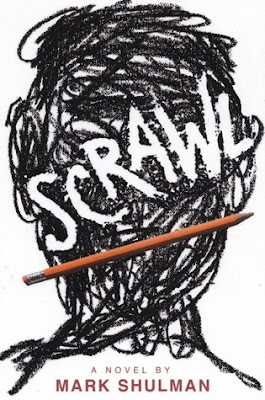
Mark Shulman is the author of Scrawl, Mom and Dad Are Palindromes, and Fillmore And Geary Take Off! The Adventures of a Robot Boy and a Boy Boy, among many others. 

Click here to read my review of Scrawl.


Mark Shulman has been a camp counselor, a radio announcer, a maitre d' in a fancy restauraunt, a New York City tour guide, and a creative advertising guy. He's written many books about many things--sharks, storms, robots, palindromes, gorillas, dodo birds, Star Wars, Ben Franklin, how to hide your stuff, how to voodoo your enemies, and how to make a video from start to finish. He's written picture books for Oscar de la Hoya (the boxer) and Shamu (the whale). Mark is from Rochester and Buffalo, New York, but he has lived in New York City for so very long that he tawks like he's from da Bronx. So do his kids. His wife Kara, a grade school reading specialist, has perfect diction.

And now Mark Shulman faces the 7 Questions:


Question Seven: What are your top three favorite books?

Aargh. My first question and already I’m stumped. My little apartment has more books than some of the bookstores I’ve been to. How can I answer that? Which three? First three ever? Most recent three? Three favorite children’s books as a child? As an adult? How about the three books most frequently re-read, regardless of age or genre, and so loved that the word should savored in the British style, with an extra u: favourite.

Okay.

The most re-read book in my world is The Thurber Carnival. James Thurber is my first writing teacher, a master of humor, style, and social commentary . I’ve absorbed so many twists of story and turns of phrase from his work that I should send flowers to his grave every year. Second is probably The Maltese Falcon. It’s not just a perfect detective story and a perfect mystery story and a perfect set of character sketches. It’s perfect. I love that Dashiell Hammett wrote it mainly to outrace the creditors, in a small apartment with young children. I can identify. And finally, a late addition to overtake Twain and E.B. White for the bronze medal: Holes by Louis Sachar. Reading this particular book is like watching an up-close magician who will repeat the trick over and over again, yet I still don’t altogether get it. It’s on my bedtable right now.


Question Six: How much time do you spend each week writing? Reading?

I’m lucky that my wife runs the reading program in her public elementary school here in New York City, and we live near a great library branch. So, there are plenty of new books to read, and I’m always in books or newspapers or their digital cousins, as well as reading aloud to my kids on a daily basis. I’m also lucky that writing is my full-time job, and I’ve been able to publish a lot of books since I hung up my advertising spurs ten years ago. Also also, I’m perhaps lucky that my wife puts a lot of time into her schoolwork after hours, so I’m free to keep writing into the night. My weeks fluctuate wildly, and I count the time spent sitting at a computer in fruitless expectation to be the same as actual writing time. So: 25 hours reading and 25 hours writing something.


Question Five: What was the path that led you to publication?

The path led down Madison Avenue, in a couple of ways. My first career was as an advertising creative type… brainstorming, presenting, writing, and eventually becoming creative director in a variety of worlds: agency, magazines, events, and communication consulting, whatever that is. This was an excellent training ground for writing craft, not to mention discipline, audience empathy, and lack of vertigo with authority figures. I was like the boy in Karate Kid, picking up moves I didn’t know I would need later. (For instance, turning long lists into long sentences.) Also, I used to give lots of tours in New York City. That’s where I learned to absorb, present, and arrange history to suit not only my narrative, but any sudden bus detour. Once I met my wife the teacher, I traded all kinds of predictability for more creative satisfaction than I’d ever imagined.

My publishing life didn’t begin with rejection. I still thought like a professional, so I scheduled meetings with publishers and editors who may not have realized that I was thoroughly inexperienced. I pitched my book ideas as if they were ad campaigns, and I suppose being confident and somewhat funny helped to sell a few of them. Over time, as my writing evolved, my sales pitches dwindled, and I got more and more chances to write.


Question Four: Do you believe writers are born, taught or both? Which was true for you?

Hmm. I’d say Art is born, Craft is taught. The talented people invent plays and stories and kindle their imaginations at a very early age, but that doesn’t ensure they’ll learn Craft. The motivated people listen and learn and persevere, but their dedication may not bring them closer to Art. The fortunate ones start in one place and evolve toward the other.

Personally, I’m a creative type, radiating ideas the way a hunk of uranium radiates, well, radiation. Hooked up to the right machine, I’m useful. Out in public, the results may vary. But I’ve always identified as a writer. I like variety. I’d like to write and publish one of everything before I’m through.


Question Three: What is your favorite thing about writing? What is your least favorite thing?

Finally, an easy-to-answer question! My favorite thing is that I love the beginning. That’s when I happily agree to complete something with no way of knowing how it will turn out: the deadline, the tone, the style, certainly the ending, and definitely the deadline. Yet I enter into writing with the confidence that I can pull it off. And when the work comes together, as it eventually always does, my faith in the writing process becomes even stronger.

My least favorite thing – no joke – is the misery I feel when I realize that, yet again, I’ve committed to something I have NO way of feeling my way through. I’m lost in the dark every time, and every time I curse myself for not being a predictable, repetitive writer. When I finally reach the end, I solemnly swear that I won’t do this to myself again. This may seem schizophrenic and counterproductive, but it is.


Question Two: What one bit of wisdom would you impart to an aspiring writer? (feel free to include as many other bits of wisdom as you like)

My advice comes more from what I would tell writers in advertising and marketing. It all applies to books.

1) Really learn to type well. 50 words per minute, minimum. At that rate, it’s much easier to get the words off your mind and onto the paper. Treat typing software like a video game and get good.

2) Get the words off your mind and onto the paper. Don’t edit or second guess while you’re blurting. Just blurt. You know more than you think you know, said Dr. Spock.

3) Talk like your narrator. Find the appropriate tone and stick with it.

4) Be your reader. Imagine what your reader would like to hear, and give it out generously. Talk directly to your reader as an individual. Don’t play to the room.

5) Know that readers don’t have to be reading your writing, so keep pulling them forward with little gifts. A clever turn, or a good joke, or something unexpected in the wording or pacing keeps building the good will.

6) Keep up with the white space. Most younger readers perceive a seven-line paragraph the way you perceive the original Declaration of Independence.

7) Know in your gut which advice to absorb immediately, and which advice to ignore. But listen to all of it.

8) Be yourself. Write what you know. Stop reading lists. Start writing. Etc.


Question One: If you could have lunch with any writer, living or dead, who would it be? Why?

If I’m inviting this writer for the conversation, I pick James Thurber. His stories are master courses in how to unspool a tale, and his peers all say he was a superb storyteller in person. However, if this lunch is doubling as a one-on-one literary critique, I’m reserving a large table for the afternoon at the Algonquin and a cup of red pens so E.B. White will have plenty of room to work. Uninterrupted.


Tuesday, November 9, 2010

Book of the Week: SCRAWL by Mark Shulman

http://www.amazon.com/gp/product/B003P9VOJ4/ref=as_li_tf_tl?ie=UTF8&camp=211189&creative=373489&creativeASIN=B003P9VOJ4&link_code=as3&tag=midgranin-20
Scrawl by Mark Shulman is a great book and well worth reading and/or purchasing. As you know, I try to get all of my books for free through this blog, but if I were going to pay money for a book, I would pay money for this one. Sometimes you pay $16.99 for a book (Scrawl’s cover price, which I looked up on my free copy) and you feel like you only got $8.99 worth of story. Not so here. I would say I got at least $50.97 worth of story, bare minimum, maybe more. That’s three times the value, at least! So you should buy this book because it just makes economic sense. You can, of course, check with your local library as well. Also, is it just me, or do these reviews get a little sillier every week:)

Silly or not, I do have an obligation to tell you about this book and more, I want to. Meet Tod Munn. He’s an overweight bully who extorts money from the weaker kids. I loved him and you will too. He’s cynical to a degree, but there is a lot of truth to his observations about his school and about the world in general. As with the main character in Amy Reed’s Beautiful, you likely won’t agree with everything he thinks and says and on some things, you will likely vehemently disagree, but I feel that Tod’s viewpoint is challenging and worth considering. Here’s an early example:

What else is in the room? There’s a cracked brown flower-pot with a dead stick in it. The stick was probably a plant. It’s got a red ribbon hanging off it like you would find on the corner of a diploma or if you won the Spelling Bee. The ribbon says “Congratulations,” but who the hell knows why? Congratulations, you finally got a low-paying teaching job. Congratulations, you retired and didn’t die of boredom teaching the same idiocy to idiots who care less about what’s in your mind than what’s in your car. Congratulations, you just put your new plant on a baking-hot radiator in a room that overlooks a brick wall in a crappy part of town. Congratulations, we’re entrusting you with the mascot of our school. It’s a dead stick.

I can’t tell you for sure how old Tod is. I’ve searched online and in the text, and I believe it’s left intentionally vague. Nor can I tell you what grade Tod is in. He has to be in middle school or high school, which makes this book upper middle grade to young adult. I’m hoping Tod’s age isn’t specified somewhere as there will be egg on my face, but I’m 95% sure I’m right about this.

And even if I’m wrong, Tod felt like he could have been a few different ages, which is certainly not something that works in every book, but it works very well here. And the best thing is readers from all age groups are likely to see themselves in Tod. There is no content too adult and no swearing, except for the occasional opposite-of-heaven, he—double hockey sticks. There’s nothing so bad younger readers shouldn’t read it, nor will older readers find it condescending. Shulman has found a perfect way to market a book to everyone.

UPDATE: Here's a little clarification on this point from an email I recieved from Mark: You're right -- Tod has no age, no grade. That was the point. Also, as a point of interest, Tod isn't defined by race or color or anything. Already I've been asked if I have any characters of color in the book, and I replied that I have something better: characters of no color. We bring our own crayons.

The reason this intentional vagueness works is Tod himself is telling the story: This is my first book, and I’m writing it for one reason only. Not for history and not for scientific research and definitely not to let out my inner demons. I’m doing it so I don’t have to pick up trash in the school courtyard like certain deviant so-called friends of mine who also got caught.
I am being reformed.

The situation is Tod and his buddies have done something very bad. What did they do? Esteemed Reader, you know I don’t spoil books, but you find out late in the game. The entire story is told in excerpts from Tod written during his detention after this mystery event. There are occasionally comments from Mrs. Woodrow who asks Tod questions about the story to get us information he would otherwise have no reason to give us. It’s a brilliant device and from a craft standpoint, it’s one of the big reasons to read this book.

Writing in the first person is difficult for a number of reasons, most notably a limited perspective. More, it limits the writer somewhat in the language they can use, although most writers cheat their way around this. But If I were writing from the first person perspective of an eleven-year-old girl and I were to point out that a particular situation is a conundrum of paradoxical proportions, it begs some questions about what sort of eleven-year-old-girl I am pretending to be. Is the character a huge nerd who regularly speaks like this? If not, the phrasing is out of character and a misstep. To be fair, writing the phrase “a conundrum of paradoxical proportions” is likely a misstep in third person as well, unless the writer is being intentionally humorous;)

Most writers cheat to some degree, crossing over the line between character voice and prose worth reading regularly despite writing in the first person. The trick is not to get caught and it’s a difficult balancing act, limiting oneself to the character’s fixed perspective while still meeting the needs of the larger narrative. What Shulman has done for himself is to add in an extra layer of complexity by writing the story not only from the perspective of his main character, but also from the writing aptitude of this character. Writers, the book is worth reading just to see Shulman pull this off, and he does pull it off.

Do I really believe that this book was written by Tod Munn, who is under the age of eighteen? No. The spelling and the prose is too perfect for that, and I’m glad of it. Books that are written the way actual teenagers write (most of them) are usually worth quite a bit less than $16.99 and the prose would serve more as a distraction than anything else. Shulman wisely gives Tod an interest in books and a knack for English, particularly spelling, but it wasn’t enough to fool me.

And yet the character of Tod does come through in these pages. I felt like I knew Tod by the end of the book. I felt like if I saw him somewhere I would know him. Because Shulman did pull off the most important trick of all: despite the obviously advanced writing, I did believe I was reading the voice of Tod, that somehow his spirit was intact within these pages.

How did Shulman pull this off? Esteemed Reader, if I knew, I’d tell you. It’s an amazing performance and one I’ll be studying for a time to figure out. If you are a writer as well, and I think most of you are, this is a book to study for character and voice. If you’re a reader, here is a story you’re gonna love and a character worth spending 230 pages with. I’m still thinking about him well after finishing.

Look, I finished the review at a manageable length! This is a good day for me. Don’t forget to check back on Thursday when we’ll have Mr. Shulman here to face the 7 Questions, and on Saturday when Bernadette Baker-Baughman will be here. And now, as is my custom, I will leave you with some of my favorite excerpts from the book:

“The only reason I’m giving you more,” Nardine (lunch lady –MGN) muttered, hurling gobs of saucy meat onto every part of the plate, “is because I know what’s in it. I can only hope it kills you.”


I didn’t have a clue what Rex was up to, but if it meant smacking some missionary in front of an old lady, or swiping that briefcase, their friends would empty the pews to get an eye for an eye.


Being mad at Bernie is like being mad at a dog. Both of them want to make you happy. Either one will make you crazy. Neither of them thinks of the consequences. And they both smell pretty bad in the rain.


They might try to shake some cigarette money out of me, but cigarettes are stupid expensive these days, and they know I don’t have that kind of money.


STANDARD DISCLAIMER: Book of the Week is simply the best book I happened to read in a given week. There are likely other books as good or better that I just didn’t happen to read that week. Also, all reviews here will be written to highlight a book’s positive qualities. It is my policy that if I don’t have something nice to say online, I won’t say anything at all (usually). I’ll leave you to discover the negative qualities of each week’s book on your own.