First Paragraph: Sahara awoke to a pounding inside her head. Thundering. Loud. Was it rain against the tent? Rain would bring relief from the dust and the smothering heat. She blinked, rubbing sleep from her eyes. She heard nothing. The sound must have been from the dream, the dream she had again and again.
Oh, Esteemed Reader, I've lost track of the number of girl-and-her-horse stories I've reviewed at this blog. However many it's been, it's too many for a grown man in his early thirties:) Don't get me wrong, I enjoyed Emma's River and Whirlwind and Linda Benson's The Horse Jar(I gotta say I like the Spanish title better: La Alcancia De Los Suenos, or, The Piggybank of Dreams).
I tease my writer's group that if I'm not happily published by a certain date, I'm going to break down and write my own girl-and-her-horse story. I'll call it The Hoof-print on my Heart:) I tell you all this so you will know it took a bit of convincing for me to agree to read yet another book about a girl and horses.
What convinced me was three things. The first was that this particular girl-and-her-horse book was written by our good friend Linda Benson, who was one of the first authors ever to appear here. I enjoyed her previous girl-and-her-horse and girl-and-her-dog books enormously and I admire her writing. Second, this particular girl-and-her-horse book is set in the world of the post-apocalypse, which made me curious. Third, I wanted to know more about Musa Publishing.
Musa Publishing is primarily an electronic publisher and why not? Most of the reading I do these days is on my Kindle. Ironically, I actually read a paper copy of The Girl Who Remembered Horses:) But I recently downloaded The Wrong-Coloured Dragon by Lynne Reid Banks, read it, and loved before I ever realized it had been published directly through Amazon rather than a major publishing house. Because what attracted me to the book was the author and the promised content, not the means of publication. I couldn't tell a difference between that book and an electronic copy of The Return of the Indian, the property of a major publisher.
It's an exciting time to be a writer with so many publishing opportunities available and I hope more established authors set off on their own, independent of publishers. It can only bode well for readers that so many more books become available without being narrowed through the ever-consolidating choke-points of major publishers. It's a power-to-the-people kind of thing.
Meet Sahara. She's the girl who remembered horses. See how Benson effortlessly introduces us to her on page 2: Sahara hated being treated like a baby. She was almost thirteen. "I'm here, sister." Laurel appeared anxious to be off. "We have little meat. I will go down along the dry river bed and look for rabbits again. Stay in camp, start the fire, and don't forget to stir the stew." Sahara made a face. Stay in camp. Build the fire. Stir the stew. Her chores were so boring. She wished she could do something important. Why couldn't she have adventures like her older sister? Sahara isn't a fully-realized three-dimensional character at the end of this passage--it will take a whole book to get her there, but we know what kind of character she is. She's an impatient thirteen-year-old with a taste for adventure who feels oppressed by the older people in her life. A character such as this can't help but get up to some mischief. Before Benson starts in with the world of the post-apocalypse and all the new things the reader may not have encountered before, she makes sure the reader knows who the main character is and what kind of story this is likely to be. It's important she ground us, because The Girl Who Remembered Horses is an unusual story with a lot going on. Mankind has all been wiped out by a huge epidemic, sort of like the Native Americans just before Columbus arrived. The details of the fall of our society are never made quite clear, but I like to imagine this story is set sometime after Stephen King's The Stand. As there's a rough and grizzled character referenced who's name is Roland, I wonder if Benson isn't also a fan of King's work:) But this isn't the world of Ashfall, where everyone's trying to eat and/or rape everyone else. The survivors of Benson's apocalypse are mostly well-behaved folks, with the possible exception of Dojo, who really does seem to love the idea of murdering baby horses. It's refreshing to read a vision of the post-apocalypse in which mankind is rebuilding itself in a way that might just be better than its current iteration. I mean I wouldn't have minded if there had been some zombies, but The Girl Who Remembered Horses a nice change of pace in a genre typically dominated by pessimism. Not that the lives of Sahara and her nomadic clan are without realistic struggles, chief among them travel and keeping everyone fed. No one remembers horses, but Sahara's been having dreams about them, and it's good timing as the clan comes across a pack of wild horses. Like Fiver in Watership Down, Sahara's been struck by divine inspiration and she has an idea the clan could train the horses to be ridden, which might be easier than walking about and having their junk hauled by dogs. Can Sahara convince her clan to listen to someone as young as she, or will the murderous Dojo bathe in the blood of wild horses? I can't tell you without spoiling, so that's where we'll leave it. Except I had to chuckle, mostly because I've been a fan of Linda Benson for years now, and it amuses me that when she envisioned the darkest vision of the future it was a world without horses. I think it speaks volumes about Linda Benson that for her, the key to mankind's survival in the post apocalypse is a kinship with animals. And the key to that kinship: a book, of course. Thankfully, an old woman has kept a collection of books, including a book on how to train horses: The woman hummed to herself. It was hard to know if she had heard or not. "This modern age," she grumbled. "No one seems to think books are important. Everyone experimenting with new things--ways to grow crops and make shelters. No one comes to the old woman on the hill anymore." Do yourself a favor, Esteemed Reader, and pick up a copy of The Girl Who Remembered Horses. It's a good read for tweens and the rest of us. As always, I'll leave you with some of my favorite passages: Sahara hoped Laurel's hunt would be successful. Rabbits and small game were scarce this season. Deer, too. She could barely remember the last time she'd eaten venison. Coyotes yodeled in the distance. She cursed them silently. They hunted, too, but at the expense of her full stomach. Ash was only nine, but surely old enough to hear about the realities of life. From the eating hall, the smell of baking bread and spicy herbs mingled with the odor of many humans. A few pale strands of light lingered to the west. She gulped, drinking in the cold air.
STANDARD DISCLAIMER: All reviews here will be written to highlight a book’s positive qualities. It is my policy that if I don’t have something nice to say online, I won’t say anything at all (usually). I’ll leave you to discover the negative qualities of each week’s book on your own.
First Paragraph: THE TWO TIGER CUBS, romping in the jungle undergrowth near their den, prick up their ears. Lynne Reid Banks will be here Thursday to face the 7 Questions. Esteemed Reader, it's been amazing how regularly we've been able to have the Ninja's childhood heroes appear at this blog, and this week is a very special one for me. I've been trading emails with Lynne Reid Banks and I have to say, the experience has been surreal. I read all The Indian in the Cupboard books when I was a wee Ninja and loved them all. I've felt about chatting with Lynne Reid Banks the way I suppose a modern fourth grader might feel if he grew up to chat with J.K. Rowling. She read my review of The Indian in the Cupboard, which I posted back on August 10th, 2010 It was one of my first classic Book of the Week reviews and when I wrote it I had no idea Lynne Reid Banks might actually read it! Once in a while, life is just too good, and being able to tell my favorite authors how much I love her books is a thrilling experience I highly recommend having:) Her interview is charming and very, very funny, and you don't want to miss it as posting it will forever stand out in my memory as one of my proudest moments as a blogger. Today, however, we are discussing another of Banks's classic works. Tiger, Tiger is historical fiction that while written with younger readers in mind, like the best middle grade works, is a book meant to be enjoyed by adults as well. The trick, as always, is a good story well-told, and content that would be of interest to any reader at any stage in their life.
It's obvious Banks means for children to read her book as she slows down for them on occasion: To launch the entertainment, two tall, splendid gladiators were set to fight, one armed with a sword and the other with a net and a trident—a fork with spiked tines and a long handle. Yet, for passages such as the one above, where definitions are made explicit for readers, what I admire most about this book is that it does not talk down to the reader. As is characteristic of her writing, Banks keeps the pace moving forward. She presents aspects of history, the relevant information the reader must know, and goes on with the story with remarkable speed. And Tiger, Tiger contains a lot of complex themes and ideas. It's an epic tale of the Roman Empire, the beginnings of the Christian church (not exactly in favor of it), animal and women's rights, and true-to-life historical depiction. A lesser writer might've taken 600 pages to tell this story, but Banks trusts her reader to be smart enough to keep up with her. She insists children bring themselves to her level rather than lower herself to theirs and the result is wonderful book still being read and celebrated. The main story of Tiger, Tiger is of two tiger cubs later named by two-legged masters Brute and Boots. In the opening pages, the cubs are stolen and their mother is killed. They're dragged back to Rome where Brute is trained to be a killer in the coliseum (can you really have a Roman epic without gladiators) and other is de-fanged and fixed like a house pet to live with a princess in her palace. Much of the novel is devoted to the tiger's experiences in their new lives: On the fairly rare occasions when he was allowed into the arena, Brute killed again—not perhaps with the spectacular ferocity of the first time, but from the point of view of the spectators, satisfactorily enough. He developed, as man-eaters will, a taste for human flesh, which added to his enthusiasm for the occasions when he was allowed to hunt down and eat two-legged prey, and maintained his growing reputation as the sanguinary star of the circus. Only for Boots, nothing changed. His fortunate, pampered life continued. Catlike, he was content with enough to eat, comfortable sleeping quarters, and the petting and affection of his mistress. He no longer missed his brother or the beautiful, savage world he had been bred in. If things had continued as they were, he might have lived out this placid, unnatural life until he died of old age. But there were cataclysms ahead for him—for all of them. I love that last line, which, naturally, precedes a break. Banks may be giving a history lesson, but she still keeps the reader hooked and keeps the pages turning first and foremost. Of course, the nice thing about history is its filled with necessary violence and taboos. There is plenty of horrendous violence sprinkled throughout, all of it historically accurate, which also helps to keep pages turning. Over the course of the novel, Banks demonstrates her gift for putting the reader in the viewpoint of multiple characters both human and animal. What would it be like to be a nearly 13-year old princess in ancient Rome whom men thought eligible to be married? What pressures would that bring? Here is what the crowd has to say when poor princess Aurelia is dragged at last to the coliseum to witness for the the first time the slaughter of humans and animals for entertainment: “How lucky we came today! Imagine how excited she must be, to see the circus for the very first time!” Many were remembering their own first visits. There was a general feeling of privilege and rejoicing, as if the daughter of Caesar were passing through a sort of initiation into the glorious state of being a full Roman citizen.
For much of Tiger, Tiger the reader comes to the story from the third person perspective of the tigers. They never talk nor have thoughts that a tiger couldn't conceivably have. Their take on the world around them in unique and interesting, but Banks makes no attempt to personify them. Instead, she presents their world as they would likely perceive it:
The smells were bad because there was no way to bury their scat. And there was the smell of other animals, and their fear. And there was a strange smell they didn't recognize, a salt smell like blood. But it wasn't blood. It was bad being enclosed. All the smells that should have dissipated on the wind were held in, close. Cloying the sensitive nostrils. Choking the breath. Confusing and deceiving, so that the real smells, the smells that mattered, couldn't be found, however often the cubs put up their heads and reached for them, sniffing in the foul darkness. A coarse, loud voice shouted, “Quiet, you little brute, or I'll give you something to howl for!” The threat in it was unmistakable. The bigger cub urinated with fear, then found a corner, pressed himself tight to the cold wall, and lay down. He didn't sleep. He was too nervous. He shivered and all his striped fur stood on end. There had been something in that voice that filled him with dread.
Ultimately, of course, Tiger, Tiger is more about humans than tigers--nearly all stories written by humans are. By putting us in multiple perspectives, both human and animal, Banks is cultivating in her reader a historical perspective. After all, those who do not lean history are destined to repeat it. By presenting us with characters as they would've likely been in their time and place, we're able to consider who they were and thus who we were:
“All societies have hierarchies,” she was told. “All societies have higher and lower, masters and slaves.” “It must be terrible to be a slave!” “You must not entertain such thoughts. Waste no pity on slaves. They have no responsibilities, no traditions to maintain, no laws to make and keep. They have no concerns about food and shelter. They only have to do what they're told, and live out their simple lives in peace and order.”
In the end, Esteemed Reader, isn't gaining perspective why we read stories in the first place? We want to know how we're to live, so we look to stories to teach us. By considering humans through history, we can learn to be better humans now.
Tiger, Tiger is a wonderful tale sure to enthrall readers of all ages and teach them a few things they didn't know before while entertaining them. What more can a reader ask for? As always, I'll leave you with some of my favorite passages from Tiger, Tiger: Julius swallowed hard. The pictures in his mind almost unmanned him. Her mother smiled. “It should, perhaps, but it doesn't. People are bloodthirsty. It's the nature of simple folk. Blood excites them, and they love to be excited. It takes them out of their boring lives.” ...appealed to Aurelia about as strongly as being tied up in the arena and fed to the wild beasts, like those strange, death-inviting Christians A spear that whistled past him— reminding him of his trainer's proddings—simply enraged him more, so that he pursued the thrower in an avenging bound, and tore out his throat. But after a few minutes of frenzied whirling, pouncing, rending, and clawing, Brute's killing urge left him. He remembered his hunger, lay down—but warily—beside his first victim, and began to eat the man's entrails. Since he had held her in his arms he ached to hold her again. The little head he had pressed protectively to his chest had left an invisible imprint there that called insistently to be filled.
STANDARD DISCLAIMER: All reviews here will be written to highlight a book’s positive qualities. It is my policy that if I don’t have something nice to say online, I won’t say anything at all (usually). I’ll leave you to discover the negative qualities of each week’s book on your own.
I’m so excited, Esteemed Reader, because this week I get to share with you one of my most favorite books of all time. I’m not sure if I could ever possibly pick an absolute favorite book, but if I did, Watership Down would surely be a strong contender for the top spot. And that pretty well concludes my review: I love Watership Down. If you haven’t read it, stop what you’re doing and read it now. If you have read it, it’s probably been a while and you need to read it again. I've read this book at least ten times and I have it on audio book to entertain me while I sweat at the gym.
I know what you’re thinking, Esteemed Reader. Classic middle grade? That means we won’t have an interview with an author this week. But that’s where you’re wrong! Richard Adams will be here at this very blog this Thursday to face the 7 Questions. So for goodness sake, be back here Thursday, wear a nice shirt, comb your hair, and make sure there’s nothing in your teeth.
I've got to tell you, starting this blog and declaring myself a ninja has to be one of the smartest things I've ever done aside from marrying Mrs. Ninja. It’s opened all sorts of doors for me and put me in contact with some amazing people, including you, Esteemed Reader. I’ve been thrilled to chat with every author we've had here and I've enjoyed chatting with literary agents as well. But Richard Adams is my hero and receiving his email has been one of the most exciting experiences of my life.
You know how sometimes you read a book that’s just so amazing you want to find its author and tell them everything their book meant to you? For most readers, this is perhaps just a thought, but it’s something I get to do on a pretty regular basis. And now I've had the chance to tell Richard Adams how much his work has inspired me and how it’s the measuring stick I use against my own work. I even sent him an excerpt of my current manuscript as Watership Down is the favorite book of my protagonist and a bully threatening to rip out its pages incites him in a pivotal scene. I’m not certain if Mr. Adams enjoyed the scene, but I certainly enjoyed sharing it with him.
I’m going to get to the meat and potatoes of discussing this book in a moment, but I want to share with you the circumstances under which I first read Watership Down. I didn’t read it as a child and that’s too bad for me. Three years ago, after a particularly nasty ice storm, I slipped in a parking lot late at night and lost consciousness. When I came to, I was in bad shape, but I drove home, took some Tylenol and went to bed (bad idea, but it’s what I did to avoid the bankrupting cost of American health care). I even got up the next day and went to work, though I couldn’t hear and I could barely walk. I figured it would pass.
It didn't pass. My boss sent me to the hospital and it was a good thing she did. A cat scan revealed I had cracked my skull and bruised my brain. For three days I was under close observation and throwing up pretty much all the time. The doctor told me and a far more distraught Mrs. Ninja (then girlfriend Ninja) that we would have to wait and see when the swelling stopped how much of my cognitive function would remain. It’s a terrible thing to sit and wait to find out if the thoughts you’re thinking are the last clear thoughts you’re ever going to have.
I assure you, if I had been up to it, I would have spent that time finishing the novel I was working on as to die, or worse, go vegetable with an unfinished manuscript is a great fear of mine. But I wasn’t up to it, so I read instead. Oh, I told my girlfriend and my family I loved them and comforted them as much as I could, but I was there for three days and that’s a long time to go without a book. Mrs. Ninja understood and she bought me a copy of Watership Down.
As I read Watership Down, I knew it was perhaps the last book I would ever be able to read, and I was okay with it. It would have been a great book to go out on. I’ll stop with the melodrama as it came out all right. My balance has never been the same and I have some slight hearing loss, but all things considered, I got off quite lucky. I even finished that silly manuscript I was working on and have since written a better one and as you know from reading this blog, I have read many fine books since.
But never before had the power of a great book been made clearer to me. Richard Adams took me out of that place and away from my worries, which were considerable. I wouldn’t have thought it possible, but he did. I forgot about the nurses and the doctors and all the dreadful possible outcomes I was facing and was transported to the world of Hazel and Fiver and Bigwig and the wonderful rabbits of Watership Down. I forgot my own concerns and focused on my concern for those brave rabbits and their struggle.
For those three anxious days, I was not at the hospital. I was in England in a warren. Never before had I so badly needed to be swept away and Watership Down did that for me. And in my more cynical moments when I’m convinced no one reads anymore and we writers are a relic unaware that our time has passed, I remember that experience and know that literature is as important and powerful as it ever was. I don’t care that most Americans watch reality television instead of reading (well, I do, but what can be done?). I need great books in my life and as you’re reading this blog (possibly while watching The Real Housewives of Atlanta), I can’t be the only one.
I almost don’t want to tell you about Watership Down. It’s an amazing experience that every reader should have at least once and if I tell you about it before hand, it may diminish it somewhat. How some readers feel about Lord of the Rings (I never did care much for all the eating and singing those hobbits did), how my mother felt about Gone With the Wind, how Stephen King fans feel about The Dark Tower (which contains multiple references to the work of Richard Adams)—that’s how I feel about Watership Down. I love it as much as I love Batman, and if you read the blog regularly, you know that’s a lot:) So I’ll repeat: if you haven’t read Watership Down, stop reading this review and go read it. For those of you who have read it, I have a job to do and it’s time for me to get to it:
Watership Down is the story of a group of misfit rabbits who leave their warren when they learn, courtesy of a psychic revelation, that their home will soon be destroyed. Fiver is the high-strung rabbit who has the revelation and he has many more before the novel is done, all of them useful. And why not? Humans have these intuitive revelations all the time. Don’t believe me? Then why is it that airline reservation cancelations consistently go up ahead of a crash? I myself have had a few odd moments that caused me to alter my path and as a result, I avoided catastrophe (didn’t happen when I was walking in that parking lot, though). These odd moments are the subject of another, kookier post, but I’ll bet many of you Esteemed Readers, if you’re honest, could tell me stories of having similar moments of intuition.
Fiver convinces his buddy Hazel that they need to get out of town. First, the two try to convince their chief rabbit that the sky is falling. They are not taken seriously, of course, and in the end only a few rabbits high-tail it out of there, all of them boys—which turns out to be a real problem later. The rabbits rough it for a bit, attempt to join another warren, visit another, and eventually decide to start their own. But, of course, if their warren is going to last more than the current generation, our heroes are going to need some girls. The second half of the novel is some dude rabbits on a quest to get some chicks—what tale could be more universal than that?
And that’s the plot of Watership Down. Our protagonists have a clear goal and it’s one readers will relate to: they are on a quest for a sustainable life where they can be free of death and harm. There is considerable opposition on all sides. After all, these are rabbits and there are farmers and foxes and trains and birds on all sides—everybody wants to kill these poor rabbits. At times, the oppositions seems insurmountable and that is the key to what makes Watership Down so very readable. Incredible opposition facing scrappy heroes that will do anything to achieve their universal goal. Write that formula down. If you want to have a hope of writing a novel with even a fraction of the longevity of Watership Down, and I do, I do—that’s how it’s done.
Adams never lets up on these rabbits. They are always being chased or imprisoned or otherwise threatened and I assure you the pages will turn themselves. Thug life? Try Bunny life. This is my favorite thing about Watership Down: it is first and foremost a good story well crafted. Adams gives us lovable characters we can relate to and then shoves them in harm’s way repeatedly. This probably isn’t what makes Watership Down a classic, and in a moment I’m going to talk about theme and metaphor and all that other stuff your English teacher lives for. But notice, all of that is secondary and readers only invest time considering it because their primary need for a good story has first been met.
The thing about Adams’ rabbits is that they are truly rabbits. These aren’t Disney characters who drive in cars, or watch television. They are rabbits and their world is the world of a rabbit. Their concerns are food, shelter, mating, and avoiding harm—which are the primary concerns of humans, no matter how much we like to otherwise trump up the importance of our actions. Every simile Adams employs is a simile from nature. Here’s one of my favorites:
He pretended to go back, but suddenly turned, rushed upon the shadows and plunged into the nearest hole faster than a raindrop into the ground.
Adams would never write “he leaped into the hole like a car whipping into a garage,” partly because that’s a terrible simile, but mostly because rabbits have no knowledge of cars or garages. The rabbits’ thinking is entirely grounded in their world, and therefore the narration is as well. The rabbits have names like Blackberry, Dandelion, Cowslip, and even Prince Rainbow. You won’t ever encounter a rabbit in Watership Down named Milkshake, or Lucky Penny, or Toilet Paper (too bad).
The one conceit of Watership Down is that Adams’ rabbits, though rabbits in every other respect, have the ability to think, reason, and communicate like humans. To be fair, given that they have this ability, it’s a wonder they haven’t developed air conditioned warrens or rabbit cars to drive into rabbit garages—but I’m making too much of this. After all, it’s just a story, and if the rabbits were not human-like in their reasoning, we would not find them relatable characters over such a long novel. Humans are deeply narcissistic and we want to read about humans even when we’re reading about rabbits.
The difference then is that Adams’ rabbits think and reason in rabbit terms. For example:
The kind of ideas that have become natural to many male human beings in thinking of females—ideas of protection, fidelity, romantic love and so on—are, of course, unknown to rabbits, although rabbits certainly do form exclusive attachments much more frequently than most people realize. However, they are not romantic and it came naturally to Hazel and Holly to consider the two Nuthanger does simply as breeding stock for the warren. This was what they had risked their lives for.
Don’t worry. The female rabbits think of themselves this way also and they’re cool with it. Before you start shouting about sexism, Esteemed Reader, two things: 1. These are rabbits, dude, not people, so chill 2. Although the first half of the book is boy heavy, there are some very strong-willed girl rabbits in the second half every bit as capable as the boys at many things, and better than them at other things (such as cooking and cleaning—I kid, I kid, and Mrs. Ninja just smacked me in the back of the head, which forced me to remind her of my gravely serious brain injury).
All right. This is clearly the longest review ever, so I want to talk about three more things and then we’ll call it a day. First, although it is perhaps unfortunate that the rabbits have done away with romantic love, it opens up the possibility of greater love. The rabbits love and fight for each other. They do not want does for themselves alone, though they will fight over them if there are not enough to go around. They want the does for the good of the warren. Everything the rabbits do they do for each other and they are stronger for it. Their warren reminds me of a hive in Heinlein’s Stranger in a Strange Land, and I yearn for this sort of community in humanity.
Second, the main theme of Watership Down is a stroke of genius. The real story here is of the contrast between the different warrens the rabbits visit. In each instance, we are presented differently constructed communities, their strengths, and their weaknesses. What sets our heroes apart is the manner in which they will construct their community differently than these flawed societies. I will not speculate that these warrens are really metaphors for some known human society. Some may think that the final, mean and nasty warren the rabbits visit is a rabbit stand in for Hitler’s Germany or Stalin’s Russia, but I don’t. I think the different warrens are simply communities of rabbits with qualities similar to the worst human societies. Oddly, there is no capitalism-gone-mad society of rabbits, perhaps because rabbits are far too clever to ever take serious the silly writings of Ayn Rand.
For me, the most interesting warren is the second the rabbits visit. The rabbits of this warren are eager for more rabbits to join because they are living a lie. They live in a nice garden with plenty of fresh veggies and free from predators because they are protected by a human farmer. The catch is that the farmer buries wire snares all around because he is also farming rabbits. The rabbits of this warren accept that a few of them will die every year so that the rest can live in utopia (paging Lois Lowry), and they are eager to welcome new rabbits because the more rabbits there are, the better the odds on not getting snared. Here is what the prophet Fiver has to say about these rabbits:
Don’t you see? The farmer only sets so many snares at a time, and if one rabbit dies, the others will live that much longer. You suggested that Hazel should tell them our adventures, Blackberry, but it didn’t go down well, did it? Who wants to hear about brave deeds when he’s ashamed of his own, and who likes an open, honest tale from someone he’s deceiving? Do you want me to go on? I tell you, every single thing that’s happened fits like a bee in a foxglove. And kill them, you say, and help ourselves to the great burrow? We shall help ourselves to a roof of bones, hung with shining wires! Help ourselves to misery and death!
Third, I must comment on the ending, though I’ll try not to spoil it. In the final act, Adams hits us with a Deus Ex Machina, which we know from dutifully reading our Aristotle is a major no-no. A key rabbit character is saved at the last minute by a human stepping in to help out. She is a god descending on the battlefield at the last second to make everything all right. This is this sort of shenanigan that ruins lesser works, but Adams gets away with it because his god from the machine does not resolve all of the conflict or even the most pressing conflict. Also, the poor rabbits go through so much hell for most of the novel, that in this particular instance the reader is likely to be okay with our hero getting one free lunch.
I lied! There’s a fourth thing, and then I really am done: Watership Down is an honest book, which is probably why it’s been banned so often. I hope to one day write a book so effective it gets banned:) I said before that these rabbits are not Disney characters. Their world is real, and the real world is often a nasty, violent place, especially for rabbits. Adams is not willfully nasty, but he tells the truth and as always, the truth is somewhat unpleasant. For this reason, Watership Down is probably not appropriate for very young readers (although, neither is the world). However, Watership Down started life as a story Richard Adams told to his two young daughters on a long drive and I can’t imagine the violence, or even the implied rape in this story, is any worse than what children have been exposed to already and certainly no worse than what they will be exposed to as they grow up.
They climbed not over but through the sun-red grass, among the awakened insect movement and the light ablaze. The grass undulated about them. They peered over anthills and looked cautiously round clumps of teazle.
“It all comes from men,” said Holly. “All other elil do what they have to do and Frith moves them as he moves us. They live on earth and they need food. Men will never rest till they’ve spoiled the earth and destroyed the animals. But I’d better go on with this tale of mine.”
Hazel’s anxiety and the reason for it were soon known to all the rabbits and there was not one who did not realize what they were up against. There was nothing very startling in what he had said. He was simply the one—as a Chief Rabbit ought to be—through whom a strong feeling, latent throughout the warren, had come to the surface.
“Well, I can’t quite make out,” answered Bigwig. “But if I understand him properly—and I’m not at all sure that I do—he says that where he comes from there are thousands of his kind—more than we can possibly imagine. Their flocks make the whole air white and in the breeding season their nests are like leaves in a wood—so he says.”
STANDARD DISCLAIMER: Book of the Week is simply the best book I happened to read in a given week. There are likely other books as good or better that I just didn’t happen to read that week. Also, all reviews here will be written to highlight a book’s positive qualities. It is my policy that if I don’t have something nice to say online, I won’t say anything at all (usually). I’ll leave you to discover the negative qualities of each week’s book on your own.
Hello there, Esteemed Reader. Lovely to see you as always. You’ll remember last week when I reviewed The Giver, I promised that Lois Lowry would be the first of two of my favorite authors from childhood to appear on this blog and that the second would be revealed this week. I know you've been losing sleep over this mystery, wondering who could be the second author. Well, rest again, Esteemed Reader. This week, the second mystery author is revealed to be none other than Jean Craighead George, author of such middle grade classics as My Side of the Mountain and Julie of the Wolves. Rejoice, Esteemed Reader! Jean Craighead George will be here on Thursday to face the 7 Questions and even though that is more content than any one blog deserves, we’ll have another surprise literary agent stopping by the blog on Saturday. Oh what a wonderful week it’s going to be and what an exciting time it is to be a ninja! My Side of the Mountain is one of my most favorite middle grade novels and one that I will probably review here sooner or later. But today we are discussing the book for which Jean Craighead George won the John Newberry Medal, Julie of the Wolves. I knew I had to chose one of these fantastic books to review (but you don’t and if you haven’t read them, you should read both), and in the end I felt like I owed Julie of the Wolves an official apology. More on that in a moment. But first, you regular Esteemed Readers know I love and respect a good hook to grab the reader right from the start and Julie of the Wolves has a great opening. It’s in the second sentence, not the first: Miyax pushed back the hood of her sealskin parka and looked at the Arctic sun. It was a yellow disc in a lime-green sky, the colors of six o’ clock in the evening and the time when the wolves awoke. True, the book is called Julie of the Wolves, so the reader expects wolves sooner or later. Still, to learn that the wolves are awakening is bound to arouse reader interest. Is this a good thing, or a scary thing? I’d wager the idea of wolves awakening is not a comforting thought for most readers. In college, I delivered pizzas regularly to a house in the country where wolves were kept and I hated it every time. Always, I delivered the pizza at night and the scary wolves would run right up to the gate to snarl at me. I don’t remember how much of a tip that family gave me, but I promise it was never enough. I can also assure you that walking up to that house in the darkness of a country road, I never found the idea of wolves awakening to be a comforting thought. I don’t want to spend the entire review focusing on these two lines, but beginnings of great novels, and more, successful novels, are always worth paying attention to. Behold, Esteemed Reader, an opening that attracted not just an agent, not just an editor, not just those responsible for selecting the winner of the Newberry Medal, but readers. The hook is all good and well, but it’s buried. Why doesn’t Jean Craighead George simply start with “the wolves awoke (brace yourself, y’all).” The answer is because Jean Craighead George is too smart for that. Let’s look at what else these two lines accomplish. First, there’s the name Miyax, far less common to most readers than Julie. When we learn that Miyax is wearing a sealskin parka and looking at the Arctic sun, we can probably deduce that she is an Eskimo and we know our setting (cold). True, there’s a picture of an Eskimo girl on the cover, but supposing the cover of this reader’s book had been torn off, and remember that an editor first read a cover-less manuscript. And characterizing Miyax with these concrete details is far more eloquent than simply saying, “An Eskimo named Miyax looked at the sun. The wolves awoke (brace yourself, y’all).” Second, revealing the setting before revealing that the wolves awoke makes all the difference. After all, if this were a story about a zookeeper or a pizza-loving jerk who can’t be bothered to get carry-out, the wolves awakening might not be a big deal. But if this story is about an Eskimo, presumably out in the open—which she is, but to be fair we have to read more than two lines to learn it—the wolves awakening is a big deal. Third and finally, Miyax is checking the time by checking the position of the sun. This tells us two important things: 1. Miyax is concerned enough about the wolves to be timing their awakening, leading us toward the conclusion that the wolves awakening is a scary thing. 2. Miyax has the ability to tell time by looking at the sun, which is an interesting trait that makes her compelling. Also, as this is to be a novel about survival, it is important to know up front that Miyax has got some survival skills. So there you have it: an opening that reveals not just a hook, but character and setting. All of this is accomplished in two lines and seamlessly. Most readers will read these lines and keep reading, which is the point. But as you know, Esteemed Reader, this is a blog about craft, and I am simply blown away by this opening. It doesn’t firmly establish the story by any means and it doesn’t have to. It simply has to pull us in so we’ll keep reading long enough for George to establish the story, which she does far more directly in the second paragraph: Her hands trembled and her heartbeat quickened, for she was frightened, not so much of the wolves, who were shy and many harpoon-shots away, but because of her desperate predicament. Miyax was lost. She had been lost without food for many sleeps on the North Slope of Alaska. The barren slope stretches for three hundred miles from the Brooks Range to the Arctic Ocean, and for more than eight hundred miles from the Churkchi to the Beaufort Sea. No roads cross it; ponds and lakes freckle its inmensity. Winds stream across it, and the view in every direction is exactly the same. Somewhere in this cosmos was Miyax; and the very life in her body, its spark and warmth, depended upon these wolves for survival. And she was not so sure they would help. Goodness me, we’re nearly out of review and I’ve spent the whole time talking about the first page! There are 170 pages in this book and all of them are worth reading. If you take nothing else away from this review, take away this: Julie of the Wolves is a great book and worth reading, especially if you are a writer looking to improve your craft. Of particular interest is the way George finds a way to establish specific traits for each member of the wolf pack. The wolves in this story never talk or behave in human ways, though Miyax often behaves in wolf ways. Yet, George finds a way to make every wolf a separate character so that the reader will be impacted when some of them fail to survive the story (not a spoiler as I haven’t said which ones). I know what you’re thinking, Esteemed Reader: if this book is all about some Eskimo named Miyax, who the heck is Julie? The answer is Julie is Miyax, who goes by the name Julie among Western people. The book is broken into three parts: Now, Before, After. In the first part of the story, Miyax interacts with the wolves and actually becomes a member of their pack. Forget Kevin Costner chatting with Indians in Dances with Wolves, Miyax is actually dancing with wolves. When we first meet Miyax, as you now know, she is starving and desperate having run away from home. We don’t care why she ran away yet because the issue of her starving is more compelling.
I've never read anything quite like Julie of the Wolves in terms of an outsider establishing a relationship with a new tribe. Miyax isn’t just dealing with a language barrier or a cultural barrier, the wolves are another species. Miyax observes the wolves and then begins to interact with them by crawling on all fours and gesturing with her body as they do. In time, she is able to communicate with the wolves and they with her. Miyax goes to extraordinary lengths to communicate with the wolves (she even takes a little pee to the face with good humor), and is rewarded with meat from the wolves’ hunt. Once this happens, the reader is assured that Miyax is all right, at least for the moment, and naturally the reader begins to wonder what the heck is Miyax doing out on the tundra starving and having to chat up wolves to survive in the first place. That is when George hits us with part two, which covers the before section of the plot and we learn what happened in the world of people to cause Miyax to run away. I’m not going to spoil it all, but what is fascinating is the way George is able to contrast and compare the society of humans to the society of wolves in such a way that the reader may find life with wolves to be preferable. I’m also not going to tell you much about the third part of the book. Does Miyax/Julie return to the world of people and make it to San Francisco to see her pen pal? Are she and the wolves eaten by a bear, the end? You’ll have to read to find out. Instead, I want to share with you the most controversial passage from a book ever. In the middle section of the novel, Miyax is forced into a marriage with a mentally handicapped man named Daniel, who attempts to rape her. In the fifth grade, we completed a unit on Alaska and wolves, so naturally our teacher had our class read Julie of the Wolves. This, of course, led to Armageddon. Parents called the school and wrote angry letters as the subject matter in Julie of the Wolves was far too adult for children. One parent swore in front of our teacher and she cried all day and had to be consoled by the principal. We kids laughed inappropriately at the book, and some, including, sigh, yours truly denounced the book as a corrupting force. Satan was prowling our elementary school and preying on the minds of the innocent under the pen name Jean Craighead George. All of our parents said so, and at that age, if our parents said something, it was true. I can recall actually feeling my mind being warped and Jean Craighead George stealing my innocence. And now, brace yourself, Esteemed Reader. Ask any children present to leave the room. And pull the curtains tightly closed lest a neighbor witness you reading what comes next. Here, in its entirety, is the offending passage: "You. You're my wife." "Daniel, what's wrong?" "They're laughing at me. That's what's wrong. They say, 'Ha, ha. Dumb Daniel. He's got a wife and he can't mate her. Ha.'" He pulled her to her feet and pressed his lips against her mouth. She pulled away. "We don't have to," she cried. "They're laughin'," he repeated, and tore her dress from her shoulder. She clutched it and pulled away. Daniel grew angry. He tripped her and followed her to the floor. His lips curled back and his tongue touched her mouth. Crushing her with his body, he twisted her down onto the floor. He was as frightened as she. The room spun, and grew blurry. Daniel cursed, kicked violently, and lay still. Suddenly he got to his feet and ran out of the house. "Tomorrow, tomorrow I can, I can, can, can, ha ha," he bleated piteously. Are you all right? Breathe, Esteemed Reader! Breath! Someone fetch the smelling salts! I’m sorry to have so basely offended you by inflicting that cruel passage upon you, Esteemed Reader, but we mustn’t be afraid to look evil in the eye and say get thee behind me Jean Craighead George! Actually, I couldn’t help laughing at this passage reading it again as an adult and remembering all of the conflict it stirred up. It’s tastefully written and does just what it’s supposed to do: it tells this part of the story and moves on. More, Daniel is contrasted with a weak wolf and a greater truth about humanity and our relationship with animals is revealed. Also, this scene serves as a catalyst for Miyax to light out for the new territories, ahead of the rest, and therefore its inclusion is absolutely essential to the story. So what are we to take away from this passage and the episode I have described? One, I should clarify for the record, Jean Craighead George is not Satan or even one of his minions. She is an amazing writer and we couldn’t be more fortunate to have her with us on Thursday to face the 7 Questions, assuming she has a sense of humor about me casually comparing her to the Prince of Darkness:) Two, this scene really isn’t such of a much. Oh, it’s terrible, what happens to Miyax and that she is put in such a predicament. But it’s relatively tame compared to some of the sections in Saraswati’s Way. If we had read that book way back when in my fifth grade class, I imagine the hallways of my elementary school would have been littered with bits of the exploded heads of parents. And certainly, The Giver, which our class did read, contained far more graphic scenes to warp our minds. But, of course, that book contained violence, which for some inexplicable reason does not bother Americans as much as sex. American parents seem to be cool with their children taking in a man murdering a woman, but don’t you dare show him kissing her when they are not wearing clothes! And yes, that is different than attempted rape, which is really violence again, but you get my point. So why on earth have I brought all of this up? Is it so that I may caution writers to keep their prose free of anything readers might find offensive? Not in this life. Offending readers is part of a writer’s job and sometimes little minds need to be warped so that they may grow to be big minds. Jean Craighead George did that for me, and I have read and enjoyed Julie of the Wolves many times since. As a writer, I have been the center of controversy on a few occasions, even on this relatively tame blog. In college, my fiction critique group annoyed me, so I wrote them a story guaranteed to offend (I’d tell you more, but this is a blog about children’s fiction), and as the writers in my class howled for my blood, it was parents howling like wolves for Jean Craighead George I thought of: confused, wrong, and really upset about their children growing up more than the book itself. Still, I promised an apology and here it is: To Jean Craighead George and to Julie of the Wolves, I, Robert Kent, Middle Grade Ninja, apologize for thinking you were offensive and for once allowing that imagined offense to keep me from reading and loving a wonderful story that was expertly crafted. For myself I can say only that I was very young and very naïve and that I have since tried to make amends by reading Julie of the Wolves and recommending it to everyone. And now I recommend it to you, Esteemed Reader. In conclusion, if you live out in the country where there are no street lights and you keep wolves on your property, please don’t make poor college students deliver pizzas to you in the dark:) Be sure to find yourself back here on Thursday, Esteemed Reader, when Jean Craighead George will be here and again on Saturday when we’ll have another literary agent drop by. Until then, I’ll leave you as always with some of my favorite passages from Julie of the Wolves: Miyax was a classic Eskimo beauty, small of bone and delicately wired with strong muscles. Her face was pearl-round and her nose was flat. Her black eyes, which slanted gracefully, were moist and sparkling. Like the beautifully formed polar bears and foxes of the north, she was slightly short-limbed. The frigid environment of the Arctic has sculpted life into compact shapes. Unlike the long-limbed, long-bodied animals of the south that are cooled by dispensing heat on extended surfaces, all live things in the Arctic tend toward compactness, to conserve heat. Amaroq got to his feet, and as he slowly arose he seemed to fill the sky and blot out the sun. He was enormous. He could swallow her without even chewing. She came back to her house in a fog so thick she could almost hold it in her hands. She sniffed the air to try to smell the cause, but only odorless ice crystals stung her nose.
STANDARD DISCLAIMER: Book of the Week is simply the best book I happened to read in a given week. There are likely other books as good or better that I just didn’t happen to read that week. Also, all reviews here will be written to highlight a book’s positive qualities. It is my policy that if I don’t have something nice to say online, I won’t say anything at all (usually). I’ll leave you to discover the negative qualities of each week’s book on your own.
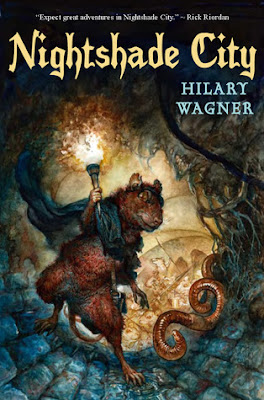
I should probably take a stab at a providing a summary of the book without giving too much away. Except one of the things I love about what Hilary does in Nightshade City is that she avoids scenes of direct exposition. Strange things are afoot at the Circle K, Esteemed Reader, so to speak. There’s something very odd going on in the catacombs where Hilary's rats live. Early in the book, we learn:
Ordinary rats lived for only a handful of years, four or five at most. Catacombs rats lived decades upon decades, just like Topsiders. The extended years were thought to be a gift from the Saints, but Vincent had sometimes wondered if they might be a curse. Why should one have to live so long surrounded by misery and constant disappointment?
Why indeed? I’m not going to tell you, Esteemed Reader. This question drives a part of the narrative, sort of like the question of “what’s the deal with that freaky island” drove the suspense of Lost. As the tale unfolds, we pick up clues about what may have happened to these rats who are so unlike rats anywhere else in the world. But at the start of the novel the reader is sort of like Charlton Heston landing on a strange planet not unlike earth, but inhabited by talking apes, struggling to figure out just what’s going on here.
What Hilary doesn’t do is to start the book with one or two dense chapters explaining the rats of the catacombs and their culture. Such a chapter would clear up some of the initial confusion the reader may have, but at the expense of boring us and right at the start when readers are most vulnerable to setting a book down and walking away forever. Instead, Hilary plunges us into the world of her rats and opens with a chase scene:
The Nightshades deftly took a sharp left, knocking an old toothless rat to the ground, his bag of candlenuts tossed into the air and scattered about the corridor. A lieutenant promptly stumbled over a nut, forcing the other soldier and Major Lithgo to skid violently through the dirt, landing atop one another in a muddled heap of tails, claws, and ears.
This is an exciting way to get us started and draws the reader right in, but with the question: “wait, was that rat carrying a bag of candlenuts? What sort of rats are these?” As the tale unfolds, we meet rats who act both like rats and like humans. They have jewelry, one of them drinks wine, and yet they are still rats living in the world of rats. Because there is no chapter explaining the rules, we have to learn them as we go. This is trickier to pull off than it sounds, but Hilary is up to the challenge.
Opening a story with a chase scene is pretty common, except that if a story opens with a chase between humans, the reader can quickly orient himself. One of the humans in a chase is Burt Reynolds laughing and flashing a crooked smile, which tells us he’s the handsome, likeable outlaw. The other human is Smokey, a fat southern sheriff in a police car, which tells us he has no patience for handsome outlaws and is probably a racist. Burt Reynolds is driving a special edition 1977 Trans Am, which tells us something about the time period we’re in, Smokey’s car tells us we’re in America, and we’re familiar with the concept of cops and robbers going in. It takes only seconds for the viewer of Smokey and the Bandit to understand the situation and to be drawn into the film.
That’s not quite the case in Nightshade City because the reader has no frame of reference. I can’t speak for you, Esteemed Reader, but I’ve never been in a lair of giant rats capable of human thought and speech. I was Heston on the Planet of the Apes. If a rat can carry candlenuts, can he carry a cell phone? Do some of the rats have guns? Do they have internet access? Do the rats live in nuclear families, or have they formed a Robert Heinlein nest where everyone loves everyone and they sit around grocking each other’s fullness?
Hilary never halts the story to lay down the rules, but we pick them up as the tale is spun. Perhaps I’ve spent too much time harping on this one detail in a 262 page novel filled with interesting details, but I just found this aspect fascinating. And the effect on the reader is at first disorientation. But after a few chapters as we learn about the characters and pick up those rules, the pages turn themselves and the reader finds himself fully immersed in a fantastic world and a fantastic tale not quite like any other I’ve ever read.
But seriously, Esteemed Reader, if you have trouble writing exposition in a manner that is not disruptive to the narrative, study Hilary Wagner’s novel. Because not only is she telling us about the world of the rats on the fly, she also has to tell us the history of the world of the rats to catch us up to the present action. We meet our heroes, Vincent and Victor Nightshade, in the middle of an epic saga that was begun long before they came along.
The quick, quick version: Once there was a kind and wise rat named Trilock, who ruled the catacombs and life was good. He had enemies, but they were banished outside of the major city. And then a great flood came, wiping out a large portion of the rat population, and during that time Trilock’s enemies murdered him and other good rats, including Vincent and Victor’s family. Flash forward several years and the catacombs are in bad shape under evil tyrant rulers who make life miserable for the other rats. Vincent and Victor flee the catacombs and meet up with some old school rebels who have formed a new home they name Nightshade City, in honor of our boys' father. But at some point, the reader knows that Vincent has to go after those bad rats who murdered his parents and the rebels have to, you know, rebel against tyranny.
What the deuce? I see we’re nearly out of time again this week and I have so much more to tell you. Well, I’ll limit myself to two more points and some sample passages from the text. I’m going to skip over the good guys, as likeable and well drawn as they are, so that I can tell you about the bad guys. Because for me, this book is all about the bad guys. In fact, and this is point one, the bad guys are so compelling and such a tremendous obstacle for our heroes to overcome, that they drive the story in a way that all the good guys in the world cannot. The bad guys make the Nightshade brothers and another heroic rat named Clover we don’t have time to discuss great simply by being so diametrically opposed to their goodness with their own extreme evil.
First off, there’s Killdeer, a nasty, drunken lout who: delegated most of his duties to Billycan, his second-in-command, which left the High Minister with nothing much to do but indulge his vices: eating, drinking, sleeping, and mating. Killdeer became the High Minister of the catacombs when: Enraged and humiliated by his banishment years before, Killdeer ambushed the Minister, assaulting the aging Trilok with primordial fury, slashing his jugular and tearing off his silver pendant, proclaiming himself the new High Minister.
This leads us directly to my second point. Did you happen to notice that there’s a character in a story being marketed to children who loses himself in sex and drunken debauchery, and is allowed to go around tearing out throats? How awesome is that? To be fair, the style of writing in Nightshade City is definitely intended to be upper middle grade to young adult, but old adults will enjoy it as well. Still, there is a wonderful freedom for writers working with anthropomorphic animals that is simply not available elsewhere (used "anthropomorphic animals" in a sentence!).
I want you to imagine a story in which hundreds of human families were drowned at the start and in which a human tyrant goes around “mating” and slashing people’s throats. Probably you can think of stories in which this has happened, but I bet those stories weren’t marketed to children. Yet somehow, the separation of these events occurring among human-like rats, but not actual humans, makes it okay.
And it does. I would encourage kids to read this book. They’re going to love it. Like the rabbits in Watership Down, Hilary’s rats allow for us to view the story of human civilization as an animal one. She can speak frankly about the darker nature of human society because of the separation of being once removed from humans by way of talking animals.
As nasty as Killdeer is, he’s a figurehead. The real star of the show is Billycan, one of my new favorite fictional characters. He is Dick Chaney to Killdeer’s George W. Bush, the true leader in the shadows plotting torture and corporate rule while hiding behind an obviously flawed leader who nabs all the headlines and distracts attention from what’s really going on. Let me seal both of my points with these passages that show us not only how ruthless Billycan is, but how much awesome violence Hilary gets away with (and in case you’re eating, I’ll leave out the passages in which Billycan disembowels a cat and rips out another rat's eye):
They claimed Billycan was possessed--supernatural even. The old ones told how he once drove a rat to stab himself, mesmerizing him with his eyes. The rat lived through the ordeal, claiming that Billycan's eyes glowed like galvanized rubies, two glass bulbs filled with a red vapory substance, commanding him to take his useless life.
Once, a desperate young rat tried to palm off a rotting pear as Stipend. Billycan chained him to a post in the center of Catacomb Hall, leaving him to die of hunger for all subjects to see. The boy's parents wailed as their son took his final breath.
And there I have to stop because we are way over our usual word count, Esteemed Reader. But if I haven’t emphasized it enough, you have to read this book. It’s a journey to another world that will suck you in, show you a great time, and might just teach you something about the nature of our world, talking rats or no. Make sure you come back on Thursday when Hilary Wagner will be here and on Saturday when we’ll have Amy Berkower with us.
I’ll leave you with a few choice descriptions from early in the book I really admired. There are a lot of excellent descriptions of fur throughout Nightshade City. In fact, I never would have guessed there were so many interesting descriptions of rat fur at a writer’s disposal. But the passages I’ve chosen describe feet. Enjoy:
The fire smoldered softly, infusing the room with a warm caramel glow, the ideal setting for a midday nap.
His legs draped over his silver throne like two dead gray rabbits.
Her tiny feet dangled above the ground like small fish flopping in distress.
STANDARD DISCLAIMER: Book of the Week is simply the best book I happened to read in a given week. There are likely other books as good or better that I just didn’t happen to read that week. Also, all reviews here will be written to highlight a book’s positive qualities. It is my policy that if I don’t have something nice to say online, I won’t say anything at all (usually). I’ll leave you to discover the negative qualities of each week’s book on your own.
This week’s book gives me an opportunity to discuss self publishing, a topic I’ve long wanted to address. It’s a tough old world for writers, Esteemed Reader. As I know many of you who read this blog are writers or publishing professionals, I’ll assume I’m preaching to the choir.
I don’t write “sour grapes” posts and I don’t mean to start now. The publishing industry is what it is. Much of what goes on there is out of writers' hands and I mean to keep this blog optimistic and focused on reading and writing books for young readers. There are many other fine blogs that detail the unfairness of the industry. I prefer to discuss the one thing we writers have control of: writing the best possible book we’re capable of, and that involves reading books by writers who are better than we are (thus, my book of the week reviews).
Still, the fact remains: it’s a tough old world for writers. Even the best writers among us have to deal with a steady barrage of rejection, be it from critics (not ninjas), be it from readers, or whomever. It’s especially frustrating for the unpublished writer who has written a whole book or twenty whole books and still the form rejection letters come in the mail from agents and editors. The unpublished writer only wants to share her story with the world and create art to be enjoyed by readers. Is that so wrong!?! And The Man keeps these writers down, or so it feels like sometimes.
What does a writer do after he’s written every agent and every publisher and still no one shows him some publication love? Assuming the writer has sought out a critique group and perhaps professional guidance (like the sort offered at conferences), and rewritten and rethought the book accordingly, it might be time to think about self publishing. It might also be time to think about writing a new novel, especially if it’s your first that’s been roundly rejected. There’s no shame in it. Plenty of writers have to plow through three, or twelve, or twenty practice novels to learn the writing craft.
But if you’ve paid your dues and you’ve crafted a truly excellent work that for some oddball reason is still being rejected, self publishing may be a viable option. Even writers published by large houses often have to do most or even all of their own publicity, whether they hire a publicist or send their books to bloggers like moi (always open for submissions). Why not publish your novel and keep all of the profit from your work? After all, John Grisham started as a self published author and it panned out pretty well for him.
Be advised, however, that there is a stigma against self published authors. Whether or not that’s fair is the subject of another post. But bookstores will be less willing to arrange signings for self published novels and even less willing to carry the book on their shelves since they’ll have to eat the full cost should it fail to sell. Given that a large number of readers now buy their books online, this is less of a concern than it used to be. But even online, a self published novel faces headwinds. Many bloggers, myself included, will probably not review your book if it’s self published and readers may hesitate to buy your book.
Having said all of that, if you are going to self publish, you should take a page out of Dr. Melissa Walker’s book (not her actual book, but you know what I mean). Sometimes I contact authors if I like the look of their book and ask for a copy to review. Sometimes they contact me (which makes me feel like a big shot). Dr. Walker’s publicist contacted me. The package I received contained not only the book, but a press release, a business card from the sales consultant, and a post card about the book. That’s more than publishers have sent me. It was a professional presentation and I was genuinely impressed.
Self publishing means that you have to do everything a publisher might otherwise do in addition to your responsibilities as writer. You’re essentially creating your own publishing house and that is just what Dr. Walker has done. The book doesn’t say it was self published. The publisher is Whale Tale Press, but their distributor is The Bookmasters Group (a press for those who wish to self publish), and the house’s only projects are A Place for Delta and its upcoming sequels. More, their website was designed by the book’s illustrator.
Aspiring self publishers take note: this level of attention to detail paid off. I read and enjoyed the book and only afterword did I realize it was self published. I bet Dr. Walker will more easily be able to arrange signings and school visits because she's created her own publishing house. And I hope she sells a lot of copies. She’s worked hard and she deserves it. Also worth noting is that Dr. Walker published the traditional method and is only now self publishing.
Listed on Whale Tales' site are a book designer, a consultant, a marketing manager, a publicist, and a marketing consultant. This isn’t some frustrated writer paying to publish her book at the last desperate moment. This is a genuine entrepreneur investing the startup capital to create a product comparable to what already exists in the marketplace. And that is essential to note about A Place for Delta to you would be self published authors out there. As self published books tend to be more expensive than those traditionally published, you have got to deliver a book that justifies the reader’s expense.
A Place for Delta has none of the hallmarks of the poorly self published novel. It’s a good looking book. It isn’t riddled with spelling or punctuation errors. It’s fully illustrated and well put together. If I picked the book up at the same time as a book from a major house, I would not be able to tell which of the two was self published. And there’s an entire section in the back of the book of educational information for readers looking to learn more about polar bears and environmental conservation. This tells me that Dr. Walker and/or her team have published A Place for Delta with an eye toward the educational market, taken steps to make the book appealing to that market, and I think it will be a success there.
And now, Esteemed Reader, I see that our time is almost up. This review is pushing my outmost limits of length and I haven’t even told you about the book. But those of you who read this blog regularly know that I use each week’s book as a springboard to discuss the lessons I take away from each title to improve my own writing. So that I don’t short change Dr. Walker completely, let me close by at least telling you what the book’s about:
Eleven-year-old Joseph Morse has received an email from his aunt Kate, who lives in Barrow, Alaska, inviting him to a research station to help take care of a polar bear cub named Delta. While there he makes friends with an Eskimo girl and uncovers a conspiracy that could threaten the life of Delta and others. There’s a mystery to solve and an adventure to be had. The book is clearly written from the perspective on an environmentalist with deep convictions and spans multiple generations to deliver an exciting story. It is also the 2010 International Best Book Award Winner for Children's Fiction. You should definitely check it out A Place for Delta, especially if you’re contemplating self publication.
STANDARD DISCLAIMER: Book of the Week is simply the best book I happened to read in a given week. There are likely other books as good or better that I just didn’t happen to read that week. Also, all reviews here will be written to highlight a book’s positive qualities. It is my policy that if I don’t have something nice to say online, I won’t say anything at all (usually). I’ll leave you to discover the negative qualities of each week’s book on your own.