I write middle-grade and young adult novels. I love beautifully written, colorful stories, which leave me still thinking about them the next day--a touch of creepy doesn't hurt either!
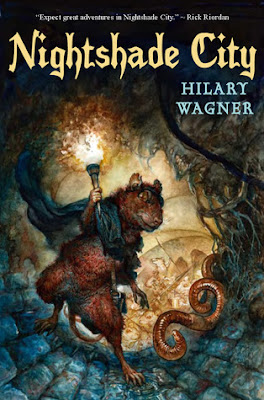
My first novel, NIGHTSHADE CITY, is out now! The second book in the NIGHTSHADE CHRONICLES, KINGS OF TRILLIUM, will release in October of 2011, both through Holiday House Books, who has been around since 1935!!!
I live in the chicagoland area with my husband, Eric, our two little sweeties, Vincent and Nomi, and our slightly neurotic Italian Greyhound, Louie. I make crazy (and I emphasize crazy) paintings too, which I show in and around Chicago and other cities! See my other side at Chicago PoP Art!
And now Hilary Wagner faces the 7 Questions:
Question Seven: What are your top three favorite books?
Wow, that's so hard to answer! I have so many favorites. I love THE WIND IN THE WILLOWS and WATERSHIP DOWN. For adult novels, I'd have to say WICKED was a great read. Okay, it's very weird that all these titles have W words in them...what gives? ;)
Question Six: How much time do you spend each week writing? Reading?
It depends. Sometimes I'll write for hours every single day. Other times, I'll take a week or so off, usually when a story is simmering in my head. I'll take random notes during that time, mentally weaving the story together and then--boom--I hit the keyboard full-bore! I squeeze in reading whenever I can, mostly late at night, before bed, curl up with a good book and all!
Question Five: What was the path that led you to publication?
I'm crazy and stubborn. Everyone tells you how hard the path to publication is and they're totally right! It is a harrowing road, but challenges keep me going and no matter how many times agents said it was not right for the current market or animal fantasy is a hard sell right now, I just kept telling myself I will get published! After 175 agent rejections, my wonderful agent, Marietta Zacker, said YES!!! After that, she sold NIGHTSHADE CITY in less than two months!
Question Four: Do you believe writers are born, taught or both? Which was true for you?
I think both! I do not have an English degree and have not taken any kind of writing courses. My degree is in Painting of all things! I always enjoyed English class though, so I suppose that helps! I know plenty of writers with Masters in English or Writing and they are simply brilliant, so it's hard to say if they were born to write or taught--maybe both! I think writing is more about developing a style you're comfortable with--one that goes deeper than the act of writing and reveals who you are. I think if you can figure that out, taught or self-taught, you may be onto something! I know I was born to write, because I can't seem to stop!
Question Three: What is your favorite thing about writing? What is your least favorite thing?
My most favorite thing is having that "light bulb" moment. I just love that! I actually had one last night with a new book I'm working on and now I know exactly what I need to do! My least favorite thing--waiting! I'm an incredibly impatient person. Writing takes a lot of time! I have to remind myself of that constantly...anything worth doing takes time, so chill out, Hilary!
Question Two: What one bit of wisdom would you impart to an aspiring writer? (feel free to include as many other bits of wisdom as you like)
Don't sweat the rejections or they'll just eat you alive! You can search on-line and find best-selling novels and world famous writers who were rejected time and time again--some, as many times as me! Just because you've racked up a lot of no's, doesn't mean you won't be getting a YES! Remember, it only takes one!
Question One: If you could have lunch with any writer, living or dead, who would it be? Why?
I would have lunch with Jonathan Barnes. He is an English adult writer--still kicking! He wrote THE SOMNAMBULIST and DOMINO MEN. I think he's a brilliant writer and possibly a little wonky in the head, so definitely someone I want to know! Maybe skip the lunch and head straight for the cocktails...that might be more fun! ;)
I should probably take a stab at a providing a summary of the book without giving too much away. Except one of the things I love about what Hilary does in Nightshade City is that she avoids scenes of direct exposition. Strange things are afoot at the Circle K, Esteemed Reader, so to speak. There’s something very odd going on in the catacombs where Hilary's rats live. Early in the book, we learn:
Ordinary rats lived for only a handful of years, four or five at most. Catacombs rats lived decades upon decades, just like Topsiders. The extended years were thought to be a gift from the Saints, but Vincent had sometimes wondered if they might be a curse. Why should one have to live so long surrounded by misery and constant disappointment?
Why indeed? I’m not going to tell you, Esteemed Reader. This question drives a part of the narrative, sort of like the question of “what’s the deal with that freaky island” drove the suspense of Lost. As the tale unfolds, we pick up clues about what may have happened to these rats who are so unlike rats anywhere else in the world. But at the start of the novel the reader is sort of like Charlton Heston landing on a strange planet not unlike earth, but inhabited by talking apes, struggling to figure out just what’s going on here.
What Hilary doesn’t do is to start the book with one or two dense chapters explaining the rats of the catacombs and their culture. Such a chapter would clear up some of the initial confusion the reader may have, but at the expense of boring us and right at the start when readers are most vulnerable to setting a book down and walking away forever. Instead, Hilary plunges us into the world of her rats and opens with a chase scene:
The Nightshades deftly took a sharp left, knocking an old toothless rat to the ground, his bag of candlenuts tossed into the air and scattered about the corridor. A lieutenant promptly stumbled over a nut, forcing the other soldier and Major Lithgo to skid violently through the dirt, landing atop one another in a muddled heap of tails, claws, and ears.
This is an exciting way to get us started and draws the reader right in, but with the question: “wait, was that rat carrying a bag of candlenuts? What sort of rats are these?” As the tale unfolds, we meet rats who act both like rats and like humans. They have jewelry, one of them drinks wine, and yet they are still rats living in the world of rats. Because there is no chapter explaining the rules, we have to learn them as we go. This is trickier to pull off than it sounds, but Hilary is up to the challenge.
Opening a story with a chase scene is pretty common, except that if a story opens with a chase between humans, the reader can quickly orient himself. One of the humans in a chase is Burt Reynolds laughing and flashing a crooked smile, which tells us he’s the handsome, likeable outlaw. The other human is Smokey, a fat southern sheriff in a police car, which tells us he has no patience for handsome outlaws and is probably a racist. Burt Reynolds is driving a special edition 1977 Trans Am, which tells us something about the time period we’re in, Smokey’s car tells us we’re in America, and we’re familiar with the concept of cops and robbers going in. It takes only seconds for the viewer of Smokey and the Bandit to understand the situation and to be drawn into the film.
That’s not quite the case in Nightshade City because the reader has no frame of reference. I can’t speak for you, Esteemed Reader, but I’ve never been in a lair of giant rats capable of human thought and speech. I was Heston on the Planet of the Apes. If a rat can carry candlenuts, can he carry a cell phone? Do some of the rats have guns? Do they have internet access? Do the rats live in nuclear families, or have they formed a Robert Heinlein nest where everyone loves everyone and they sit around grocking each other’s fullness?
Hilary never halts the story to lay down the rules, but we pick them up as the tale is spun. Perhaps I’ve spent too much time harping on this one detail in a 262 page novel filled with interesting details, but I just found this aspect fascinating. And the effect on the reader is at first disorientation. But after a few chapters as we learn about the characters and pick up those rules, the pages turn themselves and the reader finds himself fully immersed in a fantastic world and a fantastic tale not quite like any other I’ve ever read.
But seriously, Esteemed Reader, if you have trouble writing exposition in a manner that is not disruptive to the narrative, study Hilary Wagner’s novel. Because not only is she telling us about the world of the rats on the fly, she also has to tell us the history of the world of the rats to catch us up to the present action. We meet our heroes, Vincent and Victor Nightshade, in the middle of an epic saga that was begun long before they came along.
The quick, quick version: Once there was a kind and wise rat named Trilock, who ruled the catacombs and life was good. He had enemies, but they were banished outside of the major city. And then a great flood came, wiping out a large portion of the rat population, and during that time Trilock’s enemies murdered him and other good rats, including Vincent and Victor’s family. Flash forward several years and the catacombs are in bad shape under evil tyrant rulers who make life miserable for the other rats. Vincent and Victor flee the catacombs and meet up with some old school rebels who have formed a new home they name Nightshade City, in honor of our boys' father. But at some point, the reader knows that Vincent has to go after those bad rats who murdered his parents and the rebels have to, you know, rebel against tyranny.
What the deuce? I see we’re nearly out of time again this week and I have so much more to tell you. Well, I’ll limit myself to two more points and some sample passages from the text. I’m going to skip over the good guys, as likeable and well drawn as they are, so that I can tell you about the bad guys. Because for me, this book is all about the bad guys. In fact, and this is point one, the bad guys are so compelling and such a tremendous obstacle for our heroes to overcome, that they drive the story in a way that all the good guys in the world cannot. The bad guys make the Nightshade brothers and another heroic rat named Clover we don’t have time to discuss great simply by being so diametrically opposed to their goodness with their own extreme evil.
First off, there’s Killdeer, a nasty, drunken lout who: delegated most of his duties to Billycan, his second-in-command, which left the High Minister with nothing much to do but indulge his vices: eating, drinking, sleeping, and mating. Killdeer became the High Minister of the catacombs when: Enraged and humiliated by his banishment years before, Killdeer ambushed the Minister, assaulting the aging Trilok with primordial fury, slashing his jugular and tearing off his silver pendant, proclaiming himself the new High Minister.
This leads us directly to my second point. Did you happen to notice that there’s a character in a story being marketed to children who loses himself in sex and drunken debauchery, and is allowed to go around tearing out throats? How awesome is that? To be fair, the style of writing in Nightshade City is definitely intended to be upper middle grade to young adult, but old adults will enjoy it as well. Still, there is a wonderful freedom for writers working with anthropomorphic animals that is simply not available elsewhere (used "anthropomorphic animals" in a sentence!).
I want you to imagine a story in which hundreds of human families were drowned at the start and in which a human tyrant goes around “mating” and slashing people’s throats. Probably you can think of stories in which this has happened, but I bet those stories weren’t marketed to children. Yet somehow, the separation of these events occurring among human-like rats, but not actual humans, makes it okay.
And it does. I would encourage kids to read this book. They’re going to love it. Like the rabbits in Watership Down, Hilary’s rats allow for us to view the story of human civilization as an animal one. She can speak frankly about the darker nature of human society because of the separation of being once removed from humans by way of talking animals.
As nasty as Killdeer is, he’s a figurehead. The real star of the show is Billycan, one of my new favorite fictional characters. He is Dick Chaney to Killdeer’s George W. Bush, the true leader in the shadows plotting torture and corporate rule while hiding behind an obviously flawed leader who nabs all the headlines and distracts attention from what’s really going on. Let me seal both of my points with these passages that show us not only how ruthless Billycan is, but how much awesome violence Hilary gets away with (and in case you’re eating, I’ll leave out the passages in which Billycan disembowels a cat and rips out another rat's eye):
They claimed Billycan was possessed--supernatural even. The old ones told how he once drove a rat to stab himself, mesmerizing him with his eyes. The rat lived through the ordeal, claiming that Billycan's eyes glowed like galvanized rubies, two glass bulbs filled with a red vapory substance, commanding him to take his useless life.
Once, a desperate young rat tried to palm off a rotting pear as Stipend. Billycan chained him to a post in the center of Catacomb Hall, leaving him to die of hunger for all subjects to see. The boy's parents wailed as their son took his final breath.
And there I have to stop because we are way over our usual word count, Esteemed Reader. But if I haven’t emphasized it enough, you have to read this book. It’s a journey to another world that will suck you in, show you a great time, and might just teach you something about the nature of our world, talking rats or no. Make sure you come back on Thursday when Hilary Wagner will be here and on Saturday when we’ll have Amy Berkower with us.
I’ll leave you with a few choice descriptions from early in the book I really admired. There are a lot of excellent descriptions of fur throughout Nightshade City. In fact, I never would have guessed there were so many interesting descriptions of rat fur at a writer’s disposal. But the passages I’ve chosen describe feet. Enjoy:
The fire smoldered softly, infusing the room with a warm caramel glow, the ideal setting for a midday nap.
His legs draped over his silver throne like two dead gray rabbits.
Her tiny feet dangled above the ground like small fish flopping in distress.
STANDARD DISCLAIMER: Book of the Week is simply the best book I happened to read in a given week. There are likely other books as good or better that I just didn’t happen to read that week. Also, all reviews here will be written to highlight a book’s positive qualities. It is my policy that if I don’t have something nice to say online, I won’t say anything at all (usually). I’ll leave you to discover the negative qualities of each week’s book on your own.


 . Click here to read my review.