G. Neri is the 2011 Coretta Scott King Honor-winning author of Yummy,
and a two-time American Library Association Notable Book honoree. In
2010, he was the recipient of the Lee Bennett Hopkins/ International
Reading Association Promising Poet Award for Chess Rumble. He has been a
filmmaker, animator and new media producer and one of the founding
members of The Truth anti-smoking campaign for teens. He lives on the
Gulf coast of Florida with his wife and daughter and likes to troll for
alligators.
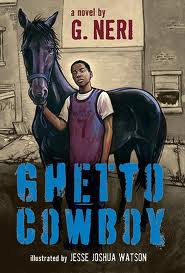
His other works include the middle grade novels Chess Rumble and Ghetto Cowboy, as well as the young adult novel, Surf Mules.
Click here to read my review of Ghetto Cowboy, which was a 2012 ALA Odyssey Honor winner and won the Horace Mann Upstanders Award.
Elizabeth Bird, a School Library Journal blogger, summed up Neri's
approach by saying, "Maybe part of the reason I like Greg Neri so much
is that he’s not afraid to be as “urban” as “urban” can be. He writes in
dialect, sets his stories in cities, talk about gangs and other
contemporary issues, and produces stories that no one else is telling.
That no one else is even attempting to tell. Because if there’s one thing Neri does well it’s tell a tale that needs to be told."
And now Greg Neri faces the 7 Questions:
Question Seven: What are your top three favorite books?
The Phantom Tollbooth by Norton Juster made me a reader. The Juggler of our
Lady by R.O. Blechman turned me onto the idea of making books, and that there's
a power and beauty in simplicity. And an adult novel, Ask the Dust by John
Fante made me a writer: the writing was stripped down, funny, raw and honest.
It blew my mind and made me think that I didn't have to be all high fallutin'
to write. Just keep it real.
Question Six: How much time do you spend each week writing? Reading?
Depends what I am working on and what phase it's in. If it’s a first draft, I
might write 2-6 pages a day. Either way, I am at my desk from 9-3pm, at least:
revising or researching or doing all the business side of writing.
Reading, I'll go on torrential tears and epic draughts. But I always have a
pile of at least 7 books waiting to be read. Mostly non-fiction and graphic
novels.
Question Five: What was the path that led you to publication?
So many paths. Early on, I did an animated film called A Picasso on the Beach
and when I stumbled upon Blechman's book, I thought, hey, this could be a book.
And on a whim I did it and showed it to a friend of a friend who had a small
imprint in California and he bought it. Unfortunately, it never came out. A bit
later, I started illustrating little books for my amusement and on a whim, I
wanted to see if I was good enough to get an illustration gig and a few weeks
later, I was hired by Scholastic to do an easy reader. But the real battle came
as a writer. I'd written a film script that became a Sundance Lab finalist but
I kept backing away from making it into a film because something wasn't right.
Turned out it was the wrong medium for the story. I came across a script a
friend wrote for a graphic novel and something clicked in my head that my story
should be a graphic novel. Everything fell into place and I was turned onto Lee
and Low Books through a friend that won their First Voice contest and boom,
they bought it. That was a book called YUMMY. Then my editor had a dream
project she'd always wanted to do about inner city chess and I thought to
myself: I can do that. If I can come up with an idea, she make it. And she did.
That became CHESS RUMBLE.
Question Four: Do you believe writers are born, taught or both? Which was true for you?
I believe people become writers. Yes, some dreamed of it since they were a kid
but for me, I didn't start writing for real till I was 40. I never dreamed of
being a writer or thought that it was something I could possibly do. I was a
story teller who had used film and painting and animation and photography to
tell stories. Books became a natural extension of that. The stories I wanted to
tell worked best in that medium. I had never written a novel or a graphic novel
or poetry. But that's what the stories demanded and I am in the service of my
stories, so that's what I did.
Question Three: What is your favorite thing about writing? What is your least favorite thing?
Favorite: when you're writing the first draft and things click and suddenly, it
comes pouring out and its easy and you're not even thinking about it, you're
just feeling it. You are the character and you are living the story without any
idea of what will happen next. You start dreaming about it and it starts coming
every time you sit down.
Least favorite: when I'm in the middle of something and I am interrupted by
travel. It may take me a week to get back into my groove and that's a major
drag. It's a constant battle.
Question Two: What one bit of wisdom would you impart to an aspiring writer? (feel free to include as many other bits of wisdom as you like)
Give yourself permission to write badly. First drafts are about getting everything
out of your head where they're all clumped together and messy, and out onto the
page where you can see what you have. It's like painting. You squeeze all the
colors out onto the palette and then you can see what you have to work with and
works and what doesn't. Almost every writer I know who is hugely successful
will tell me their first drafts are horrible. That's what we all share with the
great writers of our time: we can all be horrible too! But it's what they do
after that that makes them great. Writing is about rewriting. Join a
critique group, get feedback and listen to what your readers tell you. You need
fresh eyes.
Question One: If you could have lunch with any writer, living or dead, who would it be? Why?
I've been blessed with having met many of my contemporary favorites, so I'll
have to go with the old heads or the dead. I wouldn't mind hanging out with
those three writers in answer one. That would be a volatile mix and a dang good
time.