Showing posts with label Racism. Show all posts

Monday, November 10, 2014

An Afterword for BANNEKER BONES AND THE GIANT ROBOT BEES Part One: Let's Talk About Race (and get it over with)

The following is a three-part afterword for Banneker Bones and the Giant Robot Bees. You don't have to have read the book to read this first post (I'm saving heavy spoilers for parts 2 and 3). I'm mostly going to talk about the book, but I'm also going to talk about race.

Banneker Bones and the Giant Robot Bees isn't about race. In fact, the story goes out of its way to avoid the topic of race and I have no plans to address it in Banneker's future adventures (I'm well into writing part 2 now), though I have and will continue to address it in books outside of this series. The way I see it, by not addressing race in the Banneker Bones books, I'm making my biggest statement on the subject.

This book is about love. Honestly, as giant robot bees are a nightmare of mine from childhood, it's also about fear. But it's mostly about love:)

I can't tell you where most of my ideas come from--they just sort of come to me, usually when I'm thinking about something else. But I can tell you exactly where I was when I had the idea for this story: Seven years ago, I was driving on Indiana's most boring highway (it's nothing but cornfields and a creepy white church I inserted into my zombie tales) and talking with my future wife about an adult horror book I was no longer enjoying writing. I'd previously written some middle grade books and I'd very nearly had one of them published by a major house (back when there were more than five of them), which let me know I should probably write another. 

Most every middle grade book I read at that time was a knock off of Harry Potter: likable protagonist with surprising supernatural ability gets word that he/she has been invited to live someplace magical where hi-jinks ensue. Fair enough. This plot was old when J.K. Rowling got hold of it and it's likely to stay with us long after both she and I and all the other writers currently taking a shot at it are gone. Still, reading those books got me thinking. If an owl were to have brought me a letter when I was eleven, where would I most have wanted to have been invited?

I was also in my late twenties and a new candidate named Barack Obama looked like he had a shot at being President, which was good because I was a white man deeply and truly and forever in love with a black woman and looking for signs that our one day having a child in traditionally racist America wasn't a terrible idea. 

It was this line of thinking that led me to start poking around bookstores in search of books our child might one day read and I saw something that had always been true, I just hadn't ever really seen it: the section for books about black kids was sparse and depressing. There are several great books for children of all races written by authors of all races, but white kids have long had a lot more media available to them staring white kids. Growing up white in a small Indiana town, this had never struck me as unusual. I was white and so was almost everyone I knew. 

But looking at the kids bookshelves as an adult and future father of a half-black child, I didn't care for the looks of all those white kids on book covers as far as the eye could see. The one-shelf selection of books about black kids was mostly books about the civil rights movement and slavery, both of which are important, and both of which make for lousy leisure reading. Where were the books about black kids going to magic school, or riding a giant peach, or touring a chocolate factory? There were books about white kids having exciting adventures with their black friends, but that's not the same thing at all, and there were no books about biracial kids having adventures.

Obviously, there is no requirement that the character of a book be similar to the reader. I have enjoyed reading Watership Down numerous times despite not being a rabbit. One reason we read is to gain perspective from points of view unlike our own. Still, for there to be NO books whatsoever about biracial children in the largest bookstore in Indiana's largest city--it didn't sit well with me.

And so, getting back to that car ride with my future wife, I was complaining about this very thing and she told me it had always been that way for her. When she was a kid, her father read her Black History flashcards so she would know this country was not built by white people alone. And she always fantasized about one day writing a version of Encyclopedia Brown staring a black detective she'd named Banneker Jones, after the flashcard for Benjamin Banneker. 

I had two responses to that: 1. Great name, but Indiana Jones pretty well used up "Jones" for everyone, so his name should be Bones and his sidekick would be Skullworth, which struck me as a funny name. 2. Batman was the world's greatest detective:) 

And that pretty well got my wheels turning, because the answer to my previous question was: If an owl had brought me an invitation to go anywhere when I was eleven, I would've picked Gotham City. If that owl came today, I'd opt for a nice beach, but as a child I didn't know that red 'R' Robin wears on his chest may as well be a target and being Batman's sidekick has long been a fantasy of mine--not sure what it says about me that I imagined myself in that role and not the cape and cowl. 

For more than a year I sat on the story while working on something else, and little by little all the pieces fell into place. I would take the viewpoint of the sidekick, who like me, was a lonely white boy growing up in a small Indiana town trapped in a school he found less than interesting, and I'd make my dream come true for him. And the star of the show would be a biracial boy detective who in many ways is probably a more accurate version of myself at age eleven (my apologies to my poor parents).

And most important to me, the story would mention race just the once, and then drop it:

Ellicott wondered what it would be like to live in a family in which everyone was a different skin color. Most of the families in Brownsborough were all one skin color, including his. Now that he considered it, he supposed it was sort of boring that way.

I identify the race of each character, and then I tell the story of what happens to them. This isn't a book about slavery or civil rights or the racism so many have had to overcome and are still overcoming. Those books are available and should be read, but this book is for my son. So when he goes to find a book about a boy who looks like him, here's one that's just for fun. Banneker Bones rides a jet pack and has a robot butler and is too busy getting in adventures to worry about what it means to have a white father and a black mother or to care what other people might think of it. When it came time to do the book's cover, I asked artists Adam Smith and Steven Novak to make Banneker look like this guy:


I don't spend a great deal of my time worrying about what it means to be married to a black woman. It's not that "I don't see race." My wife has very nice skin and I like seeing it. Growing up black in Ronald Reagan's America has gone a long way to making her who she is, and that's the person I love most. But usually the only time the subject of our different races comes up is when some external person or situation brings it to our attention and then we remember, oh yeah, that's still a thing for some people.

Banneker Bones lives in a world that's moved past all that. He lives in the world I want for my son (but with fewer robot bees). And I'm pleased to say that the real world is slowly moving in that direction, even if it takes forever. Racism will never die, it will only multiply--it's too useful a tool of conformity and social control and we can't realistically divide all people permanently into shirts and skins. But I do think we're approaching a time of a browner, more unified America (it's all of us versus the 1%), and that angry racist buzzing you hear in the media is just old wasps who know winter is coming and their time is nearly done.

I've been reworking Banneker Bones and the Giant Robot Bees for half a decade now. Of all the books I've yet written, it's my favorite and the most important to me. It's the reason I started this blog and the reason I decided to publish independently. Many individual editors at traditional publishing houses were interested and no one could've fought harder for this book than my agent, Uwe Stender, but you try getting a book about a biracial boy past an editorial board, let alone one written by a white guy from Indiana.

The story of Ellicott Skullworth finding a home in Latimer City (I totally used those flashcards for names throughout the book) is the story of me falling in love and finding my own home. It's a love story for my wife and it's a book written with love for my son.

In the 2nd and 3rd parts of this afterword, I'll talk more about the plot of this book and the choices I made because regular Esteemed Readers like it when I talk about those things. Now that we've discussed race, let's please, please, please talk about something more interesting:)


Tuesday, July 8, 2014

Book Review: THE ACTUAL AND TRUTHFUL ADVENTURES OF BECKY THATCHER by Jessica Lawson

First Paragraph(s): My left leg twitched at the tickle of another night-boy. Hidden by the wide trunk of a river sycamore, I shifted in my crouch and reached a hand inside Jon’s overalls to trap and smack the creeping skitter. Darn things had been a considerable nuisance since I settled myself along the Mississippi to have a look-see at the grounded steamboat and its crew. 
The men had piled onshore and hauled sitting logs from the brush while I played at them being pirates and me being a stowaway. With the help of passed flasks and a roaring riverside fire, they’d gone from grumbling to mighty spirited in the last hour, and before long I got sucked in by a story one of them was reading from a tablet of writing paper. I was tolerably invested in the tale of a dimwit and his ornery bullwhip—the dimwit having whipped himself nearly to tears while the bull watched—and barely had time to react when the listener nearest me rose with a chuckle and a belch. 
While the crew applauded the story’s end, I deepened my crouch and slunk farther behind the tree, checking to make sure Jon’s marble sack was still stuffed into one of my hip pockets. 
The belching man stumbled around the fire with a happy laugh. “You mean to tell us,” he said, lurching at the storyteller, “that you put those words together in your own head?” 
 “That’s how writing generally works,” the story man said, standing and stretching. “Think up a few lies, put them to paper. I imagine any of you liars would make a fine writer." 

Esteemed Reader, I'm so excited to tell you about this week's book as it was written by an Esteemed Reader such as yourself and it's one of my new favorites. Jessica Lawson is a long time friend of the blog and a fan of the world's finest zombie fiction (mine, naturally). When I learned she had a book coming out, I was curious. When I found out it was a middle grade novel set in the world of Tom Sawyer, I absolutely had to read it.

I love Tom Sawyer almost as much as I love Huckleberry Finn and it's a wonder to me that a Becky Thatcher solo book wasn't already a thing. It's one of those ideas that's so clever you have to wonder why no one else has done it. I'd be hard pressed to think of a concept for a book more likely to appeal to agents, editors, teachers, librarians, and finally readers, than a new story set in Tom Sawyer's world. What I said to Mrs. Ninja when I first saw the book was "all Jessica has to do is write a story that doesn't suck, and she's golden."

Jessica Lawson has done a lot better than simply "not suck." Her writing is fiercely funny and written in the style of Mark Twain while making itself a bit more accessible to the younger readers of today. Does she have the same wit as the literary giant whose shadow is cast over all modern literature and who is remembered as a greater writer than even he could have possibly been? And that there question, which readers are bound to ask, is probably the reason why this book hasn't already been published. Comparisons between Jessica Lawson, debut novelist, and Mark Twain, literary god, are inevitable and just to make certain, her publisher has boxed her brand-new book with Twain's classics.


The marketing is a double-edged sword. It's a swell promotion opportunity for a new writer, but it puts her in the hot seat, not to mention her middle grade story for modern readers is set is Missouri 1860 when slave owning was still a thing (American prison statistics suggest it's still kind of a thing). This tells us that Jessica Lawson is either one of the bravest writers who ever lived or crazy. Well, she's not crazy. She is, however, extremely clever. 

That fellow above in the first few paragraphs of the book is a steam-boat pilot passing through by the name of Sam Clemens. No spoilers, but you long-time Mark Twain fans can be assured that Lawson pays homage where homage is due and includes a very fun plot device that declares her book not to be official cannon before anyone else can. By acknowledging within the story that she is clearly not Mark Twain and her book is its own separate thing, Jessica Lawson skirts around the comparisons and lowers the guard of feisty English majors everywhere.

As for slavery, Becky and her family have Miss Ada, a "colored woman" (alas, there are no n-bombs dropped) who lives with them and cooks their meals and is technically their slave, although the family is from the North and they don't think of her that way. She's with them of her own free will and genuinely cares for Becky, but there are dynamics to that situation wisely left unexplored. Miss Ada is a lot like Alice on The Brady Bunch, an unofficial member of the family. If there's anything that gives me pause about The Actual and Truthful Adventures of Becky Thatcher, which is a wonderful book, it's this white-washed fence of a portrayal of slavery as "not that bad." You long-time Esteemed Readers may recall I've taken a strong stance on this in the past.

If I wrote this book (why didn't I write this book!?!), I wouldn't be able to resist the temptation of writing about the harsh realities of slave owning (even a nice family from the North might change when moving to the south to discover they can own a person and more people if they like).

And it would be a mistake.

Slavery is a scene steal-er and you can't have just a little of it in your story without it taking over. How will modern readers sympathize with the Thatchers or any of the slave-owners in town if we think of them as true slave-owners? It would put a barrier between us and create a situation that the plot would have to address, drawing focus away from all else.

As I've said, Jessica Lawson is extremely clever. She doesn't deny the reality of slavery, she simply acknowledges it without wallowing or allowing it to become the main event. She does this primarily by limiting the perspective of the novel to Becky. Becky sees Miss Ada as a sort of surrogate mother, not property, and that makes us care for Becky, which is priority one. And besides, Becky Thatcher has plenty to deal with outside of slavery, such as the very real possibility that the Widow Douglas might just be a witch (love this passage):

Sid scowled plenty. “I reckon we’re not. See her red-tipped tools? Might as well be a devil’s pitchfork in that mix. She’s always outside with her crazy weeds and herbs.” He stared at me again, jutting his chin out for good measure. “Evil weeds and herbs. For her spells, I imagine.” 
I squinted at the herbs. One looked like  lavender to me. And I saw a bunch of mint for certain. Miss Ada says it spreads like gossip. But I knew it wasn’t polite to argue too much when a new friend is pointing out the town witch. Besides, those red-tipped tools were a dead giveaway. Everyone knew red was a devil color unless it was on clothes, strawberry jam, the American flag, or Christmas decorations.

I laughed all through The Actual and Truthful Adventures of Becky Thatcher. It's a fun story with a new take on familiar characters readers are going to love. Younger readers probably aren't going to care about the authorial acrobatics Jessica Lawson is performing. They're going to care that this a witty tale of fun similar to Tom Sawyer, while doing it's own thing.

Becky gains a new best friend in Amy Lawrence and the two give Huck and Tom a run for their money in the adventure having game. I'll let Ruth explain the particulars of their unique relationship:

Ruth ignored her and jabbed a finger toward the stream. “Why don’t you go sit with Amy Lawrence? Her daddy being the town drunk and your daddy being the town judge, you’re bound to run into each other soon enough.” She smiled sweetly, but her eyes stayed as mean as a trapped raccoon. “Oh, and her mama’s dead and I hear your brother’s dead, so you can talk about dead people too.”

For all the fun and excitement, this story has a lot of heart. Becky's brother Jon, who she sometimes called Huckleberry--which becomes important later--has died months before the start of our story. As if this weren't enough grief for one eleven-year-old girl, Becky's mother is severely depressed and has retreated to her bedroom full time, leaving Becky to fend for herself.

Becky has plenty of emotional baggage to unpack by the story's end, but she's also got a problem. Tom Sawyer is a no-good tattletale and needs to be dealt with. Oh, and there's the little matter of traveling criminals on the loose:

Straightening my posture so I looked good and grown-up, I stepped into Daddy’s home office to say goodbye. My eye caught on a poster sitting on his desk. Daddy was nowhere to be seen, so I let my shoulders drop and roll into a hunch while I leaned forward to read. 

WANTED: 2 PRITCHARDS (Billy and Forney) 
Wanted for train robbery, bank robbery, and possible murder. 
Description: Billy Pritchard~near 6 foot tall. Forney Pritchard~considerably shorter. 
Few teeth, longish dark hair, fondness for liquor and tobacco. 
Generally filthy.

Goodness me. I hope those Pritchard boys don't become an issue for Becky and Amy later on:) I'd tell you more, but this review is already too long, so I'll just say that any Mark Twain fan should snap up this book at once. If you're not a Mark Twain fan, you haven't read him, so read this book and then read his and you've got yourself a wonderful weekend ahead:)

Jessica Lawson has penned a truly impressive debut novel that brought me a lot of joy. I respect her as a writer whose considerable skill I can appreciate, but I also like her as a storyteller. The Actual and Truthful Adventures of Becky Thatcher is a great tale and something extra special readers don't come across that often, but always appreciate when they find.

As always, I'll leave you with some of my favorite passages from The Actual and Truthful Adventures of Becky Thatcher:

“Makes me think of John 8:32.” “Jon who?” “It’s a Bible verse, dear. John 8:32 says that the truth will set you free.” “Yes, ma’am,” I said, thinking two things. First, that instead of setting him free, the truth would most likely get Danny Boggs a whipping or scolding at home. Second, I guessed that my brother Jon and the Bible’s John probably wouldn’t be friends up in Heaven, having different opinions on what sorts of things made a person feel free.

His lips fell like someone who’d opened up a present and found a pile of cat poop.

That’s a beautiful and dangerous thing to have in a best friend, one that’s not inclined to lie. Daddy would probably plunk honesty in the category of being responsible and grown-up, but telling the plain truth didn’t suit my lifestyle much. I’d been gradually convincing Amy that most lies were right nice, because you were telling people what they wanted to hear, and what could be wrong with making people happy?

“Brought you half a pie,” I whispered back. “Miss Ada made extra.” Maybe it would cheer her daddy up. I heard that misery loves company, but I suspected it would get along with pie, too. Also, I figured Amy was an inexperienced mischief-maker, and it didn’t hurt to balance the idea of bad-doing with a reward of something good-tasting.

STANDARD DISCLAIMER: All reviews here will be written to highlight a book’s positive qualities. It is my policy that if I don’t have something nice to say online, I won’t say anything at all (usually). I’ll leave you to discover the negative qualities of each week’s book on your own. 

Thursday, April 18, 2013

NINJA BOOK CLUB: Chapter 9 THE DARK MARK

First Paragraph(s): Don’t tell your mother you’ve been gambling,” Mr. Weasley implored Fred and George as they all made their way slowly down the purple-carpeted stairs. 
“Don’t worry, Dad,” said Fred gleefully, “we’ve got big plans for this money. We don’t want it confiscated.” 
Mr. Weasley looked for a moment as though he was going to ask what these big plans were, but seemed to decide, upon reflection, that he didn’t want to know.


Hi there, Esteemed Reader. Have you seen the new Man of Steel trailer? It's pretty much my favorite thing in the world right now and I can't stop watching it. I'm putting it at the bottom of this post just in case you haven't seen it and also so I have a handy place to re-watch it. What's it have to do with Harry Potter? Nothing. I don't care how big this blog gets, I'm still going to be me, and that's a class-three dork:)

I've often read The Dark Mark is the chapter Rowling spent the most time revising. As I, alas, am not J.K. Rowling's critique partner, I couldn't tell you for sure.  I'd love to read her earlier drafts to see what didn't make the cut (and to assure me there were rough drafts and Rowling didn't simply take divine dictation). 

Something's amiss here in Chapter 9. See how Rowling builds suspense without actually revealing what's happening for another page or so:

Harry never knew whether or not he had actually dropped off to sleep — his fantasies of flying like Krum might well have slipped into actual dreams — all he knew was that, quite suddenly, Mr. Weasley was shouting. 
“Get up! Ron — Harry — come on now, get up, this is urgent!” 
Harry sat up quickly and the top of his head hit canvas. 
“’S’ matter?” he said. 
Dimly, he could tell that something was wrong. The noises in the campsite had changed. The singing had stopped. He could hear screams, and the sound of people running. He slipped down from the bunk and reached for his clothes, but Mr. Weasley, who had pulled on his jeans over his own pajamas, said, “No time, Harry — just grab a jacket and get outside — quickly!”

Rowling could've simply started the chapter with Harry running outside and beholding the wicked wizards up to terrible mischief. But where's the fun in that? If a girl wants to kiss a boy, she can grab his neck and plant one on him and that will accomplish the goal. But if she wants him to be more likely to kiss back, she should take him to dinner and talk with him and build rapport, count the smiles in their conversation, then lean in slow for the kiss. 

Rowling could've opened with the Death Eaters marching through the campground and causing a ruckus. A lesser writer would've, but Rowling knows how to build suspense. Death Eaters operating in the middle of the night makes sense as there's more than a little Klansmen about them. Also, having Harry wake up in the middle of the night, the ruckus having already started, puts him in a vulnerable position the reader has likely been in at one point or another--or maybe you've never awoken to something big going on around you. 

As Harry hears the sounds outside--and also, in the case of the singing, doesn't hear the sounds outside--he begins to worry and so does the reader. Harry worries because of the reactions of the other characters and so does the reader. By the time Harry goes outside he's nervous about what he's going to see and so is the reader. Rowling has got us ready to be kissed before she kisses us:)

Worth noting in the passage above is Harry sits up, paragraph break, he asks "S'matter?", paragraph break, and then he hears the noises outside. All three of these actions could've happened in the same paragraph, but Rowling breaks them up and I believe she does it to create more white space. 

I've written at length about this elsewhere, but I love white space and nothing punches up the page like shorter sentences that can be read faster, thusly turning pages faster. Also, having a just-woke-up Harry say "S'matter?" as opposed to the more correct, but less true-to-the-character "What is the matter?" further convinces the reader Harry really did just awaken.

As for the racists in masks, Rowling makes their threat clear by endangering one of the reader's favorite characters:

Ron told Malfoy to do something that Harry knew he would never have dared say in front of Mrs. Weasley.
“Language, Weasley,” said Malfoy, his pale eyes glittering. “Hadn’t you better be hurrying along, now? You wouldn’t like her spotted, would you?” 
He nodded at Hermione, and at the same moment, a blast like a bomb sounded from the campsite, and a flash of green light momentarily lit the trees around them. 
“What’s that supposed to mean?” said Hermione defiantly. 
“Granger, they’re after Muggles,” said Malfoy. “D’you want to be showing off your knickers in midair? Because if you do, hang around . . . they’re moving this way, and it would give us all a laugh.” 
“Hermione’s a witch,” Harry snarled. 
“Have it your own way, Potter,” said Malfoy, grinning maliciously. “If you think they can’t spot a Mudblood, stay where you are.” 
“You watch your mouth!” shouted Ron. Everybody present knew that “Mudblood” was a very offensive term for a witch or wizard of Muggle parentage.

I love that Rowling has Ron and Harry swear and have lustful thoughts for girls, both appropriate things for boys their age, while keeping this book mostly MG friendly. It would be nice if kids disciplined themselves to read one Harry Potter book a year so that they would be old enough by the time they got to Book 7 for Rowling to unleash the full YA on them. But kid readers, like adult readers, will surely be unable to stop after just one Potter. 

In fact, one of the things I most admire about the Harry Potter series is that as soon as Rowling realized she had the attention of readers, she didn't squander it. She never quite halts the story completely to discuss larger real-world issues like slavery and racism, which, unfortunately, people still need reminding are bad (dude, seriously?). At no point do slavery and racism become the focus of the story, but Rowling makes sure she has her say on both these issues:

“You know, house-elves get a very raw deal!” said Hermione indignantly. “It’s slavery, that’s what it is! That Mr. Crouch made her go up to the top of the stadium, and she was terrified, and he’s got her bewitched so she can’t even run when they start trampling tents! Why doesn’t anyone do something about it?” 
“Well, the elves are happy, aren’t they?” Ron said. “You heard old Winky back at the match . . . ‘House-elves is not supposed to have fun’ . . . that’s what she likes, being bossed around. . . .” 
“It’s people like you, Ron,” Hermione began hotly, “who prop up rotten and unjust systems, just because they’re too lazy to —”

I've always suspected Rowling likes Hermione best. I'm certain Hermione Granger is very different than the actual younger J.K. Rowling, but they likely share the same DNA. But even if that weren't true, Hermione does come in handy when Rowling wants the reader to know something, be that thematic, as in the passage above, or more practical:

“Beauxbatons,” muttered Hermione. 
“Sorry?” said Harry. 
“They must go to Beauxbatons,” said Hermione. “You know . . . Beauxbatons Academy of Magic . . . I read about it in An Appraisal of Magical Education in Europe.” 
“Oh . . . yeah . . . right,” said Harry.

And that's going to do it, Esteemed Reader. I should maybe spend some time discussing Winky the house-elf being caught with Harry's wand after it's been used to conjure the dark mark in the sky--the batsignal for evil:) But the truth is I've always found that section belabored. 

Yes, it's important to implicate Barty Crouch in the reader's mind for what's coming later, but Mr. Crouch isn't interesting or likable  Also, although having Winky the house-elf involved seems a stretch as there's no practical need for her by the true culprit behind the dark mark. The only reason Winky's present is so Hermione can rail against the mistreatment of house-elves, and it feels forced. 

Harry Potter and the Goblet of Fire is still a better book than any I'll ever write, which is why we'll back next week to discuss Chapter 10. Don't forget to check out that sweet Man of Steel trailer on your way out, Esteemed Reader:)


Last Paragraph: He thought of the letter he had written to Sirius before leaving Privet Drive. Would Sirius have gotten it yet? When would he reply? Harry lay looking up at the canvas, but no flying fantasies came to him now to ease him to sleep, and it was a long time after Charlie’s snores filled the tent that Harry finally dozed off.


Tuesday, March 19, 2013

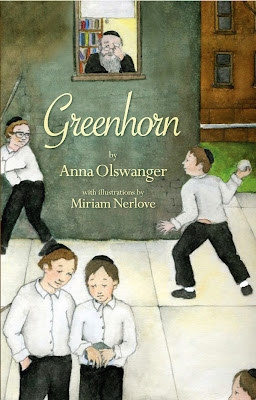
Book Review: GREENHORN by Anna Olswanger

http://www.amazon.com/gp/product/B00AG5MU8O/ref=as_li_tf_tl?ie=UTF8&camp=211189&creative=373489&creativeASIN=B00AG5MU8O&link_code=as3&tag=midgranin-20
First Paragraph: “I don’t know what’s so important the rebbe couldn't let us finish the inning,” Ruben whispered to his brother Bernie. “Now the fifth grade’s playing stickball in our part of the yard.”

Anna Olswanger will be here Thursday to face the 7 Questions.

This is going to be a difficult review, Esteemed Reader. I've been staring at the screen now for more than ten minutes, uncertain how to begin. I've just read Greenhorn for a second time and I'm devastated. I didn't cry, but I have no doubt many readers will. 

Originally, I wrote Anna Olswanger in hopes of having her be one of our weekly literary agents. Alas, she's taking on few new clients. But it turns out she doesn't just represent authors, she is one. I don't know what kind of agent she is, but Anna Olswanger is an incredibly gifted author. Agent authors have become authors to watch for me as I admired Mitchell's License by Holly McGhee and Girl Parts by John Cusick (review coming soon).

Greenhorn is a middle grade novel set in a Jewish school in Brooklyn, 1946. And this happens:

Rabbi Ehrlich cleared his throat. “We have twenty boys coming to us from Poland—” he began, then wiped his eyes again. “Their parents died in concentration camps.”
For a moment, everybody kept quiet. Then Irving, the guy in the back row, raised his hand. “My mama’s afraid our cousins back in Poland got sent to a concentration camp. So how come they’re called camps, Rebbe? Camp is where kids are supposed to spend the summer eating chocolate pudding dessert.”

The preceding paragraph is on page two so if you're a parent who somehow began reading this book aloud to your too-young child without investigating the book beforehand, you still have a chance to turn back. If a librarian or book store employee is reading this book to a group, you can quietly excuse your four-year-old. Olswanger is firing a warning shot across the nose and it's good that she does as there are some grizzly aspects to this story (by virtue of history):

“My p-p-papa told me about how the Nazis killed the Jews in concentration camps. He said the Nazis were evil p-p-people. He said they were so evil they experimented with cutting the ff-fat from dead people’s bodies to make soap.”

The Ninja is not a yet a parent, but I am a fun uncle, and I can't imagine telling my nieces and nephews about the holocaust. Let their parents do it!!! But someone needs to. Part of raising and educating a child is telling them how the world is and isn't. To not tell a child about slavery, the trail of tears, Hiroshima, and Nagasaki, and all the other terrible tales of our history is to not prepare them for the world they've been brought into. And if you're raising Americans, make sure they know the Nazis were not history's only society of racist, murderous fiends.

Greenhorn is the perfect tool for parents and educators to introduce younger children to the holocaust. Waiting for a child to reach adolescence and then giving them Eli Wiesel's Night is throwing them in the deep end of the pool. Giving children Greenhorn at an earlier age allows them to dip their feet and not get completely sucked under.

Greenhorn is set in Brooklyn at a yeshiva, after all, and removed from the worst events of the period.  Our narrator is Aaron, who has big dreams not involving the holocaust:


"See, I want to be a r-r-rabbi like my papa when I grow up. Ruben and Bernie and all the guys would laugh if they knew. How does a guy who s-s-stutters get to be a rabbi?”

Meet Daniel, Aaron's new friend and newly orphaned immigrant from Poland. He's got secrets, most prominently a small, tin mystery box:


Ruben said, “me and Bernie and the guys are starting to wonder if you got loose marbles or something. It’s okay for our little sister to go around holding a blanket because she’s only three years old, but what’s with you? How come you can’t let that box out of your sight?”

Greenhorn is a short book and you'll finish it in half an hour. I'm not going to tell you what's in Daniel's mystery box or whether or not Aaron learns to control his stutter. Olswanger's is a quick jab, designed to knock the wind out of you, and then to be read again for full understanding. 

This concludes my review: Greenhorn is a powerful book that should be in libraries everywhere. It's a great tool for teachers and parents.

I have two points I want to make for writers and then we'll call it a day. First, although Greenhorn is a short book, it's not a trite book. I'm not going to tell you the contents of Daniel's box, but knowing the subject of this story, you can likely infer whatever's inside is the result of awful. And it is. The contents of the box hit the reader between eyes (and I was already flinching), and are gruesome enough to be honest about the Holocaust. That's crucial.

Second, it is not enough for Olswanger to write "the holocaust was bad." Of course it was. This isn't a history, it's a story. As such, there are characters with goals and a mystery to draw the reader in, followed by a satisfying conclusion. The reason Greenhorn works is because it's a story first, Holocaust memorial second.  And because it's a story, Olswanger can end it on an upbeat note as not to leave younger readers totally depressed. 

I'll leave you with some of my favorite passages from Greenhorn:


"You think you’re going on the Quiz Kids Show for knowing all there is to know about synagogues? Talk about something else, Gravel Mouth.”


Ruben’s and Bernie’s eyes popped open like the tops of soda bottles.


First, Bernie and Ruben started to snore like trains pulling out from Marcy Avenue. Then Daniel made a rustling sound that meant he was sliding his tin box under his pillow.


STANDARD DISCLAIMER: All reviews here will be written to highlight a book’s positive qualities. It is my policy that if I don’t have something nice to say online, I won’t say anything at all (usually). I’ll leave you to discover the negative qualities of each week’s book on your own. 


Tuesday, February 5, 2013

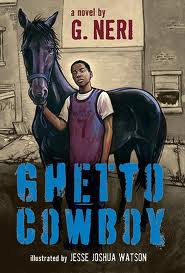
Book Review: GHETTO COWBOY by G. Neri


http://www.amazon.com/gp/product/B005CJAGB2/ref=as_li_tf_tl?ie=UTF8&camp=211189&creative=373489&creativeASIN=B005CJAGB2&link_code=as3&tag=midgranin-20
First Paragraph:We drivin’ into the sunset, the car burning up from the heat. I don’t know if it’s comin’ from outside or from Mama, who’s burning up angry at me. She ain’t said nothin’ to me since we left the principal’s office ’bout a hour ago. But she got her foot pressed on the gas like we in a race, zoomin’ past everyone on the expressway.

G. Neri will be here Thursday to face the 7 Questions.

God, I love this book! I know, I love all the books, Esteemed Reader, and next week I'll be telling you about another book I love. But I really, REALLY love this book. I love it so much I'm going to buy a copy for my nieces and nephews for Christmas (I'm the Uncle who buys books instead of toys and I regret nothing). I'm going to buy it for my white nephew and my black nephew and I'll bet they both love it as much as I do because a great story well told transcends race.

A brief aside: growing up white, I never noticed most the heroes in the books I read were white like me. Why wouldn't they be? But as an adult Ninja married to a black woman and planning a family, I've been combing books with a different mindset. What books will my kids read? Where are the books staring dark-skinned boys who go to wizarding school and tour chocolate factories? 

But here, Esteemed Reader, is G. Neri and his new classic, Ghetto Cowboy. It's a gripping read for readers of any age, and if you're a writer working on your voice, Ghetto Cowboy is a book you definitely want to read as G. Neri is all about nailing the voice of his protagonist  Witness how he writes Cole (short for Coltrane, naturally) as a genuine character who says the things Cole would say the way he would say them (but without all the swearing I imagine he might include if this were YA instead of MG):


I don’t know why I stopped going to school. I guess I didn't wanna waste no more time with teachers and homework and all a that, ’cause what difference do it make in the end? I’ll never do nothing great in my life. Do they really think I’m gonna be like Obama? Not a chance. I just feel sorry for Mama for thinking that I could be somebody. 

Writing in dialect is tricky, but so far as I can see Neri nails it. I'm not sure I can speak to authenticity. Having grown up in a small, all-white Indiana town where some folks to this day wear mullets, the Ninja is exactly as streetwise as you might imagine (best I stick to towns). But I believed in Cole as a character and I felt it was him, not Neri, speaking to me.  

Some might argue that the prose in a middle grade novel should be correct, regardless of subject or character, as it's being read by impressionable young minds. Bah! I say. Impressionable young minds want a good story well told, and "a couple of" is not the same as "coupla." Cole wouldn't say the first version and the if he did, he'd cease to be Cole. Readers, especially younger readers, would pick up on the lie. Neri wouldn't lose them all, but he'd lose some. 

Our 12-year-old hero is headed for trouble. His Mama is at her wits end. And desperate times call for desperate measures, which is why the novel opens with Mama driving Cole straight to Philadelphia where he'll live with his dad, whom he's never met, and learn a little something about caring for horses and what it means to be a cowboy. 

I'm relieved to be reviewing my first "boy and his horse" story after reading so, so many "girl and her horse" stories. In the coming weeks, I'll be reviewing my first "girl and her horse in the apocalypse" story:) Stay tuned.

By the way, this is the best and greatest description of riding a horse for the first time I have ever read or will ever read as it immediately put an image in my mind I knew to be true:

It feels like I’m sitting on one of them giant walking machines in Star Wars.

So does Cole make up with his estranged father, learn the cowboy way, and start on the path to a brighter future? Esteemed Reader, I'm not going to tell you that! You'll have to read the book. So that's where we'll leave it. Ghetto Cowboy is a wonderful book destined to make a certain kind of white adult very nervous, and I like that about it. 

Few things have made me laugh harder than watching uncomfortable white folks watching Mrs. Ninja and I during a screening of Django Unchained, because there are whole stretches of history they'd just as soon forget. But G. Neri isn't going to let them forget:

I swallow my food. “Look, you guys might think y’all is cowboys, but all I know is, real cowboys is white.”

The old man shakes his head, like I’m a fool. “Son, don’t you know black cowboys is a tradition that goes back to before the Civil War?” 

“Whatever,” I say. 

He looks disappointed. “Not whatever, man. The word cowboy started as a black word. Wear it proudly.” 

“So how come I never seen any black cowboys on TV then?” 

He waves his hand. “TV. Humph. Can’t trust the media to tell the truth. The truth is, the white man always gets his way. Looky here. . . .” 

He pulls out a book from a dusty shelf. It got pictures and drawings from a long time ago. He shows me some old black-and-white pictures of black dudes dressed in homemade clothes doing cowboy stuff — roping, riding, and cleaning horses. 

“Back in the slave days, the slave who worked in the house was called a houseboy, slaves who worked with the cows was called cowboys. Get it?” 

No, but he just getting started. He points to a picture of a black cowboy riding a horse out in the wild. He got one of them cowboy rope things whirling in the air like he about to catch some bull. “That’s Bill Pickett, son of a slave and the most famous black cowboy of all. Back then, there was almost nine thousand black cowboys out West, working cattle and driving ’em up the Chisholm Trail and such. And these cowboys was so good that eventually, the whites took the name cowboy for themselves. Stole it, really. Now we’re just trying to take it back, is all.”

Ghetto Cowboy should be in every school and library in the country. If America is ever to move past racism, it's important to keep a dialogue going that acknowledges our nation's true history. It's just as important for all children to remember our history and Neri is keeping that dialogue moving.

That's one reason why I'm so glad to have posted this review at the beginning of February. This is the perfect month to share history with the children in your life (just watching Lincoln doesn't count). Here's a good place to get started.

More than being a history lesson, Ghetto Cowboy is a book about a universal truth: boys need fathers, if they can be got, and fathers need boys to need them. It's a good story, well told, and it's one refreshingly not quite like anything else I've read. Do yourself a favor, Esteemed Reader, pick up this book.

As always, I'll leave you with some of my favorite passages from Ghetto Cowboy:

Kids can be happy ’cause they don’t know better, but when you get older, well, you just know it’s all a big lie. 

These houses is tall and skinny — only one room wide. But that’s just it, there’s one room — his room, which got a bed, a bathroom, and a closet. I look in the closet and see he pulled stuff outta it and put a blanket on the floor. Uh . . . no. I ain’t no Harry Potter. And I ain’t living in no closet. I got to think.

We head away from the court, passing over the expressway. Smush tells me they built that thing so white folks could drive right over the neighborhood without stopping.

He goes over to a record player sitting on a wood box, digs through a pile a records, and pulls one out. They look like giant black CDs.

I ask Harp about that, and he says every rider tries to make his horse special, kinda like trickin’ out a car. I look at Boo, and he ain’t got nothin’. Then I remember Mama’s bracelet in my pocket. I ask this kid CJ if he knows how to tie a knot. He nods, and I give him the bracelet. He ties it onto Boo’s hair and smiles. Bling.

STANDARD DISCLAIMER: All reviews here will be written to highlight a book’s positive qualities. It is my policy that if I don’t have something nice to say online, I won’t say anything at all (usually). I’ll leave you to discover the negative qualities of each week’s book on your own. 
 

Thursday, September 15, 2011

Book of the Week: MY BROTHER'S SHADOW by Monika Schröder

http://www.amazon.com/gp/product/B004XHZ2LI/ref=as_li_tf_tl?ie=UTF8&camp=211189&creative=373489&creativeASIN=B004XHZ2LI&link_code=as3&tag=midgranin-20
Monika Schröder knows who she is and what kind of story she’s telling in My Brother’s Shadow. The book won’t be for everyone, and that’s not a put down by any means. I absolutely loved this book and I have no doubt most readers will love it as well. More, I loved Saraswatti’s Way and was looking forward to see if this book would live up to Schröder's last. It absolutely does and Schröder can be proud that not only has she written one amazing book that everyone should read, now she’s written two.

All this reminds me, there won’t be a writer interview this week. Monika Schröder has already been kind enough to face the 7 Questions and you can read her interview anytime you like. There will, of course, be a literary agent interview on Saturday.

My Brother’s Shadow is historical fiction set in Germany in 1918 during the First World War. First World War, I hear you asking. Does that mean there won’t be any Nazis? Of course, there’s a great deal more to the history of Germany than the Nazi party, but you can’t convince Hollywood of that. And it is my sad duty to inform you that in My Brother’s Shadow, although the groundwork is being laid for Nazis, there are no actual Nazis.

There are some spoiled American children who are never going to read a story about people in another country that happened before they were born (why this should matter to American children, I have no idea, but it does seem to). My Brother’s Shadow is a YA book rather than a middle grade, but I have no doubt some children under 12 would enjoy this story and there’s nothing so very adult to prevent them from reading it. But I’m talking about the children willing to read any historical fiction in the first place, let alone a book about German Nazi-less history set during the First World War.

By its very nature, My Brother’s Shadow has ruled out readers. Almost every book does this to some degree. The Left Behind books were probably never going to be read by Christopher Hitchens and so on. Monika Schröder doesn’t care. She has a story to tell and she’s telling it. If you’re smart, you’ll pick up a copy and enjoy it. I certainly did.

Moritz Schmidt is our sixteen-year-old hero caught between two worlds: the repressive regime's traditional order and the coming democratic revolution. His brother Hans is a soldier and he’s hardcore:

It reminds me of Papa, who died at Verdun two years ago. At first his letters are proudly described the devastating impact of the German flamethrowers on the enemy’s morale, but as the battle dragged on he openly expressed his despair. When my mother read one of those sad letters to us my older brother, Hans, turned red in the face and yelled, “Maybe we should send him a nerve tonic to build up his strength if he is such a weakling.” Hans can get angry like that.

Moritz’s mother and sister and new Jewish girlfriend are revolutionaries. Poor Moritz is torn between them and comes to symbolize Germany as a whole—clinging to a revered past for which so much has been sacrificed and yearning for a new future in which democratic prosperity and Jewish girlfriends will be cool with everyone (I don’t have the heart to tell him he might be in for a bit of a wait).

And then there’s Hans, who loses an eye and half an arm in a gas explosion and is badly disfigured. With his rhetoric and his appearance, Hans reminded me a bit of Anakin Skywalker toward the end of Revenge of the Sith. And why not? In both cases, a dark empire is coming and we can see it forming in the horizon.

But for all that, My Brother’s Shadow is not about Hans or the likeminded that are going to bring about nasty business for a time. This is a book about Moritz and the German spirit and how it will triumph, even in the face of dark times. After all, American people as a whole are basically good, even as we move from one dark part of our history to the next. Does it not follow that this is also true in other countries?

Through different plot contraptions, Moritz is brought into contact with different characters in multiple locations representing multiple viewpoints, all of which contribute to Moritz’s new view of himself and the reader’s understanding of Germany’s coming revolution.

I found each encounter fascinating and Schröder has a gift for making me feel as though I’m there, witnessing each event first-hand. And every adventure Moritz has broadens our knowledge of the time and place and society by delivering important exposition as well as revealing national motivations, as during this robbery scene:

“Look at this. The order of the Crown Cross, Third Class with Swords.” I hold up the metal cross on a blue riboon. “And here is a medal commemorating Kaiser Wilhem I’s hundredth birthday.”


“I’m sure the man of the house is a hero,” Robert says. “Let’s go!”


“Didn’t these people have to give up all their metal to support the war like the rest of us,” I ask. Plants are lined up next to the radiator, each of them growing out of a brass pot. My mind shifts to the time when we brought Mama’s copper pan and water kettle to the resource collection agency. Oma and Mama had even exchanged their wedding rings for thin iron rings and a certificate that praised them for giving “gold for iron.”


“The rich don’t have to give up anything!” Otto snorts. “Wait until you see their pantyr!”


We reach the kitchen at the end of a long hallway. The pantry is filled with sacks of flour, sugar, and lentils. Canned fruits and dried sausages are lined up on a shelf.


“How did they get all this?” I ask. Robert is already chewing on a piece of cheese he has taken from an earthen container.


“Don’t you know that the rich are not suffering? They have connections and money. And they look out for their own,” Otto says.

Schröder also has a knack for cliffhanger chapter endings, such as:

“Then we have this.” Aunt Martha gets up and opens the top drawer of her sideboard. When she turns around she is holding a revolver. The expression on her face shows me that she is determined to use it.


Early on in the book is one of the best cliffhanger chapter endings I've ever read. We’ve learned Moritz supports the government and the old regime as does his companion, or so we’re told. Moritz wants to be a reporter and he jumps at the chance to follow Herr Goldmann to a protest rally to cover it for the paper. That’s when Schröder hits us with this chapter ending:

“This woman has guts,” Herr Goldmann says approvingly. He scribbles something on his notepad. I don’t respond. I can’t tell Herr Goldmann that the woman is my mother. (dum, dum, dum! – MGN)

I’ve got more to say, but that’s where we’re going to have to leave it, Esteemed Reader. I’ve got to post this thing and get to my day job. Be sure to come back on Saturday and next week when M.P. Kozlowsky will be joining us. As always, I’m going to leave you with some of my favorite passages from My Brother’s Shadow as well as an inspirational video to remind you to tell your story with gusto and show the world who you are:

It’s already September, but late summer’s humid heat has returned; it clings to me like a hot, wet towel…
“Or what they call bread, nowadays,” Mama says. Before she sits down at the table she rolls up the sleeves of her blouse. The skin on her hands and arms is tinted yellow from the acid in the ammunition factory.
Mama smiles and lets her arms fall against her skirt. “You are too old for a hug, aren’t you, now?”
I don’t feel too old for anything. For a moment, I want to throw myself onto the floor and pound my fists against the carpet until Mama sits down at the sewing machine. But instead I watch her walk into the kitchen, where she opens the lid over the stove to stoke the fire. When I turn toward the sewing machine I see my own reflection in the windowpane, the reflection of a boy who should have known better.
Hedwig and Mama quickly set the supper table, and when we sit down Hans ravishes the food like a famished animal. I can tell that Mama and Hedwig take less to make sure there is enough for him. Mama asks about the food he ate during the war and Hans thanks her for the packages, describes stews and cold canned food. Yet the conversation feels strained. Hedwig just stares at her plate, and when she does look at Hans she nods as if she is hard of hearing and they are talking over a great distance. Mama keeps moving her hand behind her ear to fasten a strand of hair that has loosened. Then there is only the sound of Hans smacking his lips and swallowing the sausage.
“We’ll get the coffee faster if we take the streetcar,” Rebecca says, and points to one waiting at the corner. We step quickly inside and sis down on a bench in the back. The now is falling heavier now, and thick flakes melt, sliding down the windowpanes. There are no other passengers. Rebecca leans her head against my shoulder. I put my arm around her and bury my face in her hair. We are finally alone.


STANDARD DISCLAIMER: Book of the Week is simply the best book I happened to read in a given week. There are likely other books as good or better that I just didn’t happen to read that week. Also, all reviews here will be written to highlight a book’s positive qualities. It is my policy that if I don’t have something nice to say online, I won’t say anything at all (usually). I’ll leave you to discover the negative qualities of each week’s book on your own.

Tuesday, January 4, 2011

Book of the Week: THE CLOCKWORK DARK: THE NINE POUND HAMMER by John Claude Bemis

The Nine Pound Hammer is a fun and exciting steampunk adventure that is equal parts funny, scary, and awesome—especially the many action sequences sure to keep readers on the edge of their seat. Full confession: the Ninja is old and out of touch and has never read steampunk before now. Yes, you are right to condemn me, Esteemed Reader. But if the rest of steampunk is anywhere near as good as this book, you can bet I will be reading more.

It’s a little bit difficult for me to review this book as a story because it’s the first in a trilogy and though I’ve started reading the second, the third isn’t out yet and until it is, it’s hard for me to judge the plot as it is incomplete. But The Nine Pound Hammer certainly gets the series started out on the right track.

Meet twelve-year-old Ray. He’s got a little sister, no mom, and a dad whom he hasn’t seen for years, but who left him a magic lodestone Ray is convinced will lead him to something great, possibly an adventure, and possibly back to dad (the lodestone has magical GPS properties, you see). The novel starts with Ray making the decision to leave little sister to a foster family and to jump off a moving train toward adventure. Writers take note, this is a very exciting way to start a novel: a gut-wrenching decision and an exciting action indicating that Ray is either very brave, or not very bright (he's brave).

Ray has some adventures in the woods with poison acorns—it would take too long to explain—some pirates (poison Arghcorns?), a bear, and then, ironically, he boards another train. This time Ray’s riding a traveling medical show train filled with a cast of marvelous characters we just know are going to accompany Ray for the next two books.

There’s something odd and dare I say magical about this train. One of the performers in the medicine show is a blind sharpshooter and just how does that work without magic? From one of the train cars, Ray hears a song that drives him mad with desire old school Odysseus style. Ray investigates and finds something there that changes everything. I’m not going to tell you what, but if you’ve read your Homer, you can probably guess. And if by Homer, you thought I meant Simpson, this will all come as quite a surprise to you.

Speaking of mythology, The Nine Pound Hammer is all about it. The story takes place at a time in America when folks like Paul Bunion and Johnny Appleseed were about. But in Bemis’s when, these folks aren’t just mythological, but real and acting in the world—and yes, I know Johnny Appleseed was always real, but there’s a more fantastic version of him that never existed and that’s the sort you’ll find roaming the pages of The Nine Pound Hammer. The myth you need to know for sure going in is the myth of John Henry, who might have been real.

Who is John Henry? If you know, skip to the next paragraph, but if you’re like me and it’s been a while, you might need a refresher. For the record, Mrs. Ninja was appalled that I didn’t remember John Henry, but I far prefer modern American mythology in which the heroes sling webs and batarangs. Here is a nice John Henry myth summary from John Bemis you’ll want to know going into The Nine Pound Hammer:

The song’s hero, John Henry, is an ex-slave who works on the railroad, a “steel-drivin’ man” who lays tracks and digs tunnels through the mountains. One day, a steam drill is brought in to replace the men digging the tunnels. In an attempt to save the men’s jobs, John Henry challenges the steam drill to see who is faster: man or machine. With Li’l Bill, his shaker (the man who holds the drill bit for the steel driver to hit with his hammer), John Henry carves out more rock than the steam drill. But as everyone cheers, he collapses with his nine-pound hammer still in his hands. The mighty steel driver’s huge heart bursts from exertion. Whether or not John Henry really existed, he is a powerful symbol of our humanity: the self-sacrificing hero who fights the soulless machine until his heart bursts.

I see I am already going to break my resolution of shorter reviews and we can’t have that. So I’ve got two points for writers this week, an angry rant, and some favorite passages to share, and after that, we’ll call it a review. But first, I must say how much I loved the Hoarhounds, which are ferocious beasts, and they alone are worth reading this book even if it weren’t great in so many other respects. Here is a lovely description of the darling Hoarhounds:

Breaking from the forest, the monster was more terrifying than Ray remembered from his dream. Larger than a bull, the Hound bristled with frost-hardened spikes of fur. Long, terrible fangs crowded its mouth, and as it swung its head, the deathly, bitter cold breath whipped out from its snout.

My first point for writers comes not from the text, but from the acknowledgements that follow the book: Enormous thanks go out to my critique group—Jennier Harrod, Stephen Messer, and Jen Wichman—talented writers who helped shape this book in so many ways. You remember our old friend Stephen Messer, don’t you? The PUBLISHED author of Windblowne. That must have been some critique group! This here point makes itself: if you are serious about your writing, get yourself a critique group. If you don’t have time for one, start a blog, reach out to other amazing bloggers and swap critiques with them:) Speaking of which, Michael, if you’re reading this, I’ve started your manuscript and I will totally have notes for you in a week or two.

My second point to writers is that if racism is required in your story, don’t try to clean it up or airbrush over it. Write the racism. Please note, I am not advising the writing of racists things—you’re on your own if you decide to go there—but if you’re writing about a situation in which racism should be present, leave it in. Here is an example from the text:

Having been introduced to the crowd as the pitchman, Nel began. Ray recognized that, although ceremonial, this gesture by Mister Everett was intended to legitimize Nel to an audience that might not otherwise accept the Negro pitchman.

Ninja, you might ask, in a story about magical rocks and pirates that takes place in a fantastical alternate history that never happened, why not leave out the racism? Excellent question, Esteemed Reader! In an alternate history, it might be okay, but if your novel is going to center around the myth of John Henry, it is not okay. I’m not going to tell you how John Henry plays into the book as that would be spoiling, but trust that the title The Nine Pound Hammer signifies his importance.

John Henry is two things: really strong and a slave. To leave out the slavery part is to betray who he is at his core, and you can’t have American slavery without racism (although corporations and credit card companies are fast figuring out a workaround). Similarly, you can’t have American history without racism as it is who we have been. Never mind that we wish we hadn’t been, we were, and to go forgetting it ensures that we shall be again.

You wouldn’t depict a famous battle without American soldiers dying as to deny that reality denies their sacrifice. Well I say to you that denying a history of disgusting, hideous racism denies the sacrifice of those who have worked to bring us where we are: not an un-racist utopia, but in a spot where with our President and that fact that Mrs. Ninja and I can be married without a hanging posse showing up we can maybe start to see the light at the end of the tunnel.

All this brings me to my angry rant: who the heck thinks they have the right to edit Mark Twain? Adventures of Huckleberry Finn, one of my most favorites, is not a racist book, though it contains racist characters from a racist time. Defending this stance is the subject of another post. I know the N-word is nasty and hard to read, but it’s also a word people actually said the way Twain depicts them saying it in that novel. More, Twain knew it was a nasty and hard-to-read word and used it accordingly. Mark Twain is perfectly capable of making his points about the foolishness and horror of racism within the text itself. His book is its own defense. He doesn’t need us cleaning up his language. Adventures of Huckleberry Finn is a literary masterpiece, not a Disney Cartoon, and we writers need to protest this affront. If they start editing Twain, what will they take out of your books long after you’re dead or before? We’ll have none of this Orwellian double-speak, thank you very much.

In conclusion, The Nine Pound Hammer is a marvelous book and you should buy yourself a copy:) Be sure to check back Thursday when John Claude Bemis will be here at this very blog to face the 7 Questions and on Saturday when our mystery literary agent will be revealed. And now, as always, I will leave you with some of my favorite passages from the book:

“You’re nuts, Lenny,” his friends laughed and goaded from the crowd.
“Not as batty as him.” Lenny pointed at Buck and sniggered. “Get it? Batty.”
His friends contorted their faces in confusion.
“Bats is blind,” Lenny explained.
His friends howled.

“Come to me, Hoarhound!” he cried. (I have always wanted to cry this myself—MGN)

Si fell at his side, kissing his brow and cheeks and wiping the sweat from his face.
“Conker!” she cried. “Are you alive? Say something!”
He smiled weakly. “I must be dead if you’re kissing on me.”

The locomotive reversed and began to slink away in the dark like a viper curling back into its den.


STANDARD DISCLAIMER: Book of the Week is simply the best book I happened to read in a given week. There are likely other books as good or better that I just didn’t happen to read that week. Also, all reviews here will be written to highlight a book’s positive qualities. It is my policy that if I don’t have something nice to say online, I won’t say anything at all (usually). I’ll leave you to discover the negative qualities of each week’s book on your own.