First Paragraph(s): I don’t believe it!” Ron said, in a stunned voice, as the Hogwarts students filed back up the steps behind the party from Durmstrang. “Krum, Harry! Viktor Krum!”
“For heaven’s sake, Ron, he’s only a Quidditch player,” said Hermione.
“Only a Quidditch player?” Ron said, looking at her as though he couldn’t believe his ears. “Hermione — he’s one of the best Seekers in the world! I had no idea he was still at school!”
Hello there, Esteemed Reader! I hope your week is going well. The Ninja has recently learned firsthand that husbands can experience sympathy pregnancy symptoms, which has to be the most ridiculous thing I've ever heard of. But I've talked with enough dad's to confirm it's a real thing. I won't bore you with the obnoxious details, but know the whole time I'm experiencing them, I am annoyed and quite disgusted with myself.
Mrs. Ninja and I have enough complications in our life with one of us being pregnant; we don't need any trouble from me. In a battle, should one soldier be shot in the leg, the rest of her platoon doesn't shoot themselves in the leg to make her feel better. The whole business of sympathy pains is absurd and I'm tired of talking about it (which could be the result of sympathy moodiness), so let's talk about Harry Potter and the Goblet of Fire.
It's to be Chapter 16 this week in which we at long last have reached the actual Goblet of Fire, allowing us to fully appreciate the title of the book. The main purpose of Chapter 16 is to establish the rules of the Triwizard Tournament and set up one of the biggest plot points of this book's adventure. Harry Potter is going to compete in that tournament. Of course he is. Can you imagine a Harry Potter book in which Harry spent chapter after chapter cheering for Cedric Diggory from the stands? That's not going to happen and the book would be a lame read if it did.
To her credit though, Rowling does take the time to build doubt in the reader's mind. This is important for two reasons: 1. it's no fun to read a story in which everything happens the manner in which the reader expects it to happen. 2. Harry is a more relatable, as well as more a consistent character if he is a reluctant hero--see every action hero movie ever made.
John McClain's days of killing terrorists by the dozens are done until his wife/daughter/son is kidnapped and he has to make a bunch of folks Die Hard one last time, depending on opening weekend grosses. The Man of Steel isn't planning to save the world until General Zod holds it hostage and only he can save us. If Harry rushes to put himself in harm's way without a compelling reason, he isn't a real character, and if his reason is merely seeking additional fame, he isn't the Harry we've grown to love over three books. Russel Crowe doesn't choose to be Gladiator, he's forced to be. And so it's to be with Harry.
As usual, whenever Rowling has some important exposition to relate to the reader and Hermione isn't available, she has Dumbledore. One of the advantages of setting a story in a school is headmasters really do give long speeches to their student body explaining rules of an event:
“Anybody wishing to submit themselves as champion must write their name and school clearly upon a slip of parchment and drop it into the goblet,” said Dumbledore. “Aspiring champions have twenty-four hours in which to put their names forward. Tomorrow night, Halloween, the goblet will return the names of the three it has judged most worthy to represent their schools. The goblet will be placed in the entrance hall tonight, where it will be freely accessible to all those wishing to compete.
“To ensure that no underage student yields to temptation,” said Dumbledore, “I will be drawing an Age Line around the Goblet of Fire once it has been placed in the entrance hall. Nobody under the age of seventeen will be able to cross this line.
“Finally, I wish to impress upon any of you wishing to compete that this tournament is not to be entered into lightly. Once a champion has been selected by the Goblet of Fire, he or she is obliged to see the tournament through to the end. The placing of your name in the goblet constitutes a binding, magical contract."
That last line is especially important. The "binding, magical contract" bit guarantees that as soon as Harry is chosen by the Goblet of Fire, he'll have no choice--the key to the reluctant action hero--but to compete in the Triwizard Tournament. And he'll win (by a tie, it's true) because, we'll, he's Harry Potter, dude. And despite his reluctance, Harry may not be entirely opposed to bit a glory:
“You’ll try and get in, won’t you, Harry?”
Harry thought briefly of Dumbledore’s insistence that nobody under seventeen should submit their name, but then the wonderful picture of himself winning the Triwizard Tournament filled his mind again. . . . He wondered how angry Dumbledore would be if someone younger than seventeen did find a way to get over the Age Line. . .
Writers, take note: Rowling may lay out the rules of the Goblet of Fire in a boring talking head scene, but she doesn't leave it there. In order to keep readers guessing as to how he'll get into the tournament and to show Harry's reluctance, Rowling has to create an obstacle to Harry's entering. It's one thing for Dumbledore to explain there's an Age Line around the Goblet of Fire, but the reader will not accept it unless we're shown. The result is quite funny and comedy is almost always worth slowing your story down for:
“Done it,” Fred said in a triumphant whisper to Harry, Ron, and Hermione. “Just taken it.”
“What?” said Ron.
“The Aging Potion, dung brains,” said Fred.
“One drop each,” said George, rubbing his hands together with glee. “We only need to be a few months older.”
Harry watched, fascinated, as Fred pulled a slip of parchment out of his pocket bearing the words Fred Weasley — Hogwarts. Fred walked right up to the edge of the line and stood there, rocking on his toes like a diver preparing for a fifty-foot drop. Then, with the eyes of every person in the entrance hall upon him, he took a great breath and stepped over the line.
For a split second Harry thought it had worked — George certainly thought so, for he let out a yell of triumph and leapt after Fred — but next moment, there was a loud sizzling sound, and both twins were hurled out of the golden circle as though they had been thrown by an invisible shot-putter. They landed painfully, ten feet away on the cold stone floor, and to add insult to injury, there was a loud popping noise, and both of them sprouted identical long white beards.
And there you have it. Rowling tells us that no one under the age of seventeen can put their name in the Goblet of Fire and then she shows us it's so, giving credibility to Dumbledore's words and a laugh to the young reader.Therefore, Harry Potter cannot enter the tournament, simple as that, so there's no point in his worrying about it. But just as the reader accepts this, Rowling reveals in the last paragraph cliff hanger that Harry's name has somehow been placed in the cup and he must compete. The reluctant hero is forced to act and is made more sympathetic by being forced. That's the meat of the chapter and if Rowling left it there, her story would be moving along nicely and I wouldn't have anything to say about it.
But Rowling doesn't leave it there. Her pacing and her plots are impeccable, usually, but the reason this series is so beloved is for its characters. Though the majority of Chapter 16 is devoted to the Goblet of Fire and this all-important plot point that sets up the novel's main mystery: who put Harry's name in the Goblet of Fire and why, there are still whole sections of the chapter devoted to character.
Rowling further's her running joke of Ron being the world's biggest Victor Krum fan, which will be extra funny later when the world-famous athlete starts dating Ron's would-be (will-be) girlfriend:
Several sixth-year girls were frantically searching their pockets as they walked — “Oh I don’t believe it, I haven’t got a single quill on me —”
"D’you think he’d sign my hat in lipstick?”
“Really,” Hermione said loftily (another unnecessary adverb--MGN) as they passed the girls, now squabbling over the lipstick.
“I’m getting his autograph if I can,” said Ron. “You haven’t got a quill, have you, Harry?”
Ron and Hermione aren't the only teens discovering lust for the first time. Harry himself again takes special notice of Cho Chang, which is a crush that will pay off more in the next adventure than this book. And to make matters more interesting, there are veela running around Hogwarts this year, distracting all the boys and mayhap some of the girls:
The girl picked up the dish and carried it carefully off to the Ravenclaw table. Ron was still goggling at the girl as though he had never seen one before. Harry started to laugh. The sound seemed to jog Ron back to his senses. “She’s a veela!” he said hoarsely to Harry.
“Of course she isn’t!” said Hermione tartly. (this adverb not quite so offensive--MGN) “I don’t see anyone else gaping at her like an idiot!” But she wasn’t entirely right about that. As the girl crossed the Hall, many boys’ heads turned, and some of them seemed to have become temporarily speechless, just like Ron.
“I’m telling you, that’s not a normal girl!” said Ron, leaning sideways so he could keep a clear view of her. “They don’t make them like that at Hogwarts!”
“They make them okay at Hogwarts,” said Harry without thinking. Cho happened to be sitting only a few places away from the girl with the silvery hair.
Teenagers thinking about the opposite sex is hardly groundbreaking stuff, but it is important that Rowling's characters be consistent and behave the way non-magical teenagers would behave at this age. More interesting is Hermione's jealousy of Ron noticing another girl, though as I've mentioned, she'll get hers later. Even with everything else going on in this chapter, Rowling makes time to service our main characters and their relationships, which is precisely why we care about everything else going on.
Of more interest to me in this chapter than teenagers and their hormones is Rowling's treatment of Hagrid, though he'll later have his own romantic issues to contend with. In some ways Hagrid is a big child and a fourth member of the trio. He genuinely seems to enjoy his time with Harry, Ron, and Hermione, and few settings in Hogwarts are as vividly described over seven books as Hagrid's hut:
Hagrid’s cabin comprised a single room, in one corner of which was a gigantic bed covered in a patchwork quilt. A similarly enormous wooden table and chairs stood in front of the fire beneath the quantity of cured hams and dead birds hanging from the ceiling. They sat down at the table while Hagrid started to make tea, and were soon immersed in yet more discussion of the Triwizard Tournament. Hagrid seemed quite as excited about it as they were.
“You wait,” he said, grinning. “You jus’ wait. Yer going ter see some stuff yeh’ve never seen before. Firs’ task . . . ah, but I’m not supposed ter say.”
“Go on, Hagrid!” Harry, Ron, and Hermione urged him, but he just shook his head, grinning.
“I don’ want ter spoil it fer yeh,” said Hagrid. “But it’s gonna be spectacular, I’ll tell yeh that. Them champions’re going ter have their work cut out. Never thought I’d live ter see the Triwizard Tournament played again!”
They ended up having lunch with Hagrid, though they didn’t eat much — Hagrid had made what he said was a beef casserole, but after Hermione unearthed a large talon in hers, she, Harry, and Ron rather lost their appetites.
It's a lovely scene and Rowling is setting us up perfectly. Who wouldn't want to spend an afternoon in Hagrid's hut, even if lunch wasn't such of a much and the conversation revolved around the main plot? It's a warm, comforting place, and to me, it feels like home. Given his love for Harry and Harry's love for Hagrid, I'm amazed the giant managed to survive seven novels, as Harry's love is typically a death sentence. But just as the reader is feeling safe, even if only for a few paragraphs, Hagrid drops a bomb:
A light rain had started to fall by midafternoon; it was very cozy sitting by the fire, listening to the gentle patter of the drops on the window, watching Hagrid darning his socks and arguing with Hermione about house-elves — for he flatly refused to join S.P.E.W. when she showed him her badges.
“It’d be doin’ ’em an unkindness, Hermione,” he said gravely, threading a massive bone needle with thick yellow yarn. “It’s in their nature ter look after humans, that’s what they like, see? Yeh’d be makin’ ’em unhappy ter take away their work, an’ insultin’ ’em if yeh tried ter pay ’em.”
“But Harry set Dobby free, and he was over the moon about it!” said Hermione. “And we heard he’s asking for wages now!”
“Yeah, well, yeh get weirdos in every breed. I’m not sayin’ there isn’t the odd elf who’d take freedom, but yeh’ll never persuade most of ’em ter do it — no, nothin’ doin’, Hermione.”
Hermione looked very cross indeed and stuffed her box of badges back into her cloak pocket.
That may be one of my favorite conversations in the series. I love that Hagrid is wrong and that Rowling dares to give him the wrong view. Hagrid's not a bad guy, the reader knows. A few paragraphs before he was everyone's favorite, so why is he here endorsing slavery?
We can debate the reasons behind Rowling's choice, and by all means, if you disagree with me, sound off in the comments below. But realistically, in order for a society to have slaves, slavery has to be endorsed by a sizable portion of its members, and not just the villains. There are some relatives in my life who hold despicable views, but they love me and I love them right back. Life's too short for philosophical grudges among family.
And it's important to note that Hagrid's argument for continued slavery, wrong though it may be, is not an unkind one. The reasons why he thinks what he thinks are as important as what he thinks. This is worth remembering if you're planning to give your own character a view on the wrong side of history and want them to still be sympathetic. Rhett Butler may have helped form the Klan, but he had handsome, dashing reasons for doing so:)
That's it for this week's long rambling about Harry Potter absolutely no one asked for. But traffic patterns tell me these weekly snore fests are being read and I enjoy writing them, so meet me here next week for a discussion of Chapter 17 in which Ron and Harry finally start their big lover's quarrel.
Last Paragraph(s): The fire in the goblet had just turned red again. Sparks were flying out of it. A long flame shot suddenly into the air, and borne upon it was another piece of parchment.
Automatically, it seemed, Dumbledore reached out a long hand and seized the parchment. He held it out and stared at the name written upon it. There was a long pause, during which Dumbledore stared at the slip in his hands, and everyone in the room stared at Dumbledore. And then Dumbledore cleared his throat and read out —
“Harry Potter.”
Showing posts with label Mrs. Ninja. Show all posts
Wednesday, June 19, 2013
Monday, March 11, 2013
NINJA STUFF: Cannibalism: A Post About Editing (Part One)
THIS WEEK IN NINJA-ING: Tuesday's Book of the Week is Finn Finnegan, Wednesday we're discussing Chapter 4 of Harry Potter and the Goblet of Fire, and Thursday author Darby Karchut will face the 7 Questions. Saturday, as ever, we'll be joined by a surprise literary agent.
Greetings, Esteemed Reader, from the home of YA writer Jody Sparks. I'm writing this from the soft, over-sized chair in front of her fireplace which is currently occupied by a basket filled with pine cones. Mike Mullin is at the table beside me writing the newest chapter in Ashfall 3: The Revenge, and Jody herself is at her desk behind me editing a manuscript. Shannon Alexander and Lisa Fipps couldn't be here today, but Mrs. Ninja has joined us and is sitting on the couch across from me looking very pretty, yet terribly serious as she writes.
It's Writing Day once again, that monthly day the YA Cannibals gather at someone's house and write. Jody and her family prepared some delicious crepes and we had breakfast with a discussion on writing and life, and now we've scattered to do a day's worth of writing free from distraction. I've got Spotify going in my headphones, but when I take them out I can hear people breathing and that's all. The YA Cannibals know how to party:)
We show our friendship by our silence. Today is a day to write away from the distractions of the real world. If I were to stop writing and try to engage anyone in the room in conversation, the person I spoke to would speak back--we're not jerks:)
But I know Mike is in a deep trance at this moment imagining a new scene for Alex and Darla, either of whom may presently be in the process of being raped or eaten:) Mike's many fans would surely not want me to break his meditative concentration, to yank him out of Iowa, out of the ash, out of the adventure just to hear me ask if he'd mind me spiking my coffee with more of his booze (I told you we knew how to party).
We'll write until we reach our goals, which are writ large on a white board for all to see. Everyone in this room knows I'm planning to finish this post before we take our first break, and they'll know I plan to write my review of the 4th Chapter of Harry Potter and the Goblet of Fire for the Ninja Book Club. Mike's already reached his goal of 500 words and he's writing more--show off:) Around 5:00 or so we'll play a card game, then call it a day.
Don't be fooled, Esteemed Reader. We don't call ourselves the YA Cannibals (I tried to make it MG Biters, but the YA writers outnumber me) because we sit around being nice to each other. Today is Writing Day and that is lovely, but we meet twice each month, and the other day, the dark day, is Critique Day. Critique Day has sometimes ended in tears.
The motto of the YA Cannibals is "We eat our own."
Every person in this house has eaten a portion of my heart at one Critique Day or another and they're some of the only people I trust to do it. These are the ruthless mercenaries who looked me in the eye, each and everyone of them, and told me my 850-page horror novel about alien abduction (I'll tell you more some other post, but it was fiction, I promise) should be shelved (like pulling the plug on a loved one). Because they broke my heart then, I trusted them more recently when they praised my book about zombies.
Incidentally, one nice thing about writing a zombie book is I can tell you what I'm writing about without spoiling anything:) In my book, the dead come to life to eat the living and if they bite you, when you die, you become a zombie. Oh no! I've given away the whole plot:)
Having a critique group I think of as family is one of the greatest weapons in my writing arsenal. I can get more done, faster, because I have the Cannibals. I feel like Batman (each and every day) when an army of super-powered aliens heads to Gotham. It's good to have super-friends one can call in such a situation:
"Hey, Hall of Justice, it's me. Is Clark there? Gotham's being invaded. Worse, I'm pretty sure the aliens know I have no super powers and my weakness is getting shot in the face. Lurking in the shadows until you get here."
Goodness, that second cup of coffee is tasting fine:)
Because each of the Cannibals has their own super-power, each is incredibly valuable to me in a different way. Just as Aquaman can rally great schools of fish, Mike Mullin checks the facts in my manuscripts. I've rarely met someone who paid closer attention to details than Mike. Jody is all about emotion, character, and motivation. Lisa's our poet, so she pays close attention to the language and vocabulary used. Shannon gives me a mother's perspective and helps me maintain suspension of disbelief.
It may or may not take a village to raise a child, but finishing a publishable novel absolutely requires a writer's group. There's a reason the backs of good books are usually chock full of acknowledgements. To some degree, I've done my part to help shape the novels of the YA Cannibals. Lord knows they've done a lot of work on mine.
Because I can't really spoil a book about zombies (and the murderer was... a zombie), I'll share some of the YA Cannibals' specific edits with you and explain why the group was right and I was, alas, wrong. But I see this post is already running long, so I think I'll throw up that Back to the Future logo I like to use and make this a two-part post:
We've got so much going on this week, the second part of this will have wait until next Monday. That means an entire week will have passed for you, Esteemed Reader, but it will only have been minutes for me and I'll be on my third cup of inspiring coffee:) I'm going to take a restroom break, and then I'll join you in the future!
Tuesday, February 5, 2013
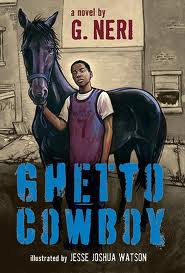
Book Review: GHETTO COWBOY by G. Neri
First Paragraph:We drivin’ into the sunset, the car burning up from the heat. I don’t know if it’s comin’ from outside or from Mama, who’s burning up angry at me. She ain’t said nothin’ to me since we left the principal’s office ’bout a hour ago. But she got her foot pressed on the gas like we in a race, zoomin’ past everyone on the expressway.
G. Neri will be here Thursday to face the 7 Questions.
God, I love this book! I know, I love all the books, Esteemed Reader, and next week I'll be telling you about another book I love. But I really, REALLY love this book. I love it so much I'm going to buy a copy for my nieces and nephews for Christmas (I'm the Uncle who buys books instead of toys and I regret nothing). I'm going to buy it for my white nephew and my black nephew and I'll bet they both love it as much as I do because a great story well told transcends race.
A brief aside: growing up white, I never noticed most the heroes in the books I read were white like me. Why wouldn't they be? But as an adult Ninja married to a black woman and planning a family, I've been combing books with a different mindset. What books will my kids read? Where are the books staring dark-skinned boys who go to wizarding school and tour chocolate factories?
But here, Esteemed Reader, is G. Neri and his new classic, Ghetto Cowboy. It's a gripping read for readers of any age, and if you're a writer working on your voice, Ghetto Cowboy is a book you definitely want to read as G. Neri is all about nailing the voice of his protagonist Witness how he writes Cole (short for Coltrane, naturally) as a genuine character who says the things Cole would say the way he would say them (but without all the swearing I imagine he might include if this were YA instead of MG):
I
don’t know why I stopped going to school. I guess I didn't wanna waste
no more time with teachers and homework and all a that, ’cause what
difference do it make in the end? I’ll never do nothing great in my
life. Do they really think I’m gonna be like Obama? Not a chance. I just
feel sorry for Mama for thinking that I could be somebody.
Some might argue that the prose in a middle grade novel should be correct, regardless of subject or character, as it's being read by impressionable young minds. Bah! I say. Impressionable young minds want a good story well told, and "a couple of" is not the same as "coupla." Cole wouldn't say the first version and the if he did, he'd cease to be Cole. Readers, especially younger readers, would pick up on the lie. Neri wouldn't lose them all, but he'd lose some.
Our 12-year-old hero is headed for trouble. His Mama is at her wits end. And desperate times call for desperate measures, which is why the novel opens with Mama driving Cole straight to Philadelphia where he'll live with his dad, whom he's never met, and learn a little something about caring for horses and what it means to be a cowboy.
I'm relieved to be reviewing my first "boy and his horse" story after reading so, so many "girl and her horse" stories. In the coming weeks, I'll be reviewing my first "girl and her horse in the apocalypse" story:) Stay tuned.
By the way, this is the best and greatest description of riding a horse for the first time I have ever read or will ever read as it immediately put an image in my mind I knew to be true:
It feels like I’m sitting on one of them giant walking machines in Star Wars.
So does Cole make up with his estranged father, learn the cowboy way, and start on the path to a brighter future? Esteemed Reader, I'm not going to tell you that! You'll have to read the book. So that's where we'll leave it. Ghetto Cowboy is a wonderful book destined to make a certain kind of white adult very nervous, and I like that about it.
Few things have made me laugh harder than watching uncomfortable white folks watching Mrs. Ninja and I during a screening of Django Unchained, because there are whole stretches of history they'd just as soon forget. But G. Neri isn't going to let them forget:
I swallow my food. “Look, you guys might think y’all is cowboys, but all I know is, real cowboys is white.”
The old man shakes his head, like I’m a fool. “Son, don’t you know black cowboys is a tradition that goes back to before the Civil War?”
“Whatever,” I say.
He looks disappointed. “Not whatever, man. The word cowboy started as a black word. Wear it proudly.”
“So how come I never seen any black cowboys on TV then?”
He waves his hand. “TV. Humph. Can’t trust the media to tell the truth. The truth is, the white man always gets his way. Looky here. . . .”
He pulls out a book from a dusty shelf. It got pictures and drawings from a long time ago. He shows me some old black-and-white pictures of black dudes dressed in homemade clothes doing cowboy stuff — roping, riding, and cleaning horses.
“Back in the slave days, the slave who worked in the house was called a houseboy, slaves who worked with the cows was called cowboys. Get it?”
No, but he just getting started. He points to a picture of a black cowboy riding a horse out in the wild. He got one of them cowboy rope things whirling in the air like he about to catch some bull. “That’s Bill Pickett, son of a slave and the most famous black cowboy of all. Back then, there was almost nine thousand black cowboys out West, working cattle and driving ’em up the Chisholm Trail and such. And these cowboys was so good that eventually, the whites took the name cowboy for themselves. Stole it, really. Now we’re just trying to take it back, is all.”
Ghetto Cowboy should be in every school and library in the country. If America is ever to move past racism, it's important to keep a dialogue going that acknowledges our nation's true history. It's just as important for all children to remember our history and Neri is keeping that dialogue moving.
That's one reason why I'm so glad to have posted this review at the beginning of February. This is the perfect month to share history with the children in your life (just watching Lincoln doesn't count). Here's a good place to get started.
More than being a history lesson, Ghetto Cowboy is a book about a universal truth: boys need fathers, if they can be got, and fathers need boys to need them. It's a good story, well told, and it's one refreshingly not quite like anything else I've read. Do yourself a favor, Esteemed Reader, pick up this book.
As always, I'll leave you with some of my favorite passages from Ghetto Cowboy:
Kids can be happy ’cause they don’t know better, but when you get older, well, you just know it’s all a big lie.
These
houses is tall and skinny — only one room wide. But that’s just it,
there’s one room — his room, which got a bed, a bathroom, and a closet. I
look in the closet and see he pulled stuff outta it and put a blanket
on the floor. Uh . . . no. I ain’t no Harry Potter. And I ain’t living
in no closet. I got to think.
We
head away from the court, passing over the expressway. Smush tells me
they built that thing so white folks could drive right over the
neighborhood without stopping.
He
goes over to a record player sitting on a wood box, digs through a pile
a records, and pulls one out. They look like giant black CDs.
STANDARD DISCLAIMER: All reviews here will be written to highlight a book’s positive qualities. It is my policy that if I don’t have something nice to say online, I won’t say anything at all (usually). I’ll leave you to discover the negative qualities of each week’s book on your own.
Tuesday, July 19, 2011
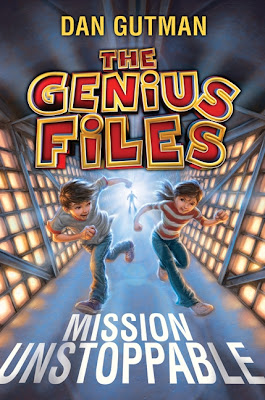
Book of the Week: THE GENIUS FILES: MISSION UNSTOPPABLE by Dan Gutman
I promised last week to tell you what I thought of the eighth Harry Potter movie. Mrs. Ninja and I did indeed see it in Imax over the weekend. It’s a good time, but the book was better (of course it was). Mrs. Ninja cried, but I found it to be an odd experience. It’s a fine finale, to be sure, but I wish Warner Brothers hadn't broken the story in half as it’s hard to get invested in a film that’s all ending with no beginning or even a brief summary of what happened prior to the first scene. My favorite part of the movie was the (minor spoiler) opening shot of Dobby the house elf’s grave assuring he will not be in the movie as he is the Jar Jar Binks of the Harry Potter universe:)
The thing I first noted about this week’s book, The Genius Files: Mission Unstoppable by Dan Gutman, is its dedication: To Liza Voges. For those who don't know, Lisa Voges is Dan Gutman's literary agent at Eden Street. I think it speaks volumes of the importance of having a literary agent that this book was dedicated to her. In fact, it was Liza Voges who wrote me and asked if I'd like to read her client's book. And did I ask her some questions, say about 7 of them? You know I did, Esteemed Reader, and I'll be posting her interview on Saturday, so be sure to come back for that, as well as on Thursday, when we'll have the man himself, Mr. Dan Gutman, right here at this very blog.
While I'm pointing out things about the beginning of the book, let me also share this opening quote with you:
“Do stupid stuff, and even stupider stuff will happen to you.”
--Nobody said this. But somebody should have.
I don't actually have a point to make about this quote, it just cracked me up and I wanted to share it with you. I also want to share with you the first page as it's just a bang-up opening and you know how much I love great openings that hook the reader from the start. Especially when they are followed up with an exciting and engaging novel that is very funny. Read the next paragraph and just try not to get hooked (Go ahead. I'll wait):
There were ten items on Coke McDonald’s to-do list on June 17, but JUMP OFF A CLIFF was not one of them.
CLEAN OUT MY LOCKER was on the list.
PICK UP MY YEARBOOk was on the list.
GET BIRTHDAY PRESENT FOR PEP was on the list.
PACK FOR SUMMER VACATION was on the list.
But nothing about jumping off a cliff.
And yet, oddly enough, jumping off a cliff was the one thing that Coke McDonald was actually going To Do on June 17.
Not only was he going to jump off a cliff, but first he was going to push his twin sister, Pepsi.
Now, before we get to the cliff-jumping part of the story, maybe I’d better explain something. Why would anyone in their right mind name their children Coke and Pepsi?
How sweet an opening is that? Obviously, starting a story with your characters about to jump off a cliff is exciting stuff. The only way to make it more exciting is to put a river of alligators beneath the cliff and/or bamboo spikes:)
What’s interesting here is that Gutman isn’t actually showing us his characters jumping off a cliff just yet. He will, of course, as not to would be like offering us a bowl of candy and then withdrawing it when we reached for some. But what directly follows the passage you just read is five pages of exposition. Coke and Pepsi don’t actually jump off the cliff until the last page of the second chapter.
Now don’t get me wrong. The exposition is well written and funny and combined with the opening lines, it sets the tone for the very humorous, tongue-and-cheek story that we’re about to read. One passage is so entertaining, I’m going to share it with you in a moment. And characters’ being named Coke and Pepsi McDonald does require a little explanation.
But exposition is exposition and the promise of a cliff jump is the spoonful of sugar that helps the medicine go down. The pages fly by as the reader rushes to get to the bit about the cliff. Although, as I've said, these pages are by no means something the reader wouldn't enjoy without the hook, they’re certainly made better for it.
And to be fair, the first eleven pages of chapter two are catching us up on what’s happened to force the McDonald twins to jump off a cliff. Their jumping off a cliff means nothing to us until we know just a little bit about them to care that they might die and the bare minimum explanation as to why they would want to jump off a cliff. If these kids are just a couple of reckless cliff jumpers, who cares. But if they are being chased by men who want to kill them and then by a woman carrying an exploding Frisbee who gives them wing suits with which to glide off the cliff like squirrels, that’s a quite a different matter.
Chapter three has the twins gliding through the air and fortunately I recently viewed Transformers 3 and so could picture this quite clearly in my mind (there are wing suits as well as robots in Michael Bay’s cinematic triumph, worth noting for any Academy members reading this). Actually, for better or for worse, I’m betting a fair amount of readers will be thinking of Transformers 3, which is simply a matter of serendipitous release dates. But even if readers aren't thinking of the silver screen, Gutman has written a high octane opening that gives the reader enough of what they want that they’ll be satisfied for a few more chapters of plot and character until a school is burned down.
And by now, Esteemed Reader, you know just what sort of book you’re getting into. Someone is trying to kill Coke and Pepsi McDonald because, wait for it, they scored extremely well on standardized tests and have therefore been selected for a top secret government program known as The Genius Files.
After witnessing the destruction of the pentagon on September 11, 2001, Dr. Herman Warsaw has decided that the only answer to the world’s problems is to enlist the genius children across the United States and to send them on top secret missions that not even their parents can know about. But could the inventor of such a crazy scheme be, in fact, crazy himself? Dum, dum, dum! But I’ve said too much.
What alarmed me just a little was that there is a lengthy description of the events of September 11th, 2001, in Chapter 5, even going so far as to counter the popular conspiracy theory that a plane did not actually crash into the pentagon. Doesn't everyone already know all that stuff? I don’t want to spend much time on this subject as it’s just a detail of the overarching plot, but it occurred to me that it’s coming up on ten years and therefore there are children who will be reading this book who won’t remember that day, but who may have seen YouTube conspiracy videos and who will need these details spelled out for them.
There’s nothing profound here beyond the Ninja’s realization that he’s getting older, time is passing, and a new generation is scheming to rise up and replace him one day. Still, it’s a testament to Gutman’s knowing his reader that he accepts they may need to be caught up to follow the story.
Okay, back on track. The Genius Files: Mission Unstoppable is a good start for what promises to be a fun and exciting series (there’s an excerpt from Book 2 at the end, but don’t read it before hand as it totally spoils Book 1). I’m looking forward to more adventures with Coke and Pepsi and I’ll bet you will too. It’s just a good set-up. What kid wouldn’t like to have a secret double life as a government operative? And Gutman is funny while he keeps the thrills coming, ensuring a good time lies ahead.
And now I have three points I want to make about craft and some lengthy passages to share and we’ll call it a review. My first point I’m going to let Gutman make for me:
Ordinarily in a story, this is where the author tells the readers what the main character—or, in this case, characters—look like. The author might on for page after page, painting a glorious word picture of Coke’s and Pep’s hair, their faces, the way they walk and talk, the way they dress, and so on.
But you know what? Who cares? Do you really care what Coke and Pep look like? Does it really matter to you. It’s boring. By the time you get to Chapter Three, you will have forgotten the description you read back in Chapter One, anyway. Coke and Pep are twelve-year-old twins, about to turn thirteen in a week. Okay? Nuff said. That’s all you need to know right now.
You really want to know what they look like? Look at the cover of this book. Go ahead, I’ll wait.
Okay, now that we got that out of the way, let’s move on to the good part—the part where Coke and Pep go over the cliff.
What he said. I don’t really have anything to add.
The second thing I want to draw your attention to is that The Genius Files is a series being written for today’s kids. It’s anyone’s guess as to which books will end up being new classics and which won’t and much of it is beyond the author’s control. After all, Bridge to Terabithia is very much a story of its time and yet it remains popular today. Too many writers avoid specifically nailing their book to the time in which it is written in hopes of giving the novel longevity. Even the Ninja was advised to cut President Obama from his hopefully soon-to-be-published manuscript for this very reason.
But adult writers don’t do this. Under the Dome by Stephen King (reading it again because it ruled) makes use of Wolf Blitzer and Anderson Cooper, whom readers twenty or thirty years from now might not know, and James Patterson opens many of his Alex Cross novels with a review of movies or books that just came out (somebody get Patterson a blog). The Genius Files never states a date, but Gutman does provide links to webpage’s for readers to verify information. How long those links will be good is anyone’s guess. But in the meantime, it’s an innovative way to further involve young readers and to make a book a part of their overall interactive media experience.
The McDonalds are on a trip across America and Gutman explains to young readers how they can go online to Google Maps and chart their journey. It’s a good idea and a way to create an interactive, multimedia experience without investing in a website or other online campaign. The Genius Files may go on to become a classic, it may not. There’s no way to know. For all we know, Harry Potter may yet fizzle out and future readers will have never heard of him. They may not, and this is truly frightening, even know who Batman is (I could never live in such a world). After all, it’s a comic book, not The Odyssey (Superman, on the other hand…). Although, for the record, Frank Miller’s The Dark Knight Returns is an American epic I hope will linger after our empire has collapsed.
Gutman isn’t particularly worried what readers one hundred years from now will think about The Genius Files. He wants to hook today’s readers and he’s written a book for them. Should a classics edition be released in one hundred years with updated links, gravy, and there’s nothing preventing future generations from doing it. But Gutman isn’t sacrificing today’s readership in the hopes of being discovered after his death, which seems to be the strange strategy of a number of writers.
My third and final point is that Gutman slips in a bit of editorial now and again, but he does it without interrupting the story. No one wants to read a writer’s manifesto. We don’t really care what the writer’s political beliefs may be. We just want a good story. Writers who include entire chapters of idealogical diatribes will likely lose readers (we’re looking for fiction, not Bill Maher’s New Rules). But a writer who gives us a good story well told can get away with slipping a few quick shots in now and again, so long as he does so sparingly and without halting the narrative.
For example, the twins themselves are named Coke and Pepsi McDonald in “an ironic statement about how corporations control people’s lives.” After all, they have to be named something, and Gutman knows as well as you and I do that sooner or later we are going to have to fight back against big business to avoid being shills and slaves, so why not fan the flames of revolution just a little? Heck, as a writer of a great adventure, you've got the attention of young readers, which is what you wanted in the first place, so why not tell them a little of what you want to say? So long as you keep it in the story and pick your moments, that’s a writer’s privilege.
And having Pep respond in conversation with her father: “But wasn’t Manifest Destiny just an excuse to steal the land and kill the Indians who were living in North America long before we did?” asked Pep. “Wasn’t it almost like genocide?” doesn’t alter the tone of the story, nor does it interrupt it. There’s a line and the closer you come to crossing it, the more readers you risk alienating. Still, Gutman delivers on an exciting adventure and therefore earns a few asides. And why not provoke the thoughts of young readers with an alternate version of Manifest Destiny than the official story they may have read so long as you’re quick about it? Isn’t provoking young minds the whole point?
And that’s where we’ll leave it. Come on back on Thursday to see Dan Gutman face the 7 Questions and again on Saturday when literary agent Liza Voges will be here to do the same. As always, I’ll leave you with some of my favorite excerpts from The Genius Files: Mission Unstoppable:
“Ahhhhhhhhhhhhhhhhhhhhhhhhhh!”
Chances are you’ve never fallen off a cliff. If you had, you probably wouldn’t be reading this right now. Because you would be dead.
But have you ever jumped off a high diving board? Have you ever dropped into a steep water slide or a half pipe? Have you ever been on a really high roller coaster?
Well, forget it. Falling off a cliff is nothing like any of those experiences. You still have no idea what the McDonald twins were going through.
Coke had a theory to explain grown-ups, as he did for most things in life. In his view, babies are born with a specific number of brain cells, which waste away and die off as people get older. So by the time they reach thirty—and certainly by the time they reach forty—most of their brain cells are gone. This explains why grown-ups do and say the things they do.
To back up his theory, in third grade Coke did a school research project involving music. He made a list of the greatest composers in history, from Beethoven to the Beatles. Then he tracked when they wrote their best music.
Irving Berlin wrote his first hit song—“Alexander’s Ragtime Band”—when he was just twenty-three years old. The Beatles made Sgt. Pepper’s Lonely Hearts Club Band, their most innovative album, when John Lennon was twenty-seven and Paul McCartney was twenty-five. Beethoven started going deaf at thirty-one. Mozart was composing minuets at age five and was dead at thirty-five.
Almost as a rule, composers created their finest work in their twenties. There was a severe drop after the age of thirty. This, to Coke, was proof that the human brain deteriorates by the time people become parents. Which explains why parents are so weird. They’re essentially operating with an empty skull filled with dead brain cells.
And if his family wanted him to drive hours out of his way to Minnesota to see another @#$%^** ball of twine, he decided, then, @#$%^**, he would drive them there. That's the kind of a man he was.
Please excuse the language. This is just what was going through Dr. McDonald's mind.
STANDARD DISCLAIMER: Book of the Week is simply the best book I happened to read in a given week. There are likely other books as good or better that I just didn’t happen to read that week. Also, all reviews here will be written to highlight a book’s positive qualities. It is my policy that if I don’t have something nice to say online, I won’t say anything at all (usually). I’ll leave you to discover the negative qualities of each week’s book on your own.
Subscribe to:
Posts (Atom)